Varganici Cristian-Dragos, Rosu Liliana, Rosu Dan, Asandulesa Mihai
Centre of Advanced Research in Bionanoconjugates and Biopolymers, "Petru Poni" Institute of Macromolecular Chemistry, 41A Gr. Ghica-Voda Alley, 700487 Iasi, Romania.
Department of Electroactive Polymers and Plasmochemistry, "Petru Poni" Institute of Macromolecular Chemistry, 41A Gr. Ghica-Voda Alley, 700487 Iasi, Romania.
Polymers (Basel). 2024 Nov 29;16(23):3363. doi: 10.3390/polym16233363.
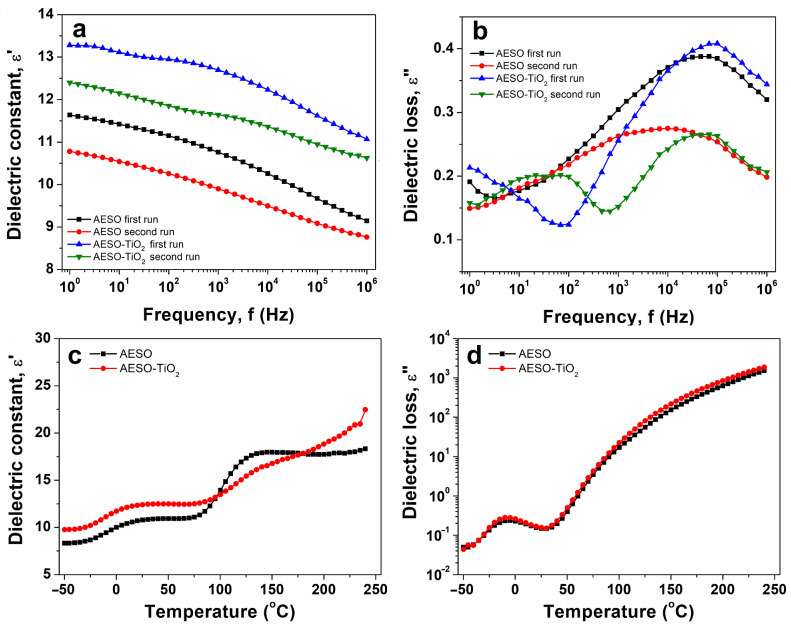
Environmental issues and the reduction of fossil fuel resources will lead to the partial or total substitution of petroleum-based materials with natural, raw, renewable ones. One expanding domain is the obtaining of engineering materials from vegetable oils for sustainable, eco-friendly polymers for different applications. Herein, the authors propose a simplified and green synthesis pathway for a thermally curable, acrylated and epoxidized soybean oil matrix formulation containing only epoxidized soybean oil, acrylic acid, a reactive diluent (5%) and just 0.15 mL of catalyst. The small amount of reactive diluent significantly reduced the initial system viscosity while eliminating the need for adding solvent, hardener, activator, etc. Both the thermally cured composite with a 2% TiO microparticle filler and its pristine matrix were comparably characterized in terms of structural, thermal, morphological, dielectric and wettability by Fourier transform infrared spectroscopy, differential scanning calorimetry, thermogravimetry, scanning electron microscopy, broadband dielectric spectrometry and contact angle measurements. The 2% filler in the composite generated superior thermal stability via lower mass loss (48.89% vs. 57.14%) and higher degradation temperatures (395 °C vs. 387 °C), increased the glass transition temperature from -20 °C to -10 °C, rendered the microcomposite hydrophobic by increasing the contact angle from 88° to 96° and enhanced dielectric properties compared to the pristine matrix. All investigations recommend the microcomposite for protective coatings, capacitors, sensors and electronic circuits. This study brings new contributions to green chemistry and sustainable materials.
环境问题和化石燃料资源的减少将导致石油基材料被天然、原始、可再生材料部分或全部替代。一个不断扩大的领域是从植物油中获取工程材料,用于不同应用的可持续、环保聚合物。在此,作者提出了一种简化的绿色合成途径,用于制备一种热固化、丙烯酸化和环氧化大豆油基配方,该配方仅包含环氧化大豆油、丙烯酸、一种反应性稀释剂(5%)和仅0.15毫升催化剂。少量的反应性稀释剂显著降低了初始体系粘度,同时无需添加溶剂、固化剂、活化剂等。通过傅里叶变换红外光谱、差示扫描量热法、热重分析法、扫描电子显微镜、宽带介电谱和接触角测量等手段,对含有2% TiO微粒填料的热固化复合材料及其原始基体在结构、热性能、形态、介电性能和润湿性方面进行了比较表征。复合材料中2%的填料通过更低的质量损失(48.89%对57.14%)和更高的降解温度(395℃对387℃)产生了优异的热稳定性,将玻璃化转变温度从-20℃提高到-10℃,通过将接触角从88°增加到96°使微复合材料具有疏水性,并与原始基体相比增强了介电性能。所有研究都推荐该微复合材料用于防护涂层、电容器、传感器和电子电路。这项研究为绿色化学和可持续材料做出了新的贡献。