Tikhomirova Maria A, Kuzmenko Oleg L, Arifulin Eugene A, Shirokova Olesya M, Musinova Yana R, Sheval Eugene V
Koltzov Institute of Developmental Biology, Russian Academy of Sciences, 119334 Moscow, Russia.
Belozersky Institute of Physico-Chemical Biology, Lomonosov Moscow State University, 119991 Moscow, Russia.
Int J Mol Sci. 2024 Dec 7;25(23):13162. doi: 10.3390/ijms252313162.
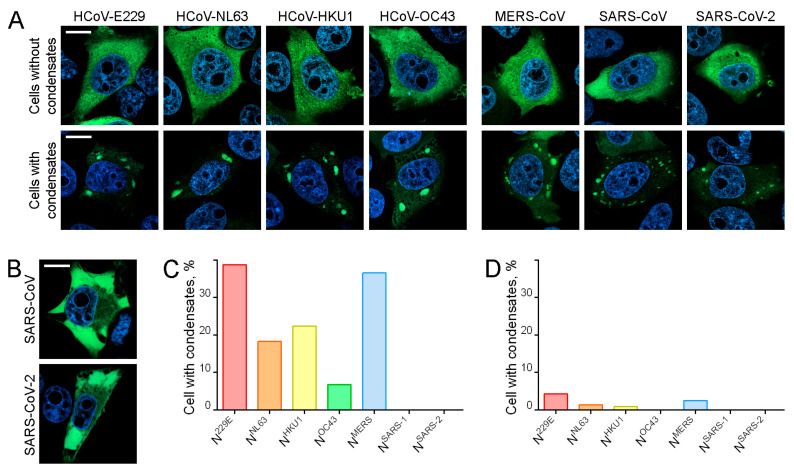
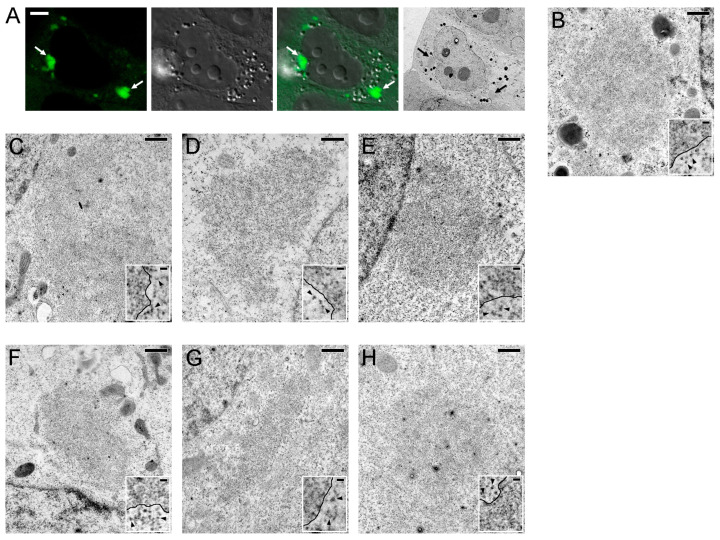
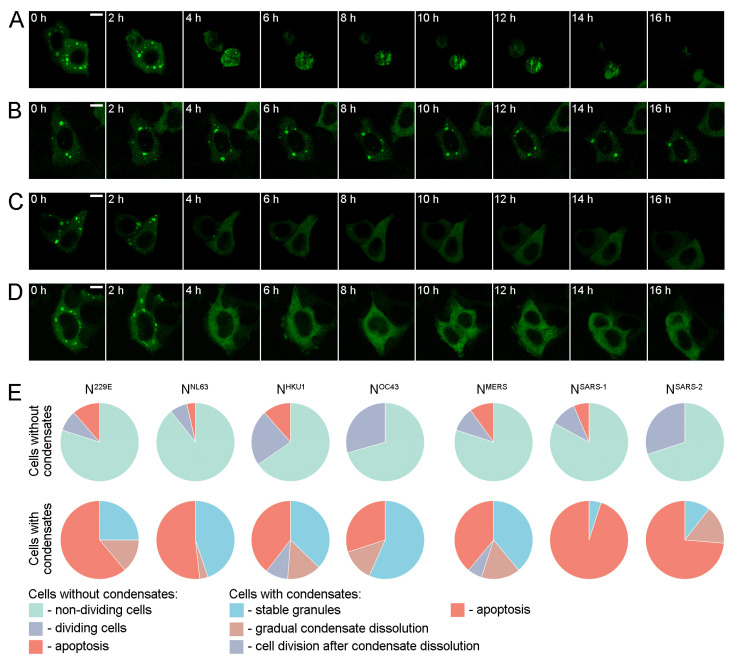
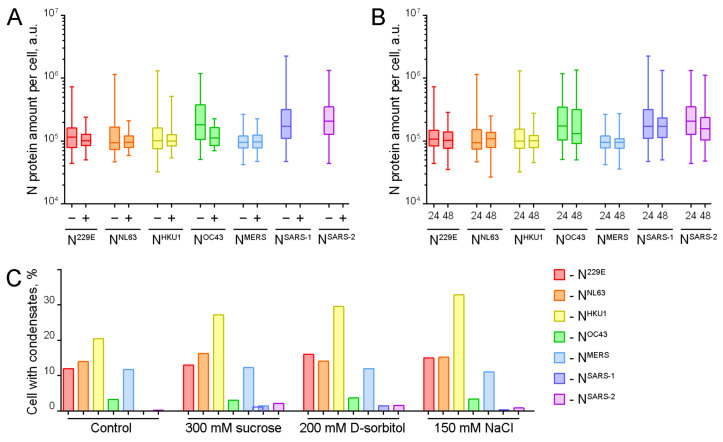
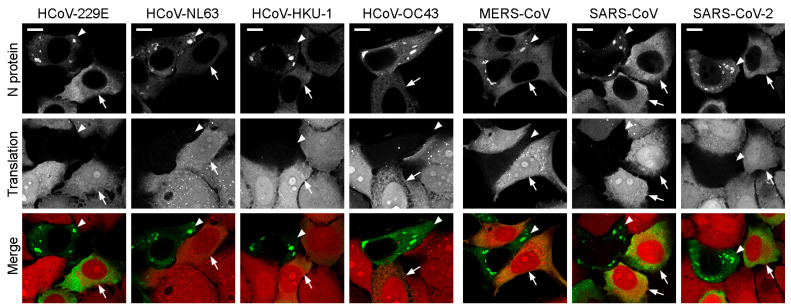
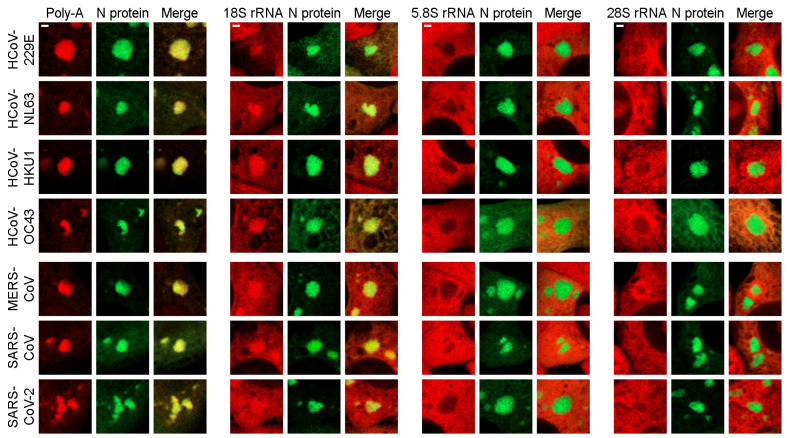
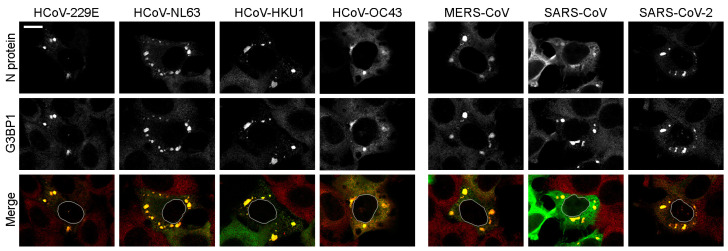
To date, seven human coronaviruses (HCoVs) have been identified. Four of these viruses typically manifest as a mild respiratory disease, whereas the remaining three can cause severe conditions that often result in death. The reasons for these differences remain poorly understood, but they may be related to the properties of individual viral proteins. The nucleocapsid (N) protein plays a crucial role in the packaging of viral genomic RNA and the modification of host cells during infection, in part due to its capacity to form dynamic biological condensates via liquid-liquid phase separation (LLPS). In this study, we investigated the capacity of N proteins derived from all HCoVs to form condensates when transiently expressed in cultured human cells. Some of the transfected cells were observed to contain cytoplasmic granules in which most of the N proteins were accumulated. Notably, the N proteins of SARS-CoV and SARS-CoV-2 showed a significantly reduced tendency to form cytoplasmic condensates. The condensate formation was not a consequence of overexpression of N proteins, as is typical for LLPS-inducing proteins. These condensates contained components of stress granules (SGs), indicating that the expression of N proteins caused the formation of SGs, which integrate N proteins. Thus, the N proteins of two closely related viruses, SARS-CoV and SARS-CoV-2, have the capacity to antagonize SG induction and/or assembly, in contrast to all other known HCoVs.
迄今为止,已鉴定出七种人类冠状病毒(HCoVs)。其中四种病毒通常表现为轻度呼吸道疾病,而其余三种可导致严重疾病,常导致死亡。造成这些差异的原因仍知之甚少,但可能与单个病毒蛋白的特性有关。核衣壳(N)蛋白在病毒基因组RNA的包装以及感染期间宿主细胞的修饰中起着关键作用,部分原因是其能够通过液-液相分离(LLPS)形成动态生物凝聚物。在本研究中,我们研究了所有HCoVs来源的N蛋白在培养的人类细胞中瞬时表达时形成凝聚物的能力。观察到一些转染细胞含有细胞质颗粒,其中积累了大部分N蛋白。值得注意的是,SARS-CoV和SARS-CoV-2的N蛋白形成细胞质凝聚物的趋势明显降低。凝聚物的形成不是N蛋白过度表达的结果,而这是诱导LLPS蛋白的典型情况。这些凝聚物包含应激颗粒(SGs)的成分,表明N蛋白的表达导致了整合N蛋白的SGs的形成。因此,与所有其他已知的HCoVs相比,两种密切相关的病毒SARS-CoV和SARS-CoV-2的N蛋白具有拮抗SG诱导和/或组装的能力。