Wang Kaili, Li Chenyang, Zhou Jinbo, Ren Jiayin, You Meng
State Key Laboratory of Oral Diseases, National Center for Stomatology, National Clinical Research Center for Oral Diseases, Department of Oral Medical Imaging, West China Hospital of Stomatology, Sichuan University, Chengdu 610041, China.
Healthcare (Basel). 2024 Nov 25;12(23):2355. doi: 10.3390/healthcare12232355.
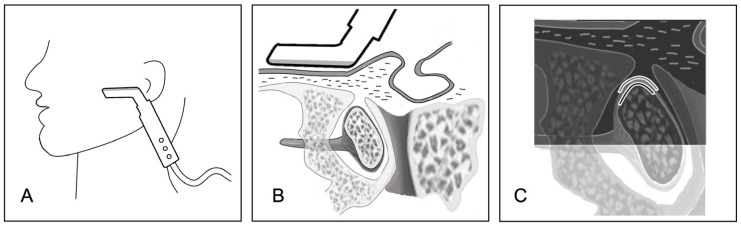
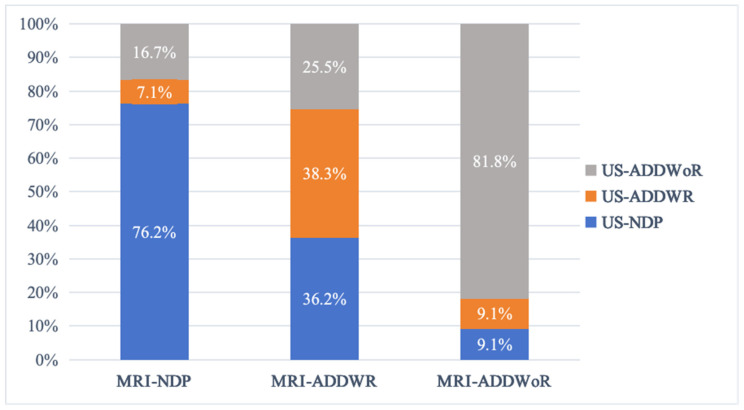
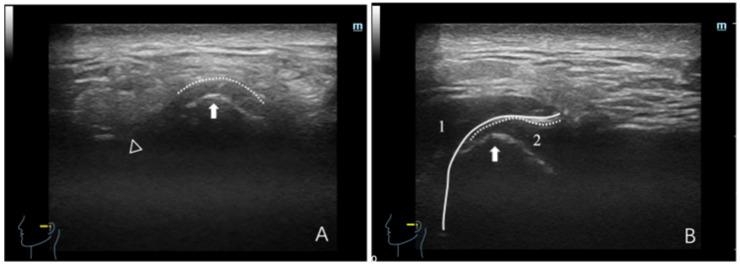
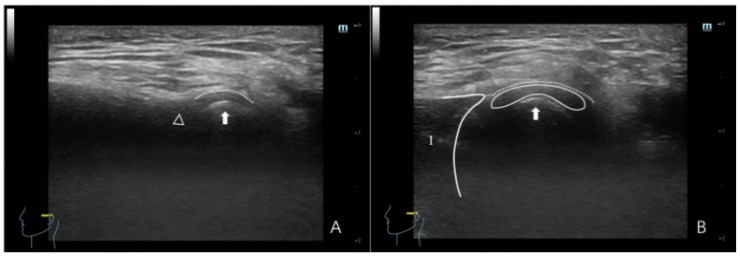
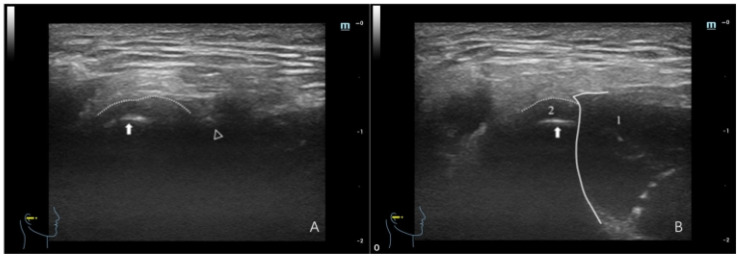
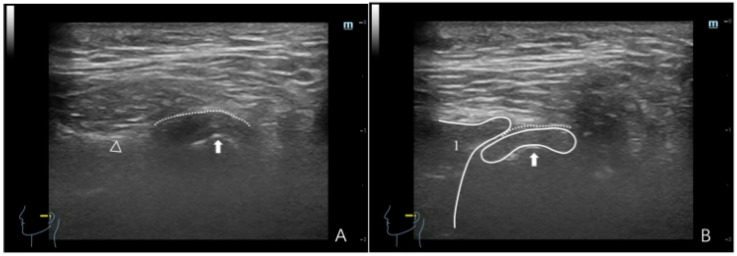
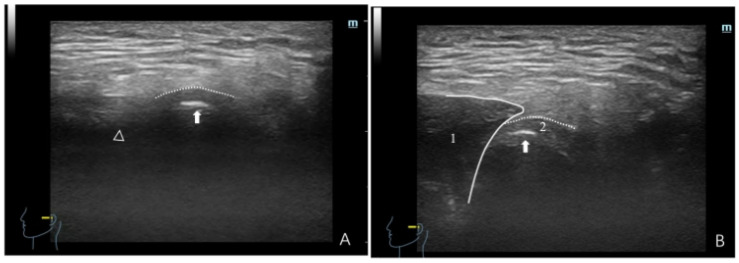
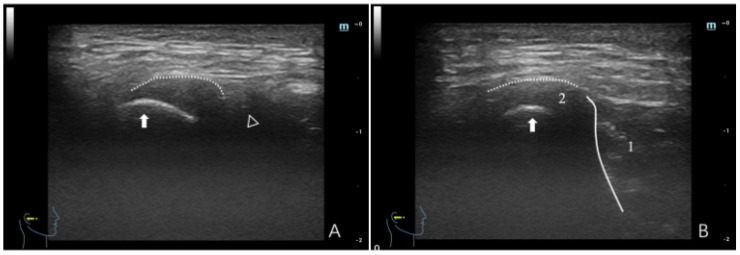
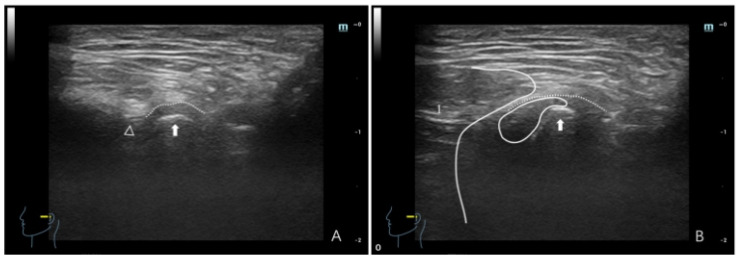
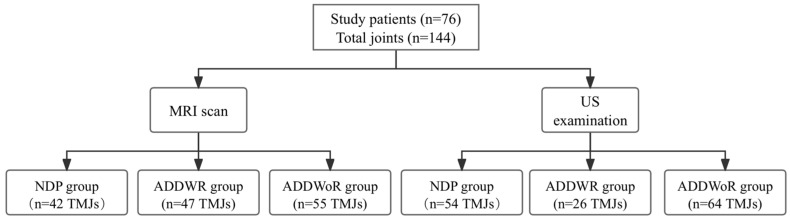
The objective of this study was to assess the diagnostic efficacy of dynamic high-resolution ultrasonography (HRUS) in detecting anterior disc displacement with reduction (ADDWR) and anterior disc displacement without reduction (ADDWoR) in the temporomandibular joint (TMJ). A total of 144 TMJs was categorized into three groups according to the magnetic resonance imaging (MRI) findings, which served as the reference standard: the normal disc position (NDP) group, the ADDWR group, and the ADDWoR group. Static images of the TMJ in full opening and maximum intercuspal positions, along with dynamic sequences during jaw opening, were obtained utilizing a 14 MHz L-shaped linear array transducer. The diagnostic efficacy of dynamic HRUS for identifying ADDWR and ADDWoR was evaluated in terms of accuracy, sensitivity, specificity, positive predictive value (PPV), negative predictive value (NPV), diagnostic odds ratio (DOR), and the Youden index. According to the MRI findings, the NDP, ADDWR, and ADDWoR groups consisted of 42 (29.2%), 47 (32.6%), and 55 (38.2%) TMJs, respectively. HRUS data revealed 54 TMJs (37.5%) in the NDP group, 26 TMJs (18.1%) in the ADDWR group, and 64 TMJs (44.4%) in the ADDWoR group. With MRI as the reference standard, HRUS exhibited a diagnostic accuracy of 71.4%, sensitivity of 51.4%, and specificity of 91.4% for ADDWR. For the ADDWoR, HRUS attained a diagnostic accuracy of 86.5%, sensitivity of 90.0%, and specificity of 82.1%. With MRI serving as the reference standard, dynamic HRUS has high diagnostic value for ADDWoR, with better diagnostic accuracy than ADDWR. Ultrasonography has the potential to be used as a highly effective and non-invasive imaging modality for the early screening of ADD in future clinical practice.
本研究的目的是评估动态高分辨率超声检查(HRUS)在检测颞下颌关节(TMJ)可复性盘前移位(ADDWR)和不可复性盘前移位(ADDWoR)方面的诊断效能。根据磁共振成像(MRI)结果,将总共144个TMJ分为三组,MRI结果作为参考标准:正常盘位置(NDP)组、ADDWR组和ADDWoR组。使用14 MHz L形线性阵列换能器获取TMJ在最大开口位和最大牙尖交错位的静态图像,以及开口过程中的动态序列。从准确性、敏感性、特异性、阳性预测值(PPV)、阴性预测值(NPV)、诊断比值比(DOR)和尤登指数方面评估动态HRUS对识别ADDWR和ADDWoR的诊断效能。根据MRI结果,NDP组、ADDWR组和ADDWoR组分别由42个(29.2%)、47个(32.6%)和55个(38.2%)TMJ组成。HRUS数据显示,NDP组有54个TMJ(37.5%),ADDWR组有26个TMJ(18.1%),ADDWoR组有64个TMJ(44.4%)。以MRI作为参考标准,HRUS对ADDWR的诊断准确性为71.4%,敏感性为51.4%,特异性为91.4%。对于ADDWoR,HRUS的诊断准确性为86.5%,敏感性为90.0%,特异性为82.1%。以MRI作为参考标准,动态HRUS对ADDWoR具有较高的诊断价值,诊断准确性优于ADDWR。超声检查有可能在未来临床实践中作为一种高效且无创的成像方式用于ADD的早期筛查。