Santini Simone, Marinozzi Andrea, Talia Adrian J, Herrera-Rodríguez Alejandro, Herrera-Pérez Mario, Valderrabano Victor
Swiss Ortho Center, Swiss Medical Network, Schmerzklinik Basel, 4010 Basel, Switzerland.
Department of Orthopaedic and Trauma Surgery, Fondazione Policlinico Campus Bio-Medico, Via Alvaro del Portillo, 200, 00128 Roma, Italy.
J Clin Med. 2024 Nov 24;13(23):7099. doi: 10.3390/jcm13237099.
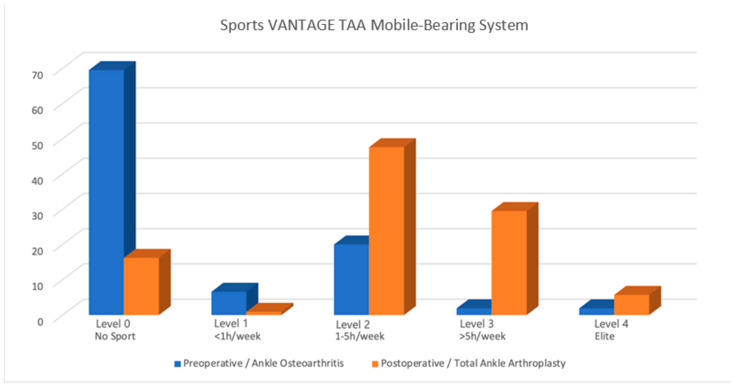
The interest in performing total ankle arthroplasty (TAA) to address end-stage ankle osteoarthritis (OA) is continuously growing. Sports activity plays an important role in our world. The literature is sparse regarding return-to-sports activity following TAA. The levels and types of sports in TAA are rarely reported. The purpose of this prospective case series study is to investigate sports activity in ankle osteoarthritis (OA) and TAA in terms of rate, frequency, type, and clinical outcomes with a minimum 2 years of follow-up after surgery. A total of 103 patients (105 implants, 52 female, and 51 male), mean age 60.5 years (range, 23-84 years) with end-stage ankle OA were treated using a three-component, uncemented, mobile-bearing VANTAGE Total Ankle System. The mean follow-up was 2.9 years (range, 2-5 years). Visual Analogic Scale Pain Score (VAS, 0-10 points), Ankle Dorsiflexion/Plantarflexion (DF/PF) range of motion (ROM; degrees), functional American Orthopaedic Foot and Ankle Society (AOFAS) Ankle/Hindfoot Score (0-100 points), Subjective Patients' Satisfaction Score (0-10 points), Sports Activity Rate, Sports Frequency Score, and sports type were assessed. The mean preoperative VAS Pain Score was 6.7 points (range, 3-10 points) and 0.2 points for postoperative (range, 0-3 points) ( < 0.001). The mean DF/PF ROM was 24.9° preoperative (range, 0-60°) and 52.9° postoperative (range, 15-85°) ( < 0.001). The mean preoperative functional AOFAS Ankle/Hindfoot Score was 39.5 points (range, 4-57 points) and 97.8 points for postoperative (range, 75-100 points) ( < 0.001). The mean postoperative Subjective Patients' Satisfaction Score was 9.7 points (range, 7-10 points). The preoperative Sports Activity Rate was 31.1%, with 85.4% for postoperative ( < 0.001). All the groups exhibited substantial Sports Frequency Score increases ( < 0.001). The most practised sports were hiking, biking, fitness, and swimming. total ankle arthroplasty (TAA) is an effective treatment for end-stage ankle OA. TAA facilitates a noteworthy increase in sports activity. This research offers important sports insights to patients with ankle OA and TAA.
为治疗终末期踝骨关节炎(OA)而进行全踝关节置换术(TAA)的关注度持续上升。体育活动在我们的生活中扮演着重要角色。关于TAA术后恢复体育活动的文献较为稀少。TAA患者参与体育活动的水平和类型鲜有报道。本前瞻性病例系列研究的目的是,在术后至少随访2年的基础上,从恢复率、频率、类型和临床结果等方面,调查踝骨关节炎(OA)和接受TAA治疗患者的体育活动情况。共有103例患者(105个植入物,52例女性,51例男性),平均年龄60.5岁(范围23 - 84岁),患有终末期踝OA,采用了一种三件式、非骨水泥固定、活动平台的VANTAGE全踝关节系统进行治疗。平均随访时间为2.9年(范围2 - 5年)。评估了视觉模拟评分法疼痛评分(VAS,0 - 10分)、踝关节背屈/跖屈(DF/PF)活动范围(ROM;度)、美国矫形足踝协会(AOFAS)踝关节/后足功能评分(0 - 100分)、患者主观满意度评分(0 - 10分)、体育活动恢复率、体育活动频率评分以及体育活动类型。术前VAS疼痛评分平均为6.7分(范围3 - 10分),术后为0.2分(范围0 - 3分)(<0.001)。术前DF/PF ROM平均为24.9°(范围0 - 60°),术后为52.9°(范围15 - 85°)(<0.001)。术前AOFAS踝关节/后足功能评分平均为39.5分(范围4 - 57分),术后为97.8分(范围75 - 100分)(<0.001)。术后患者主观满意度评分平均为9.7分(范围7 - 10分)。术前体育活动恢复率为31.1%,术后为85.4%(<0.001)。所有组的体育活动频率评分均显著增加(<0.001)。最常进行的体育活动是徒步、骑自行车、健身和游泳。全踝关节置换术(TAA)是治疗终末期踝OA的有效方法。TAA显著促进了体育活动的增加。本研究为踝OA和TAA患者提供了重要的体育活动相关见解。