Chen Conmin, Tsai Kuang-Ting, Yeh Kuang-Ting, Hung Shuo-Suei
Department of Medical Education, Taipei Tzu Chi Hospital, Buddhist Tzu Chi Medical Foundation, New Taipei City 231, Taiwan.
Department of Medical Education, National Cheng Kung University Hospital, College of Medicine, National Cheng Kung University, Tainan 701, Taiwan.
J Clin Med. 2024 Dec 3;13(23):7369. doi: 10.3390/jcm13237369.
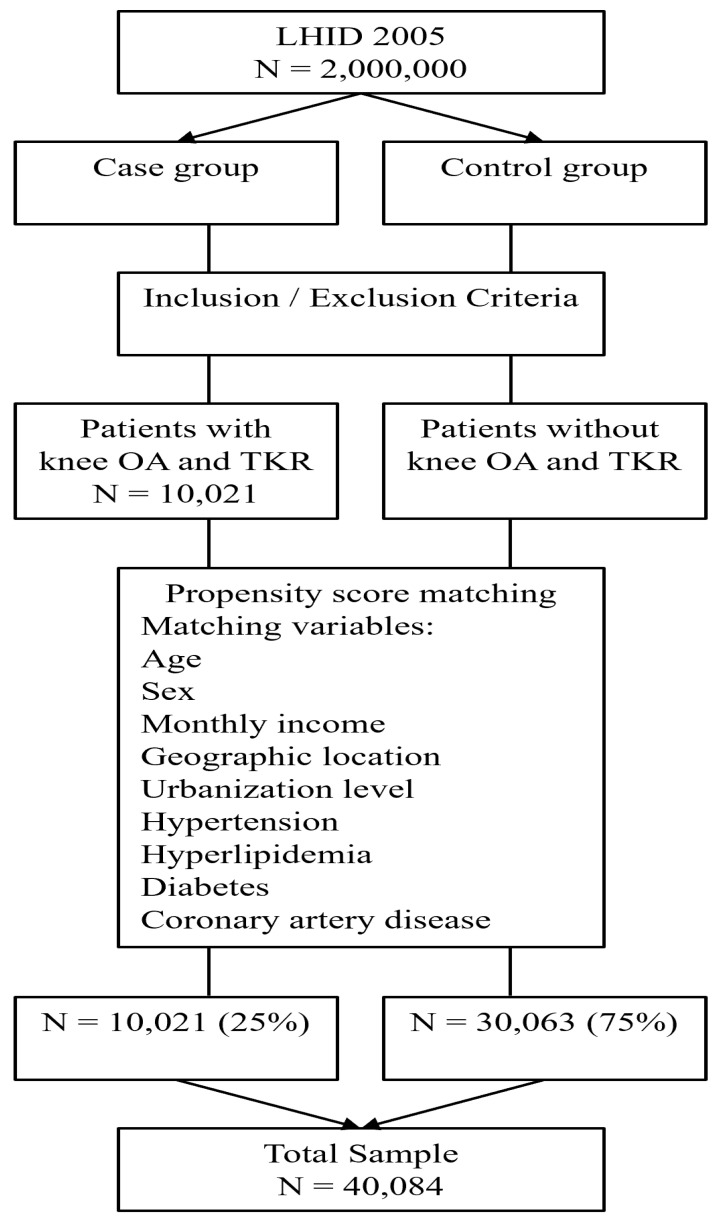
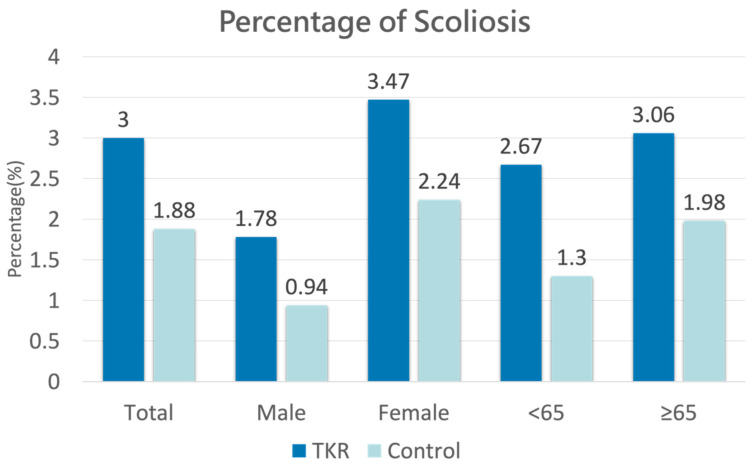
: Scoliosis has been linked to pelvic position and tilt angle, but few studies have explored its relationship with knee pathology, which can be a significant burden for the elderly. Our aim is to investigate the relationship between scoliosis and knee osteoarthritis (OA). : This population-based case-control study using data from the National Health Insurance Database of Taiwan included patients diagnosed with OA who underwent total knee replacement (TKR) for the first time between 2014 and 2019. Propensity score matching was employed to select controls who did not undergo TKR. Scoliotic cases were identified if they had been diagnosed before knee OA and TKR. The study samples included 10,021 patients with OA/TKR and 30,063 patients without OA/TKR. We then utilized logistic regression analysis to calculate the odds ratio (OR) and 95% confidence interval (CI) for the diagnosis of scoliosis prior to the index date. : The findings indicate that patients with pre-existing scoliosis have a 1.627 times greater likelihood of undergoing TKR, with significantly higher odds ratios observed across both female (OR = 1.583) and male (OR = 1.909) and younger (OR = 2.102) and older (OR = 1.575) patients. However, a notable limitation of this study is the absence of data on scoliosis curve side, which prevented us from analyzing the relationship between curve direction and knee arthritis laterality. Furthermore, while we included diagnostic codes indicating left or right TKR, the lack of precise measurements for variables such as lower limb length discrepancies may introduce residual confounding. : Our research suggests a significant association between scoliosis and the development of knee OA.
脊柱侧弯与骨盆位置和倾斜角度有关,但很少有研究探讨其与膝关节病变的关系,而膝关节病变对老年人来说可能是一个重大负担。我们的目的是研究脊柱侧弯与膝关节骨关节炎(OA)之间的关系。:这项基于人群的病例对照研究使用了台湾国民健康保险数据库的数据,纳入了2014年至2019年间首次接受全膝关节置换术(TKR)的OA患者。采用倾向评分匹配法选择未接受TKR的对照。如果脊柱侧弯病例在膝关节OA和TKR之前被诊断出来,则予以识别。研究样本包括10,021例OA/TKR患者和30,063例未患OA/TKR的患者。然后,我们利用逻辑回归分析计算在索引日期之前诊断为脊柱侧弯的比值比(OR)和95%置信区间(CI)。:研究结果表明,既往有脊柱侧弯的患者接受TKR的可能性高1.627倍,在女性(OR = 1.583)和男性(OR = 1.909)以及年轻患者(OR = 2.102)和老年患者(OR = 1.575)中观察到的比值比均显著更高。然而,本研究的一个显著局限性是缺乏脊柱侧弯曲线侧的数据,这使我们无法分析曲线方向与膝关节炎侧别之间的关系。此外,虽然我们纳入了指示左或右TKR的诊断代码,但下肢长度差异等变量缺乏精确测量可能会引入残余混杂因素。:我们的研究表明脊柱侧弯与膝关节OA的发生之间存在显著关联。