Baba Yuki, Kawano Seiji, Takaki Akinobu, Kono Yoshiyasu, Horii Joichiro, Takahashi Sakuma, Kawai Daisuke, Kobayashi Sayo, Okada Hiroyuki
Department of Internal Medicine, Japanese Red Cross Himeji Hospital, Himeji, Japan.
Department of Gastroenterology and Hepatology, Okayama University Graduate School of Medicine, Dentistry and Pharmaceutical Sciences, Okayama, Japan.
Medicine (Baltimore). 2024 Dec 13;103(50):e40849. doi: 10.1097/MD.0000000000040849.
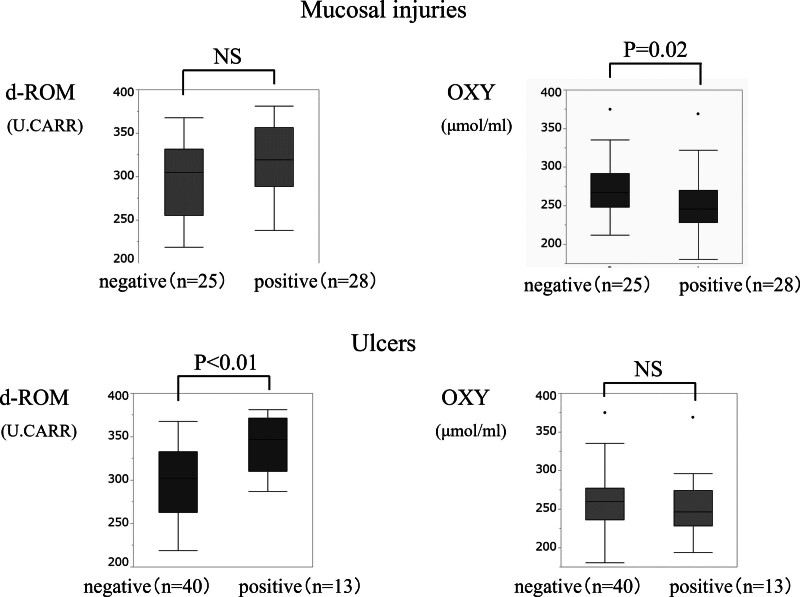
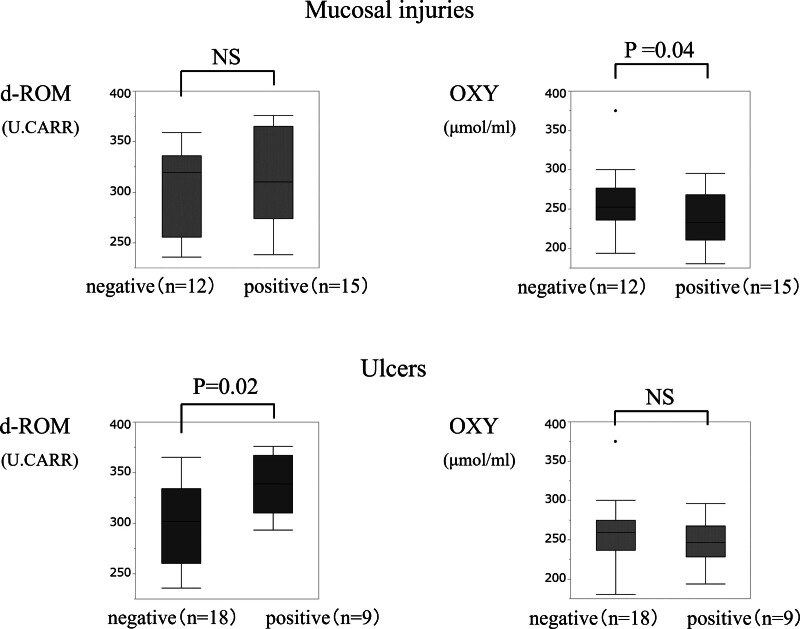
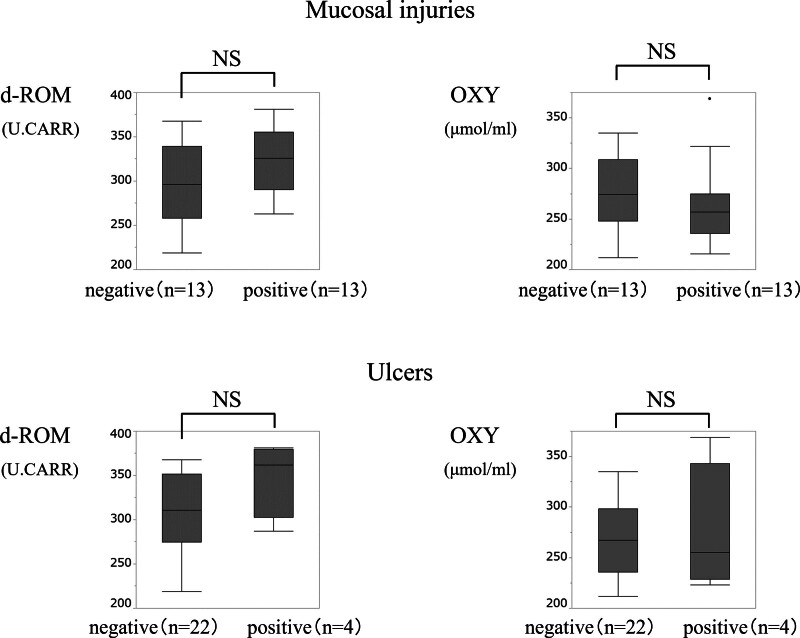
Several reports revealed that oxidative stress was involved in the mouse model of nonsteroidal anti-inflammatory drug (NSAIDs)-induced small intestinal mucosal injuries. Thus, we aimed to investigate in the prospective clinical study, that the relevance of oxidative stress balance in small intestinal mucosal injury in NSAIDs users. We prospectively included 60 patients who had been taking NSAIDs continuously for more than 3 months and exhibited obscure gastrointestinal bleeding (number UMIN 000011775). Small intestinal mucosal injuries were assessed by capsule endoscopy (CE), and reactive oxygen metabolites (d-ROMs) levels and oxidant capacity (OXY) adsorbent test were performed to investigate the relevance of oxidative stress balance. More than half of the patients (N = 32, 53%) had small intestinal mucosal injuries by CE, and 14 patients (24%) had ulcers. The incidence of ulcers was relatively higher in nonaspirin users. Serum OXY levels were significantly lower in the mucosal injury group (P = .02), and d-ROM levels were significantly higher in the ulcer group (P < .01). In aspirin users, d-ROM and OXY levels did not differ significantly with respect to mucosal injuries or ulcers. However, in nonaspirin users, OXY level was significantly lower in the mucosal injury group (P = .04), and d-ROM levels were significantly higher in the ulcer group (P = .02). Nonaspirin NSAIDs-induced intestinal mucosal injury is associated with antioxidant systems, resulting in increased oxidative stress.
多项报告显示,氧化应激参与了非甾体抗炎药(NSAIDs)诱导的小鼠小肠黏膜损伤模型。因此,我们旨在通过前瞻性临床研究,探讨NSAIDs使用者小肠黏膜损伤中氧化应激平衡的相关性。我们前瞻性纳入了60例持续服用NSAIDs超过3个月且出现不明原因胃肠道出血的患者(注册号UMIN 000011775)。通过胶囊内镜(CE)评估小肠黏膜损伤,并进行活性氧代谢产物(d-ROMs)水平和氧化能力(OXY)吸附试验,以研究氧化应激平衡的相关性。超过半数患者(N = 32,53%)经CE检查存在小肠黏膜损伤,14例患者(24%)有溃疡。非阿司匹林使用者溃疡发生率相对较高。黏膜损伤组血清OXY水平显著降低(P = 0.02),溃疡组d-ROM水平显著升高(P < 0.01)。在阿司匹林使用者中,d-ROM和OXY水平在黏膜损伤或溃疡方面无显著差异。然而,在非阿司匹林使用者中,黏膜损伤组OXY水平显著降低(P = 0.04),溃疡组d-ROM水平显著升高(P = 0.02)。非阿司匹林类NSAIDs诱导的肠道黏膜损伤与抗氧化系统有关,导致氧化应激增加。