Hinduja Saurabh, Darzi Ali, Ertugrul Itir Onal, Provenza Nicole, Gadot Ron, Storch Eric A, Sheth Sameer A, Goodman Wayne K, Cohn Jeffrey F
Department of Psychology, University of Pittsburgh, Pittsburgh, PA 15213 USA.
Department of Information and Computing Sciences, Utrecht University, 3584 CS Utrecht, The Netherlands.
IEEE Trans Affect Comput. 2024 Oct-Dec;15(4):2025-2041. doi: 10.1109/taffc.2024.3395117. Epub 2024 Apr 30.
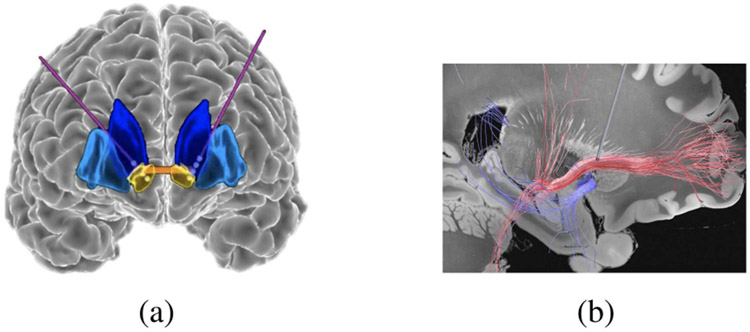
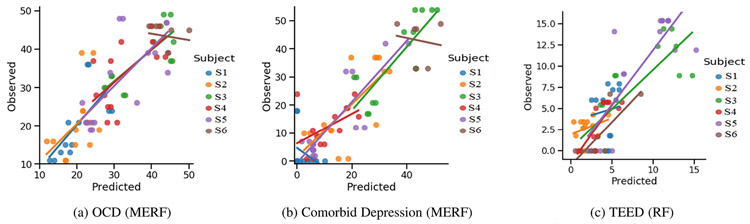
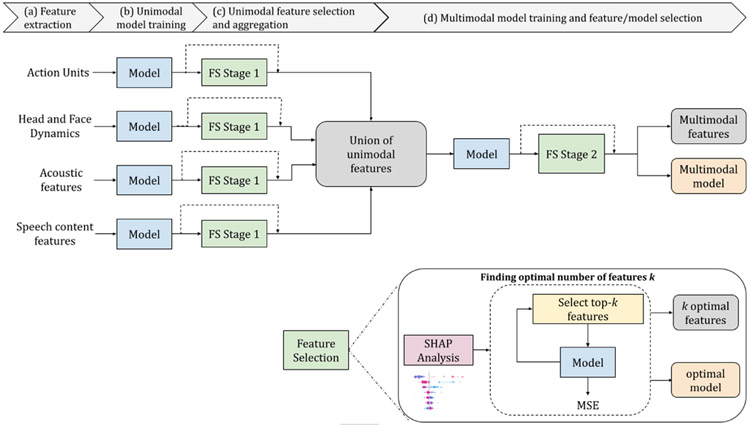
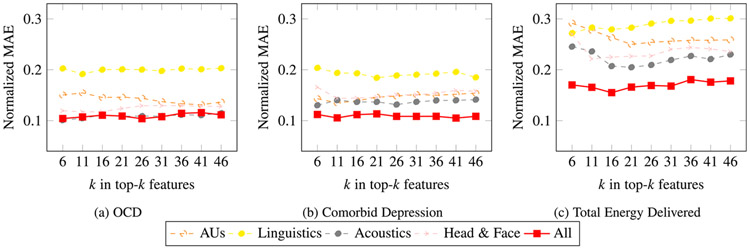
To develop reliable, valid, and efficient measures of obsessive-compulsive disorder (OCD) severity, comorbid depression severity, and total electrical energy delivered (TEED) by deep brain stimulation (DBS), we trained and compared random forests regression models in a clinical trial of participants receiving DBS for refractory OCD. Six participants were recorded during open-ended interviews at pre- and post-surgery baselines and then at 3-month intervals following DBS activation. Ground-truth severity was assessed by clinical interview and self-report. Visual and auditory modalities included facial action units, head and facial landmarks, speech behavior and content, and voice acoustics. Mixed-effects random forest regression with Shapley feature reduction strongly predicted severity of OCD, comorbid depression, and total electrical energy delivered by the DBS electrodes (intraclass correlation, ICC, = 0.83, 0.87, and 0.81, respectively. When random effects were omitted from the regression, predictive power decreased to moderate for severity of OCD and comorbid depression and remained comparable for total electrical energy delivered (ICC = 0.60, 0.68, and 0.83, respectively). Multimodal measures of behavior outperformed ones from single modalities. Feature selection achieved large decreases in features and corresponding increases in prediction. The approach could contribute to closed-loop DBS that would automatically titrate DBS based on affect measures.
为了开发可靠、有效且高效的强迫症(OCD)严重程度、共病抑郁严重程度以及深部脑刺激(DBS)传递的总电能(TEED)的测量方法,我们在一项针对难治性强迫症患者接受DBS治疗的临床试验中训练并比较了随机森林回归模型。在手术前和手术后基线的开放式访谈期间以及DBS激活后的3个月间隔对6名参与者进行了记录。通过临床访谈和自我报告评估真实的严重程度。视觉和听觉模态包括面部动作单元、头部和面部地标、言语行为和内容以及语音声学。采用Shapley特征约简的混合效应随机森林回归能够强烈预测强迫症严重程度、共病抑郁以及DBS电极传递的总电能(组内相关系数,ICC,分别为0.83、0.87和0.81)。当回归中省略随机效应时,对于强迫症严重程度和共病抑郁的预测能力降至中等,而对于传递的总电能预测能力仍相当(ICC分别为0.60、0.68和0.83)。多模态行为测量方法优于单模态测量方法。特征选择实现了特征的大幅减少和预测能力的相应提高。该方法可能有助于基于情感测量自动调整DBS的闭环DBS。