Pathak Priya R, Stockwell Melissa S, Lane Mariellen M, Robbins-Milne Laura, Friedman Suzanne, Pethe Kalpana, Krause Margaret C, Soren Karen, Matiz Luz Adriana, Solomon Lauren B, Burke Maria E, Bracho-Sanchez Edith
Division of Child and Adolescent Health, Department of Pediatrics, Vagelos College of Physicians and Surgeons, Columbia University, New York, NY, United States.
NewYork-Presbyterian Hospital, New York, NY, United States.
JMIR Pediatr Parent. 2024 Dec 17;7:e57702. doi: 10.2196/57702.
Since the COVID-19 pandemic, telemedicine has been widely integrated into primary care pediatrics. While initial studies showed some concern for disparities in telemedicine use, telemedicine uptake for pediatric patients in a low-income, primarily Latino community over a sustained period has yet to be described.
We aimed to assess the relationship between demographics, patient portal activation, and telemedicine visits, as well as characterize diagnoses addressed in telemedicine, in a low-income, primarily Latino population over time.
A multidisciplinary team conducted outreach for telemedicine and patient portal activation with the adoption of a new electronic health record. Data were collected on all in-person and telemedicine visits from February 2020 through April 2021 for 4 community-based pediatric practices. The outcomes included patient portal activation, telemedicine use, and reason for telemedicine visits. Bivariate tests and multivariate regression analyses were conducted to assess the independent effects of demographics on the likelihood of portal activation and having a telemedicine visit. Telemedicine diagnoses were categorized, and subanalyses were conducted to explore variations by age and month.
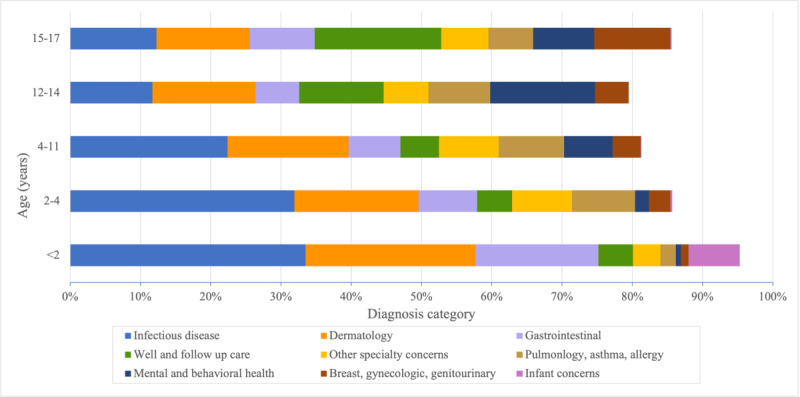
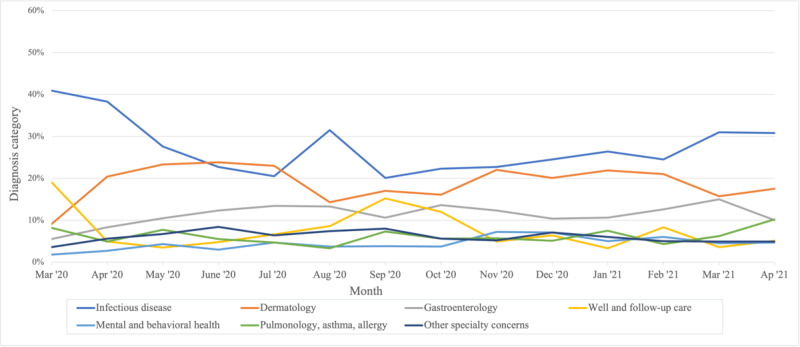
There were 12,377 unique patients and 7127 telemedicine visits. Latino patients made up 83.4% (n=8959) of the population. Nearly all patients (n=10,830, 87.5%) had an activated portal, and 33.8% (n=4169) had at least 1 telemedicine visit. Portal activation decreased with age >2 years (2-4 years: adjusted odds ratio [aOR] 0.62, 95% CI 0.51-0.76; 5-11 years: aOR 0.28, 95% CI 0.23-0.32; 12-14 years: aOR 0.29, 95% CI 0.23-0.35; and 15-17 years: aOR 0.46, 95% CI 0.36-0.58). Spanish-speaking (aOR 0.52, 95% CI 0.45-0.59) and non-Latino patients (aOR 0.64, 95% CI 0.54-0.76) had decreased odds of activation and having a telemedicine visit (aOR 0.81, 95% CI 0.74-0.89 and aOR 0.71, 95% CI 0.62-0.81, respectively). The top 5 diagnostic categories for telemedicine were infectious disease (n=1749, 26.1%), dermatology (n=1287, 19.5%), gastrointestinal (n=771, 11.7%), well and follow-up care (n=459, 7%), and other specialty-related care (n=415, 6.3%). Infectious disease showed the most variation over time. Age-based patterns included a decrease in the proportion of infectious disease diagnoses by increasing age group and a higher proportion of well and follow-up care in older ages. Additional telemedicine diagnoses included common infant concerns for patients younger than 2 years of age; pulmonary, asthma, and allergy concerns for toddler or school-age children; behavioral health concerns for younger adolescents; and genitourinary and gynecologic concerns for older adolescents.
The high engagement across demographics suggests feasibility and interest in telemedicine in this low-income, primarily Latino population, which may be attributable to the strength of outreach. Language-based disparities were still present. Telemedicine was used for a wide range of diagnoses. As telemedicine remains a vital component of pediatric health care, targeted interventions may enhance engagement to serve diverse pediatric patient populations.
自新冠疫情以来,远程医疗已广泛融入基层儿科医疗。虽然初步研究显示对远程医疗使用方面的差异存在一些担忧,但在低收入、主要为拉丁裔的社区中,儿科患者在一段持续时间内对远程医疗的接受情况尚未得到描述。
我们旨在评估在一个低收入、主要为拉丁裔的人群中,随着时间推移,人口统计学特征、患者门户激活与远程医疗就诊之间的关系,以及描述远程医疗中涉及的诊断情况。
一个多学科团队通过采用新的电子健康记录,开展了远程医疗和患者门户激活的推广工作。收集了2020年2月至2021年4月期间4个社区儿科诊所的所有面对面就诊和远程医疗就诊的数据。结果包括患者门户激活、远程医疗使用情况以及远程医疗就诊原因。进行了双变量检验和多变量回归分析,以评估人口统计学特征对门户激活可能性和进行远程医疗就诊可能性的独立影响。对远程医疗诊断进行了分类,并进行了亚分析以探讨年龄和月份的差异。
共有12377名独特患者和7127次远程医疗就诊。拉丁裔患者占人口的83.4%(n = 8959)。几乎所有患者(n = 10830,87.5%)都激活了门户,33.8%(n = 4169)至少进行了1次远程医疗就诊。年龄大于2岁时门户激活率下降(2 - 四岁:调整后的优势比[aOR] 0.62,95%置信区间0.51 - 0.76;5 - 11岁:aOR 0.28,95%置信区间0.23 - 0.32;12 - 14岁:aOR 0.29,95%置信区间0.23 - 0.35;15 - 17岁:aOR 0.46,95%置信区间0.36 - 0.58)。说西班牙语的患者(aOR 0.52,95%置信区间0.45 - 0.59)和非拉丁裔患者(aOR 0.64,95%置信区间0.54 - 0.76)激活门户和进行远程医疗就诊的几率降低(分别为aOR 0.81,95%置信区间0.74 - 0.89和aOR 0.71,95%置信区间0.62 - 0.81)。远程医疗的前5大诊断类别为传染病(n = 1749,26.1%)、皮肤病学(n = 1287,19.5%)、胃肠道疾病(n = 771,11.7%)、健康及随访护理(n = 459,7%)以及其他专科相关护理(n = 415,6.3%)。传染病随时间变化最大。基于年龄的模式包括随着年龄组增加传染病诊断比例下降,以及老年患者中健康及随访护理比例更高。其他远程医疗诊断包括2岁以下患者常见的婴儿问题;幼儿或学龄儿童的肺部、哮喘和过敏问题;青少年早期的行为健康问题;以及青少年晚期泌尿生殖系统和妇科问题。
各人口统计学特征群体的高参与度表明在这个低收入、主要为拉丁裔的人群中远程医疗具有可行性和吸引力,这可能归因于推广工作的力度。基于语言的差异仍然存在。远程医疗用于广泛的诊断。由于远程医疗仍然是儿科医疗保健的重要组成部分,有针对性的干预措施可能会提高参与度,以服务不同的儿科患者群体。