Pedruzzi Luca, Oliveri Paolo, Francesconi Martina, Lemasson Alban, Palagi Elisabetta
EthoS (Ethologie Animale et Humaine) - U.M.R 6552, Université de Rennes, Université de Normandie, CNRS, Rennes, France.
Unit of Ethology, Department of Biology, University of Pisa, Pisa, Paris, Italy.
Am J Primatol. 2025 Jan;87(1):e23709. doi: 10.1002/ajp.23709.
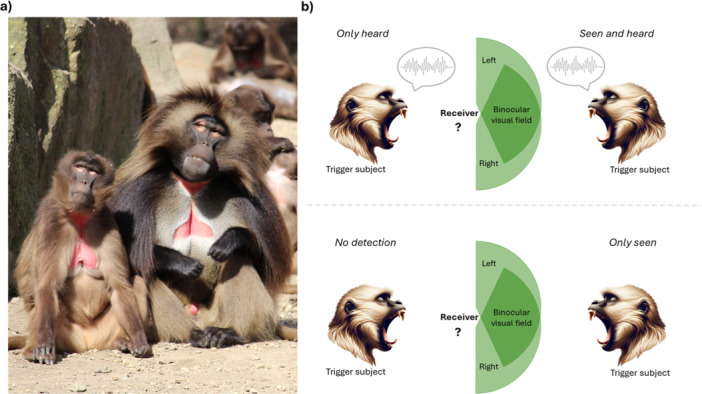
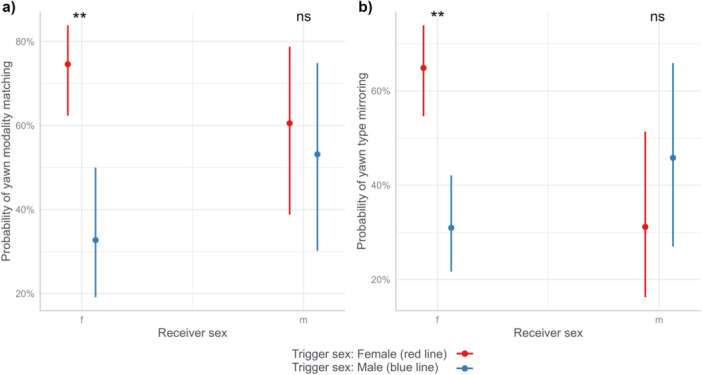
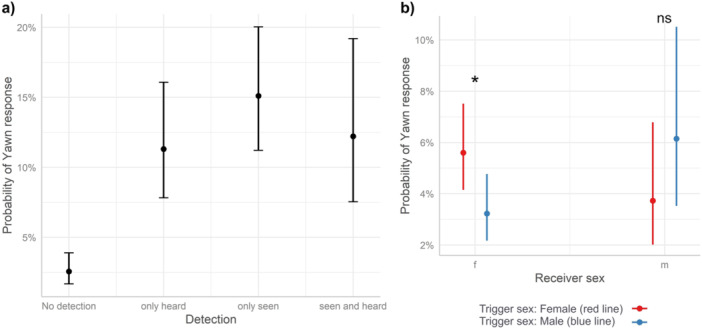
Behavioral contagion is widespread in primates, with yawn contagion (YC) being a well-known example. Often associated with ingroup dynamics and synchronization, the possible functions and evolutionary pathways of YC remain subjects of active debate. Among nonhuman animals, geladas (Theropithecus gelada) are the only species known to occasionally emit a distinct vocalization while yawning. Yet, the role of different sensory modalities in YC remains poorly understood. Due to their social and communicative complexity, geladas serve as an excellent model for investigating the effects of multimodality and social factors on behavioral contagion. Here we studied a large zoo-housed colony of geladas (103 subjects, 1422 yawns) and confirm the previous evidence for visual and auditory YC. Hearing, seeing, or hearing and seeing yawns significantly triggered contagious yawning at comparable levels. Additionally, we found no evidence of laterality influencing responses based on the side of detection. While the social bond, measured via grooming, between the trigger and receiver did not correlate with YC, a consistent sex effect emerged. Females responded more frequently to female than to male yawns and were more likely to match modality (i.e., vocalized vs. nonvocalized) and mirror morphology of other females' yawns. Effective female-female communication and affiliation are crucial for maintaining cohesion and fostering strong intra-unit relationships among geladas. Our results underscore the importance of different sensory components in the distribution of YC, particularly for species living in complex social systems. These findings raise further questions about the functional and emotional significance of yawning and potential inter-sexual differences, suggesting that the phenomenon is more complex than previously thought.
行为传染在灵长类动物中很普遍,打哈欠传染(YC)就是一个众所周知的例子。YC通常与群体动态和同步性有关,其可能的功能和进化途径仍是激烈辩论的主题。在非人类动物中,狮尾狒(狮尾狒属)是已知的唯一一种在打哈欠时偶尔发出独特叫声的物种。然而,不同感官模态在YC中的作用仍知之甚少。由于其社会和交流的复杂性,狮尾狒是研究多模态和社会因素对行为传染影响的绝佳模型。在这里,我们研究了一个大型圈养的狮尾狒群体(103只个体,1422次打哈欠),并证实了之前关于视觉和听觉YC的证据。听到、看到或同时听到和看到打哈欠会在相当程度上显著引发传染性打哈欠。此外,我们没有发现基于检测侧的偏侧性影响反应的证据。虽然通过梳理毛发衡量的触发者和接受者之间的社会联系与YC无关,但出现了一致的性别效应。雌性对雌性打哈欠的反应比对雄性打哈欠更频繁,并且更有可能匹配模态(即发声与不发声)并模仿其他雌性打哈欠的形态。有效的雌性 - 雌性交流和联系对于维持狮尾狒群体的凝聚力和促进强大的群体内关系至关重要。我们的结果强调了不同感官成分在YC传播中的重要性,特别是对于生活在复杂社会系统中的物种。这些发现引发了关于打哈欠的功能和情感意义以及潜在性别差异的进一步问题,表明这一现象比以前认为的更为复杂。