Mohamed Amira S, El Sabbahi Samir A, Elkorashy Reem I, Grace Mariam O
Department of Basic Science, Faculty of Physical Therapy, May University in Cairo, Egypt and Senior of Physical Therapy at Cairo University Specialized Pediatric Hospital, Cairo, Egypt.
Department of Basic Science, Faculty of Physical Therapy, Cairo University, Egypt.
J Taibah Univ Med Sci. 2024 Nov 19;19(6):1087-1097. doi: 10.1016/j.jtumed.2024.11.002. eCollection 2024 Dec.
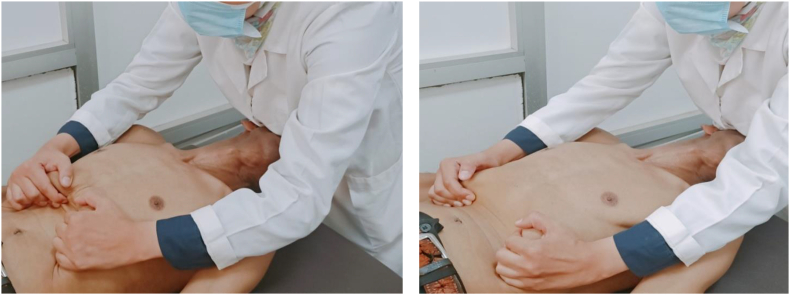
To investigate the effect of selective manual therapy (MT) techniques on chest expansion, pulmonary function (forced vital capacity [FVC], forced expiratory volume in 1 s [FEV1], and FEV1/FVC ratio), craniovertebral angle (CVA), kyphosis angle, functional capacity, and dyspnea in patients with chronic obstructive pulmonary disease (COPD).
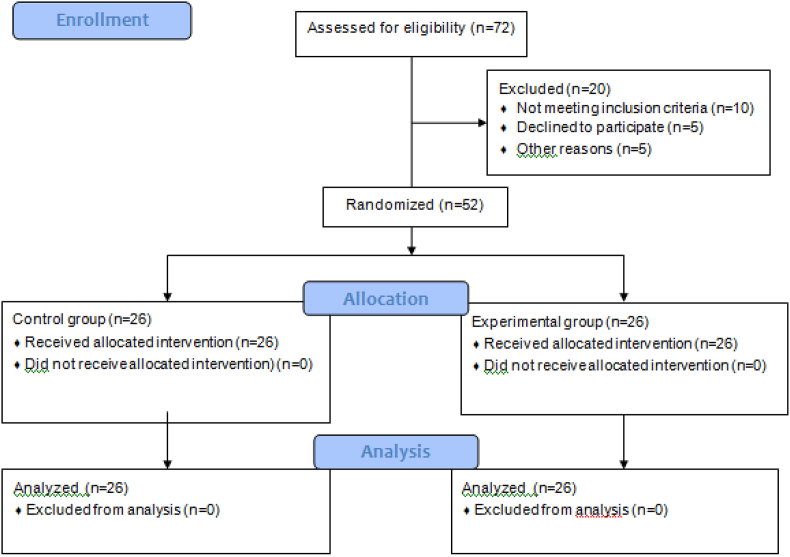
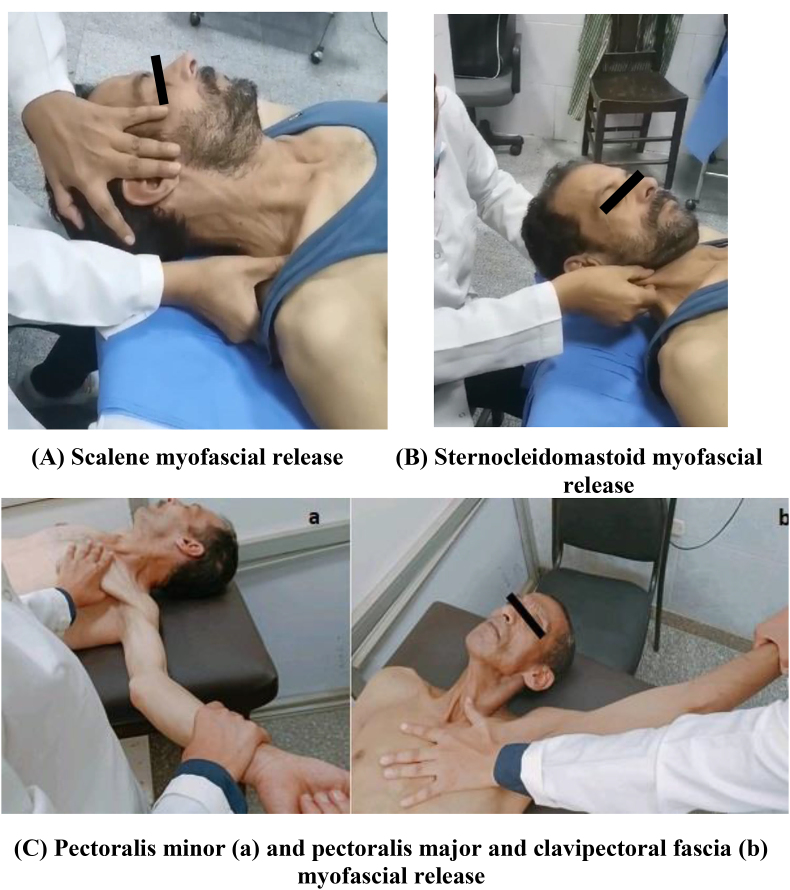
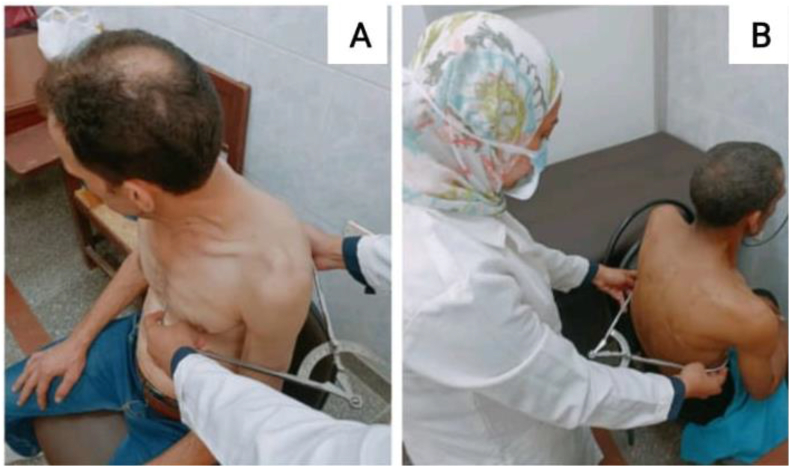
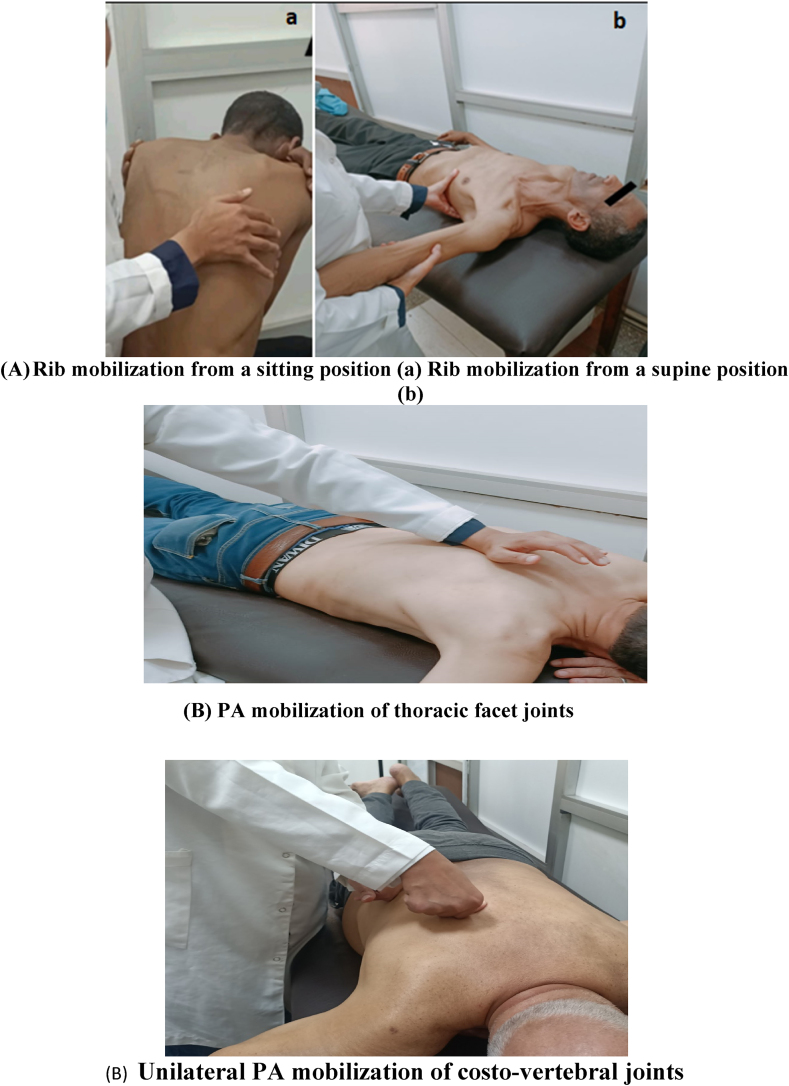
A parallel double-blinded randomized controlled trial involved 52 male subjects with a mean age of 56.23 ± 3.54. Patients were randomly assigned to two groups, each consisting of 26 subjects: the control group (A) received only conventional physical therapy, and the experimental group (B) received both MT and conventional physical therapy. Treatment was administered three times per week for 8 weeks. Chest expansion by chest caliper; FVC, FEV1, and FEV1/FVC ratio by spirometry; CVA and kyphosis angle by Kinovea software; functional capacity by the 6-min walk test (6MWT); and dyspnea by the modified Medical Research Council dyspnea index all were measured at baseline and after 8 weeks.
Prior to treatment, there was no statistically significant differences between the two groups in the between-group analyses (p > 0.05). After treatment,a statistically significant difference was found between both groups, with a predilection for the experimental group in FEV1 middle difference (MD) of 0.55 L, FVC MD = 0.39 L, FEV1/FVC% MD = 18.97, dyspnea MD = -2.58, 6MWT MD = 92.81 m, CVA MD = 5.21°, kyphosis angle MD = 3.1°, anteroposterior (AP) chest expansion MD = 1.08 cm, and lateral chest expansion MD = 1.54 cm.
The combination of MT approaches with conventional physical therapy leads to a clinically significant difference in AP chest expansion, FVC, FEV1, CVA, functional capacity, and dyspnea, and a statistically significant difference in kyphosis angle, FEV1/FVC%, and lateral chest expansion compared to using conventional physical therapy only in patients with COPD.
探讨选择性手法治疗(MT)技术对慢性阻塞性肺疾病(COPD)患者胸廓扩张度、肺功能(用力肺活量[FVC]、第1秒用力呼气容积[FEV1]和FEV1/FVC比值)、颅椎角(CVA)、脊柱后凸角、功能能力和呼吸困难的影响。
一项平行双盲随机对照试验纳入了52名平均年龄为56.23±3.54岁的男性受试者。患者被随机分为两组,每组26名受试者:对照组(A组)仅接受传统物理治疗,试验组(B组)接受MT和传统物理治疗。治疗每周进行3次,共8周。使用胸围尺测量胸廓扩张度;通过肺量计测量FVC、FEV1和FEV1/FVC比值;使用Kinovea软件测量CVA和脊柱后凸角;通过6分钟步行试验(6MWT)评估功能能力;使用改良的医学研究委员会呼吸困难指数评估呼吸困难程度。所有指标均在基线时和8周后进行测量。
治疗前,两组间分析无统计学显著差异(p>0.05)。治疗后,两组间存在统计学显著差异,试验组在FEV1中差异(MD)为0.55L、FVC MD = 0.39L、FEV1/FVC% MD = 18.97、呼吸困难MD = -2.58、6MWT MD = 92.81m、CVA MD = 5.21°、脊柱后凸角MD = 3.1°、前后胸扩张MD = 1.08cm和侧胸扩张MD = 1.54cm方面更具优势。
与仅使用传统物理治疗相比,MT方法与传统物理治疗相结合在COPD患者的前后胸扩张度、FVC、FEV1、CVA、功能能力及呼吸困难方面产生了临床显著差异,在脊柱后凸角、FEV1/FVC%及侧胸扩张方面产生了统计学显著差异。