Bi Qingqing, Zhu Jie, Zheng Jinju, Xu Qingyun, Chen Juan, Zhang Lei, Mu Xiaofeng
Department of Laboratory Medicine, Qingdao Central Hospital, Qingdao, China.
Department of Clinical Laboratory, Peking University First Hospital, Beijing, China.
Immun Inflamm Dis. 2024 Dec;12(12):e70105. doi: 10.1002/iid3.70105.
Bacterial coinfection in patients with SARS-CoV-2 infection is an important risk factor for death. This study investigated whether there were differences in levels of serum inflammatory markers in COVID-19 patients with bacterial coinfections compared with those without bacterial infection.
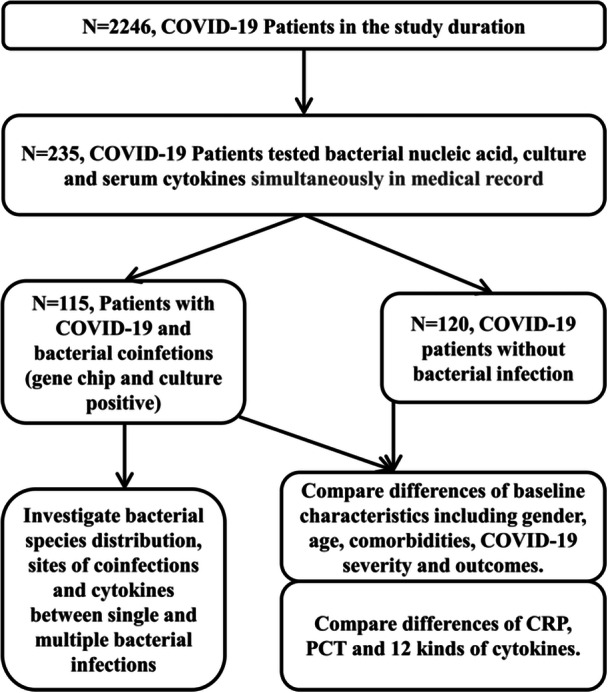
A total of 235 inpatients with SARS-CoV-2 infection admitted to Qingdao Central Hospital from December 7, 2022, to August 7, 2024, were included. Patients were divided into a bacteria-positive group (115 cases) and a bacteria-negative group (120 cases) according to whether they had bacterial coinfections. PCT, CRP, and 12 kinds of cytokines were compared between groups, and the distribution of bacterial species in the positive group was statistically analyzed.
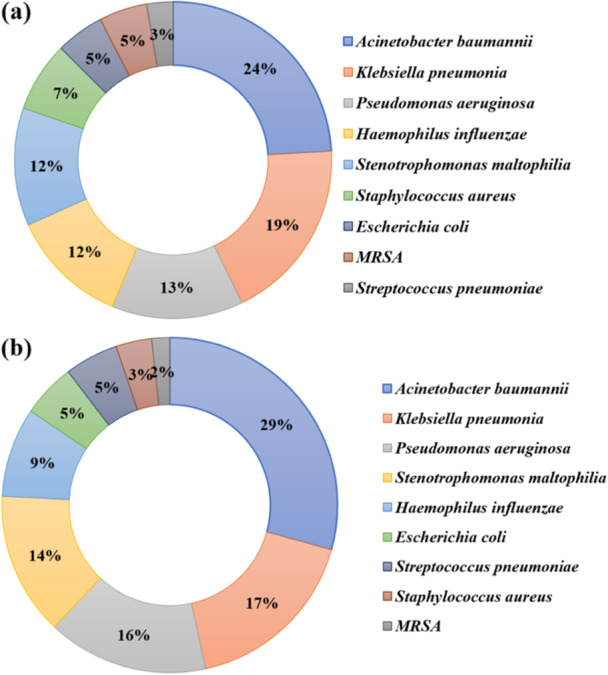
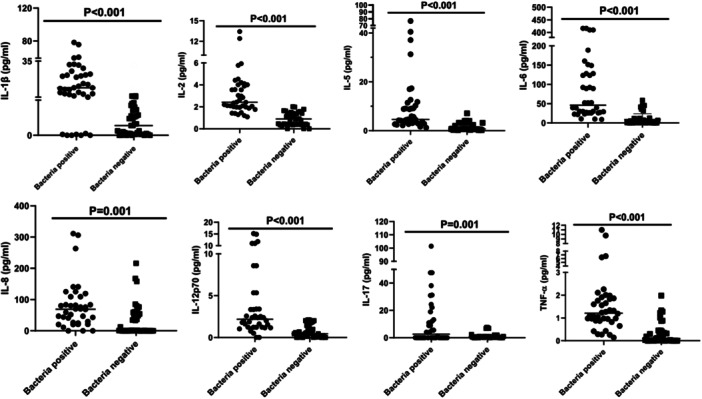
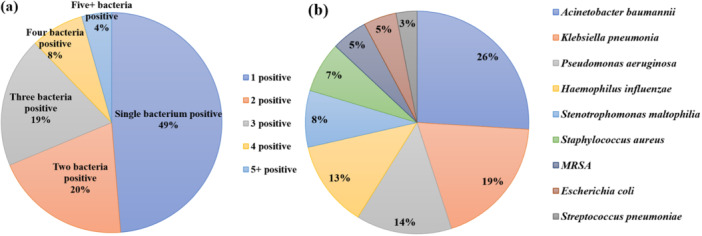
The serum levels of CRP (Z = 8.94, p < 0.001), PCT (Z = 5.59, p < 0.001), IL-1β (t = 4.863, p < 0.001), IL-2 (t = 5.810, p < 0.001), IL-5 (t = 3.837, p < 0.001), IL-6 (t = 4.910, p < 0.001), IL-8 (t = 3.325, p < 0.001), ILIL-12p70 (t = 4.722, p < 0.001), IL-17 (t = 3.315, p = 0.001) and TNF-α (t = 4.251, p < 0.001) between the two groups were significantly different. IL-4, IL-10, IFN-α, and IFN-γ were not statistically significant (p > 0.05). Among the 115 bacteria-positive patients, 56 patients were positive for one species and 59 patients were multiple infections. Acinetobacter baumannii, Klebsiella pneumoniae, Pseudomonas aeruginosa, Staphylococcus aureus, and Haemophilus influenzae were common species.
Serum PCT and CRP levels in COVID-19 patients with bacterial coinfection are higher than those without bacterial infection. Cytokines such as IL-1β, IL-2, IL-5, IL-6, IL-8, IL-12p70, IL-17, and TNF-α may be involved in the progression of COVID-19 combined with bacterial infection. They can be used as potential markers to evaluate the disease condition and prognosis.
新型冠状病毒肺炎(SARS-CoV-2)感染患者合并细菌感染是死亡的重要危险因素。本研究调查了合并细菌感染的新型冠状病毒肺炎(COVID-19)患者与未合并细菌感染的患者血清炎症标志物水平是否存在差异。
纳入2022年12月7日至2024年8月7日在青岛中心医院住院的235例SARS-CoV-2感染患者。根据是否合并细菌感染,将患者分为细菌阳性组(115例)和细菌阴性组(120例)。比较两组患者的降钙素原(PCT)、C反应蛋白(CRP)及12种细胞因子水平,并对阳性组细菌种类分布进行统计分析。
两组患者血清CRP水平(Z = 8.94,p < 0.001)、PCT水平(Z = 5.59,p < 0.001)、白细胞介素-1β(IL-1β,t = 4.863,p < 0.001)、IL-2(t = 5.810,p < 0.001)、IL-5(t = 3.837,p < 0.001)、IL-6(t = 4.910,p < 0.001)、IL-8(t = 3.325,p < 0.001)、IL-12p70(t = 4.722,p < 0.001)、IL-17(t = 3.315,p = 0.001)和肿瘤坏死因子-α(TNF-α,t = 4.251,p < 0.001)差异有统计学意义。IL-4、IL-10、干扰素-α(IFN-α)和干扰素-γ(IFN-γ)差异无统计学意义(p > 0.05)。115例细菌阳性患者中,56例为单一菌种阳性,59例为多重感染。鲍曼不动杆菌、肺炎克雷伯菌、铜绿假单胞菌、金黄色葡萄球菌和流感嗜血杆菌为常见菌种。
合并细菌感染的COVID-19患者血清PCT和CRP水平高于未合并细菌感染的患者。IL-1β、IL-2、IL-5、IL-6、IL-8、IL-12p70、IL-17和TNF-α等细胞因子可能参与COVID-19合并细菌感染的病情进展。它们可作为评估病情和预后的潜在标志物。