Marasco Ramona, Mosqueira Maria J, Seferji Kholoud A, Al Romaih Sarah M, Michoud Grégoire, Xu Jian, Bez Cristina, Castillo Hernandez Tatiana, Venturi Vittorio, Blilou Ikram, Daffonchio Daniele
Biological and Environmental Sciences and Engineering Division (BESE), King Abdullah University of Science and Technology (KAUST), Thuwal, Saudi Arabia.
Plant Systems Physiology, Radboud University, Nijmegen, The Netherlands.
Microb Biotechnol. 2024 Dec;17(12):e70043. doi: 10.1111/1751-7915.70043.
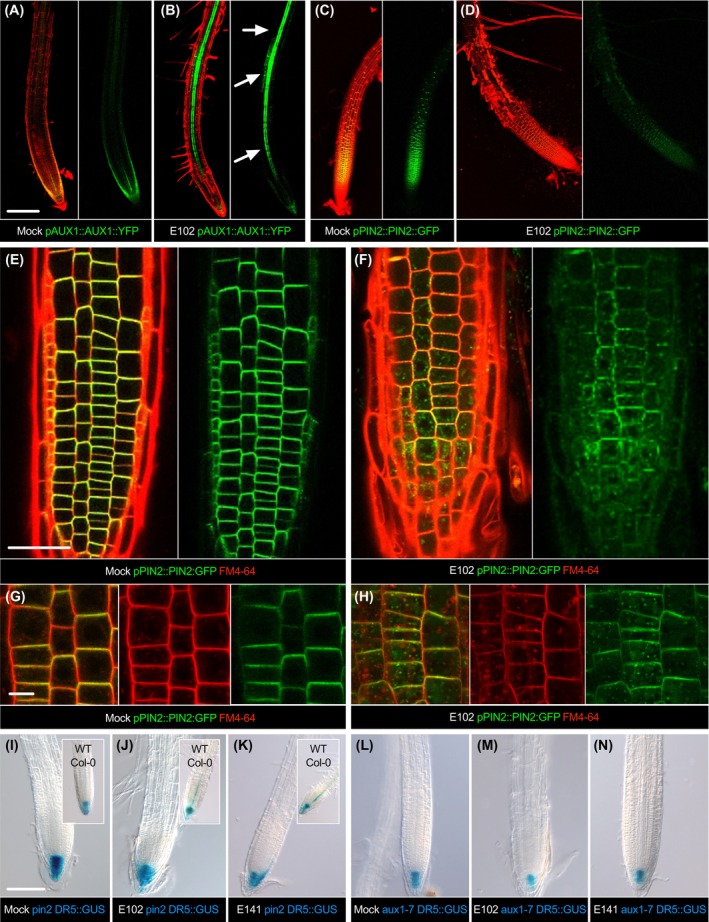
By providing adaptive advantages to plants, desert microorganisms are emerging as promising solutions to mitigate the negative and abrupt effects of climate change in agriculture. Among these, pseudomonads, commonly found in soil and in association with plants' root system, have been shown to enhance plant tolerance to salinity and drought, primarily affecting root system architecture in various hosts. However, a comprehensive understanding of how these bacteria affect plant responses at the cellular, physiological and molecular levels is still lacking. In this study, we investigated the effects of two Pseudomonas spp. strains, E102 and E141, which were previously isolated from date palm roots and have demonstrated efficacy in promoting drought tolerance in their hosts. These strains colonize plant roots, influencing root architecture by inhibiting primary root growth while promoting root hair elongation and lateral root formation. Strains E102 and E141 increased auxin levels in Arabidopsis, whereas this effect was diminished in IAA-defective mutant strains, which exhibited reduced IAA production. In all cases, the effectiveness of the bacteria relies on the functioning of the plant auxin response and transport machinery. Notably, such physiological and morphological changes provide an adaptive advantage to the plant, specifically under stress conditions such as salinity. Collectively, this study demonstrates that by leveraging the host's auxin signalling machinery, strains E102 and E141 significantly improve plant resilience to abiotic stresses, positioning them as potential biopromoters/bioprotectors for crop production and ecosystem restoration in alignment with Nature-based Solution approaches.
通过为植物提供适应性优势,沙漠微生物正成为缓解气候变化对农业产生的负面和突发影响的有前景的解决方案。其中,假单胞菌常见于土壤中并与植物根系相关联,已被证明能增强植物对盐分和干旱的耐受性,主要影响各种宿主的根系结构。然而,目前仍缺乏对这些细菌如何在细胞、生理和分子水平上影响植物反应的全面理解。在本研究中,我们调查了两种假单胞菌菌株E102和E141的作用,这两种菌株先前从枣椰树根系中分离出来,并已证明在促进宿主耐旱性方面具有功效。这些菌株定殖于植物根系,通过抑制主根生长同时促进根毛伸长和侧根形成来影响根系结构。E102和E141菌株提高了拟南芥中的生长素水平,而在生长素缺陷突变菌株中这种作用减弱,这些突变菌株的生长素产量降低。在所有情况下,细菌的有效性都依赖于植物生长素反应和转运机制的功能。值得注意的是,这种生理和形态变化为植物提供了适应性优势,特别是在盐分等胁迫条件下。总体而言,本研究表明,通过利用宿主的生长素信号传导机制,E102和E141菌株显著提高了植物对非生物胁迫的恢复力,使其成为符合基于自然的解决方案方法的作物生产和生态系统恢复的潜在生物促进剂/生物保护剂。