Drejeriene Ieva, Gruode Jurate, Cicenas Saulius, Loizides Charalambos, Eliades Alexia, Achilleos Achilleas, Kypri Elena, Tsangaras Kyriakos, Ioannides Marios, Koumbaris George, Stanciute Diana, Krasauskas Arnoldas, Patsalis Philippos C
Faculty of Medicine, Vilnius University, Vilnius, Lithuania.
Klaipeda University Hospital, Klaipeda, Lithuania.
Discov Oncol. 2024 Dec 18;15(1):757. doi: 10.1007/s12672-024-01640-7.
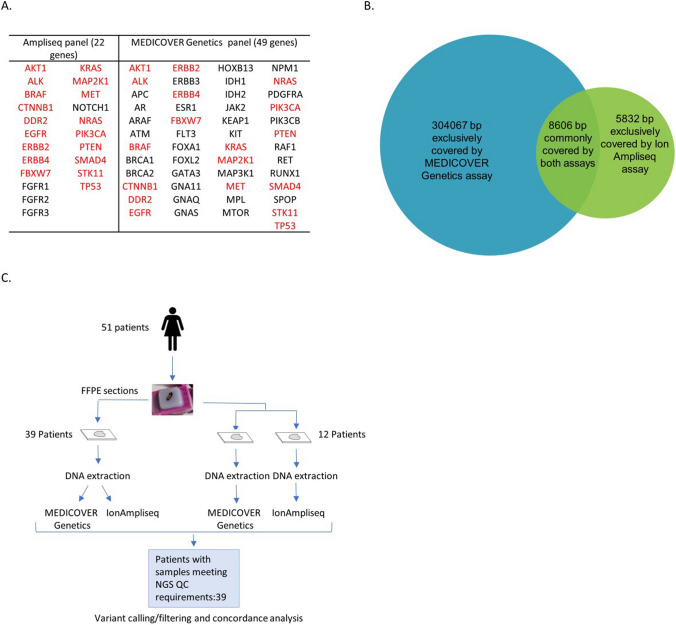
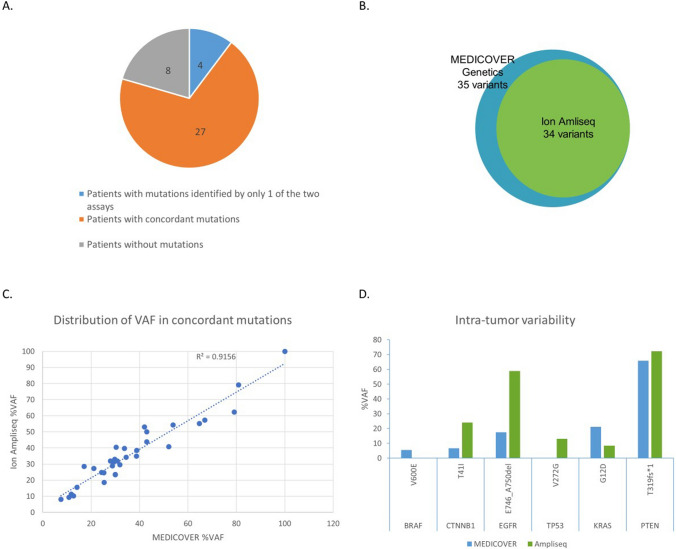
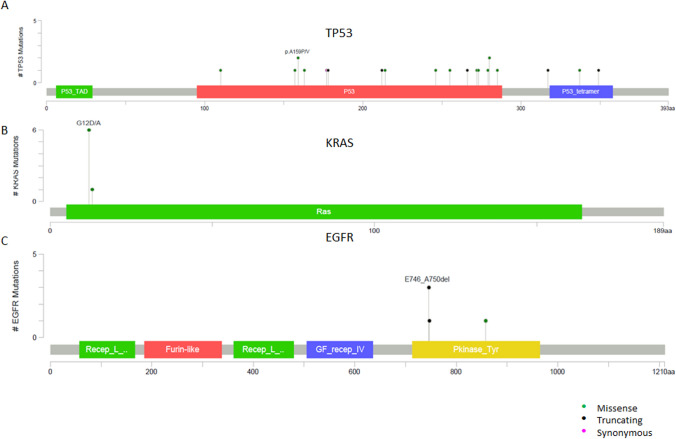
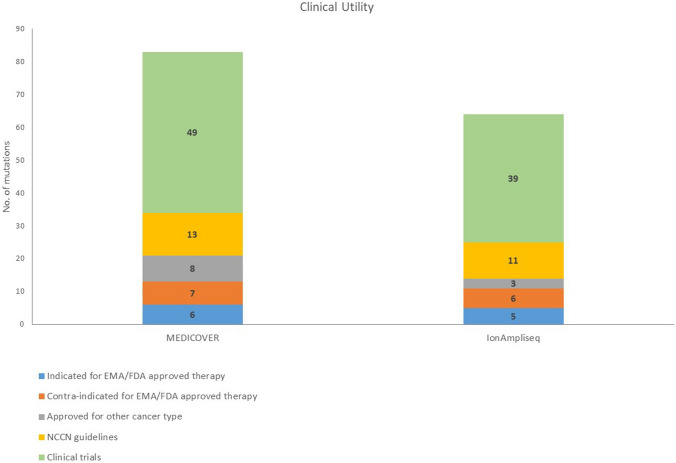
Non-small cell lung cancer (NSCLC) is the most prevalent type of lung cancer the mutational spectrum of which has been extensively characterized. Treatment of patients with NSCLC based on their molecular profile is now part of the standard clinical care. The aim of this study was firstly to investigate two different NGS-based tumor profile genetic tests and secondly to assess the clinical actionability of the mutations and their association with survival and clinicopathological characteristics. Overall, 52 mutations were identified in 31 patients by either one or both assays. The most frequently mutated genes were TP53 (40.4%), KRAS (13.46%) and EGFR (9.62%). TP53 and KRAS mutations were associated with worst overall survival while KRAS was positively correlated with adenocarcinoma. The two methods showed a high concordance for the commonly covered genomic regions (97.14%). Ten mutations were identified in a genomic region exclusively covered by the MEDICOVER Genetics custom tumor profile assay. Likewise, one MET mutation was identified by the Ion Amliseq assay in a genomic region exclusively covered by Ion Amliseq. In conclusion both assays showed highly similar results in the commonly covered genomic areas, however, the MEDICOVER Genetics assay identified additional clinically actionable mutations that can be applied in clinical practice for personalized treatment decision making for patients with NSCLC.
非小细胞肺癌(NSCLC)是最常见的肺癌类型,其突变谱已得到广泛表征。基于分子特征对NSCLC患者进行治疗现已成为标准临床护理的一部分。本研究的目的首先是调查两种不同的基于二代测序(NGS)的肿瘤特征基因检测方法,其次是评估突变的临床可操作性及其与生存和临床病理特征的关联。总体而言,通过一种或两种检测方法在31例患者中鉴定出52个突变。最常发生突变的基因是TP53(40.4%)、KRAS(13.46%)和EGFR(9.62%)。TP53和KRAS突变与总体生存最差相关,而KRAS与腺癌呈正相关。这两种方法在共同覆盖的基因组区域显示出高度一致性(97.14%)。在MEDICOVER Genetics定制肿瘤特征检测方法专门覆盖的基因组区域中鉴定出10个突变。同样,在Ion Amliseq检测方法专门覆盖的基因组区域中通过Ion Amliseq检测方法鉴定出1个MET突变。总之,两种检测方法在共同覆盖的基因组区域显示出高度相似的结果,然而,MEDICOVER Genetics检测方法鉴定出了额外的具有临床可操作性的突变,可应用于临床实践中为NSCLC患者做出个性化治疗决策。