Pilfold Nicholas W, Mateo-Chero Denisse, Farfan-Rios William, Watsa Mrinalini, Owen Megan A, Van Horn Russell C
Conservation Science Wildlife Health, San Diego Zoo Wildlife Alliance, Escondido, California, United States of America.
Department of Biology and Sabin Center for Environment and Sustainability, Wake Forest University, Winston-Salem, North Carolina, United States of America.
PLoS One. 2024 Dec 18;19(12):e0314547. doi: 10.1371/journal.pone.0314547. eCollection 2024.
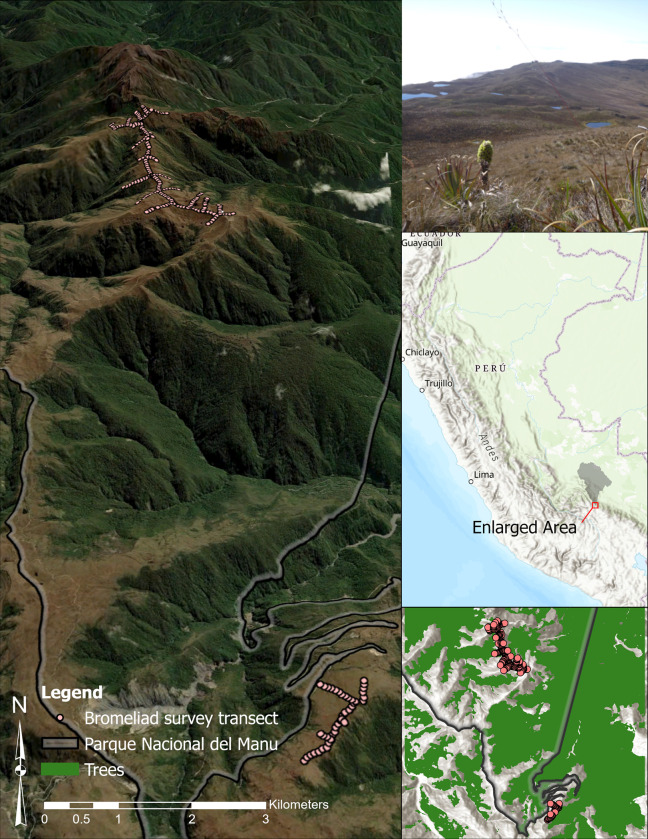
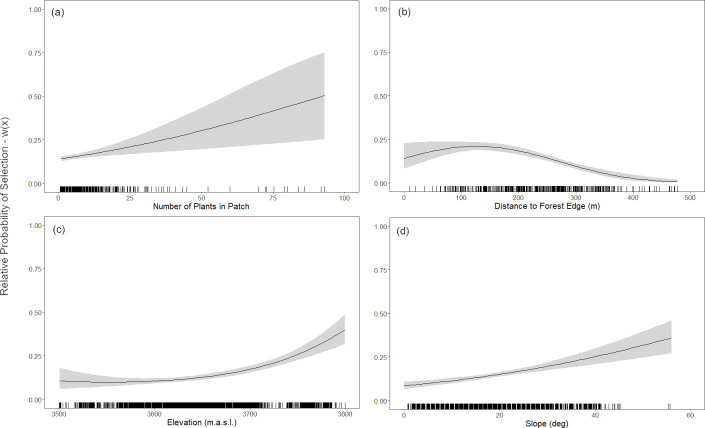
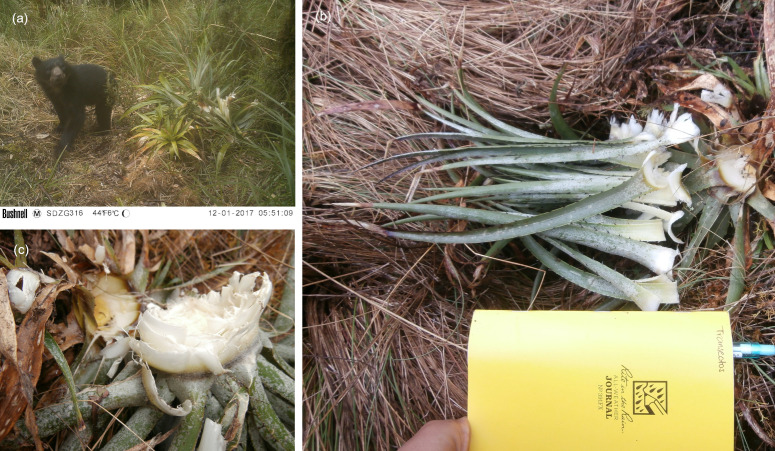
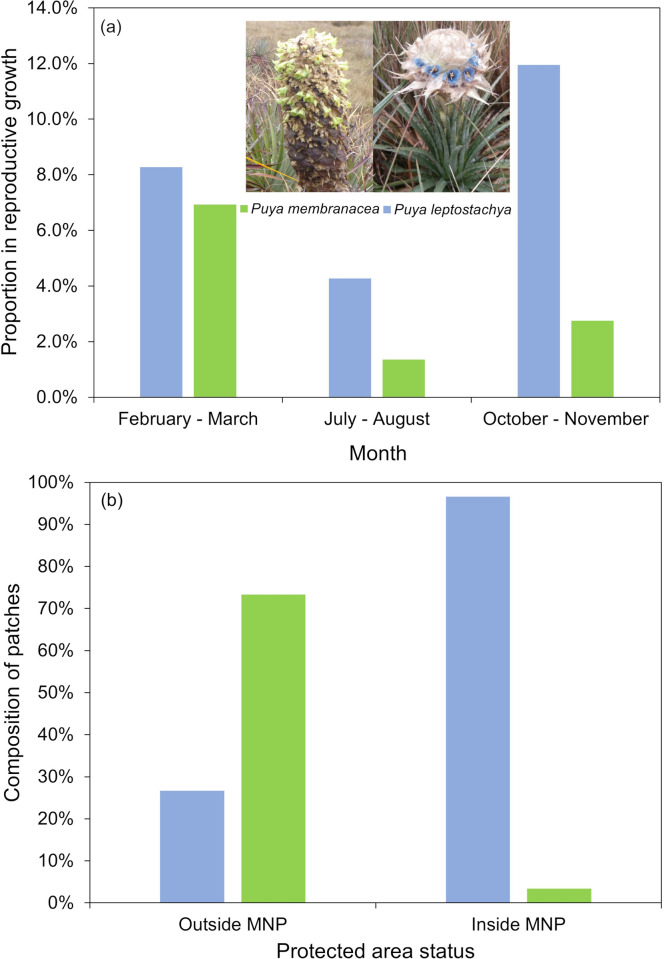
Andean bears (Tremarctos ornatus) forage extensively on bromeliads (Puya spp.) across their range, although their selectivity for bromeliads is less understood. We report on foraging activity by Andean bears on two species of bromeliad, Puya leptostachya and Puya membranacea, in high elevation puna grasslands (3499-3806 m.a.s.l) within and near Manu National Park (MNP) in SE Peru. We established two ridgeline transects (inside and outside MNP) with perpendicular transects running downslope. We recorded whether bromeliad plants were foraged by Andean bears on four separate sampling occasions that included wet and dry seasons from July 2017 to August 2018. We observed foraging by Andean bears at 6.8% of the available individual plants spread across 16.7% of the available patches. We utilized Resource Selection Functions to evaluate the environmental factors influencing the selection of bromeliad patches by Andean bears for foraging. Andean bears showed selection for Puya leptostachya over Puya membranacea, preferring to forage during the dry season at higher density patches of younger vegetative-stage bromeliads, possibly due to the increased bioavailability of nutrients in the basal meristematic plant tissue the bears prefer to eat. Andean bears selected bromeliad patches growing on east-facing, steep, high-altitude slopes, in a band near the cloud forest edge, which likely reflected a combination of optimal growing conditions for the bromeliads and habitat selection by the bears. Observations of foraging on grassland bromeliads occurred almost exclusively within the boundaries of MNP, which may in part reflect bears avoiding cattle impacts outside of the park. Andean bears showed active behavioral selection for bromeliads within the puna grasslands, and we recommend that grassland buffers around the cloud forest should be considered as primary habitat in conservation management plans.
安第斯熊(Tremarctos ornatus)在其分布范围内广泛以凤梨科植物(Puya spp.)为食,不过它们对凤梨科植物的选择性尚不太为人所知。我们报告了秘鲁东南部马努国家公园(MNP)及其附近高海拔普纳草原(海拔3499 - 3806米)内,安第斯熊对两种凤梨科植物——细穗普亚凤梨(Puya leptostachya)和膜质普亚凤梨(Puya membranacea)的觅食活动。我们设立了两条山脊样带(一条在MNP内,一条在其外),并设有垂直于山脊向下倾斜的样带。我们在2017年7月至2018年8月的四个不同采样时段(包括湿季和干季)记录了凤梨科植物是否被安第斯熊采食。我们观察到,在所有可用的单株植物中,有6.8%被安第斯熊采食,这些单株分布在所有可用斑块的16.7%中。我们利用资源选择函数来评估影响安第斯熊选择凤梨科植物斑块进行觅食的环境因素。相较于膜质普亚凤梨,安第斯熊表现出对细穗普亚凤梨的偏好,它们更倾向于在旱季觅食处于幼年营养阶段、密度较高的凤梨科植物斑块,这可能是因为熊类偏好食用的植物基部分生组织中的养分生物可利用性增加。安第斯熊选择生长在朝东、陡峭、高海拔山坡上、靠近云雾森林边缘地带的凤梨科植物斑块,这可能反映了凤梨科植物的最佳生长条件与熊类的栖息地选择的综合结果。在草原凤梨科植物上的觅食观察几乎都发生在MNP的边界内,这可能部分反映出熊类避开了公园外牛群的影响。安第斯熊在普纳草原内对凤梨科植物表现出积极的行为选择,我们建议在保护管理计划中,应将云雾森林周围的草原缓冲区视为主要栖息地。