Dungu Kia Hee Schultz, Hagen Christian Munch, Bækvad-Hansen Marie, Yakimov Victor, Buil Demur Alfonso, Carlsen Emma Malchau, Vissing Nadja Hawwa, Brink Henriksen Tine, Mogensen Trine Hyrup, Hougaard David Michael, Nygaard Ulrikka, Bybjerg-Grauholm Jonas
Department of Paediatrics and Adolescent Medicine, Copenhagen University Hospital, Copenhagen, Denmark.
Department of Clinical Medicine, University of Copenhagen, Copenhagen, Denmark.
Commun Med (Lond). 2024 Dec 18;4(1):268. doi: 10.1038/s43856-024-00711-8.
Neonatal herpes simplex virus (HSV) infection is life-threatening, with a mortality of up to 70-80% when disseminated, often due to vague symptoms and delayed treatment. Neonatal screening using dried blood spot (DBS) samples is among the most impactful preventative health measures ever implemented, but screening for HSV has not been investigated.
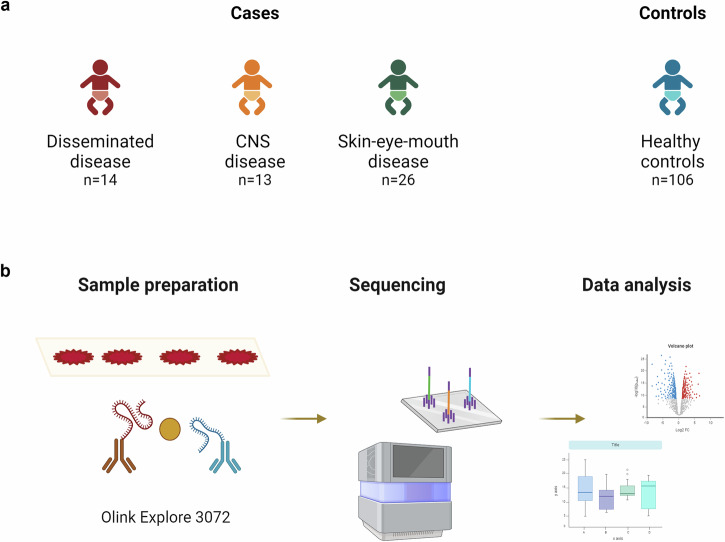
We investigated high throughput multiplexed proteomics on DBS samples collected on days 2-3 of life from a nationwide cohort of neonates with HSV infection (n = 53) and matched controls. We measured 2941 proteins using the Olink Explore 3072 panels and proximity extension assays, followed by differential protein expression by Analysis of Variance with post-hoc correction and functional annotation.
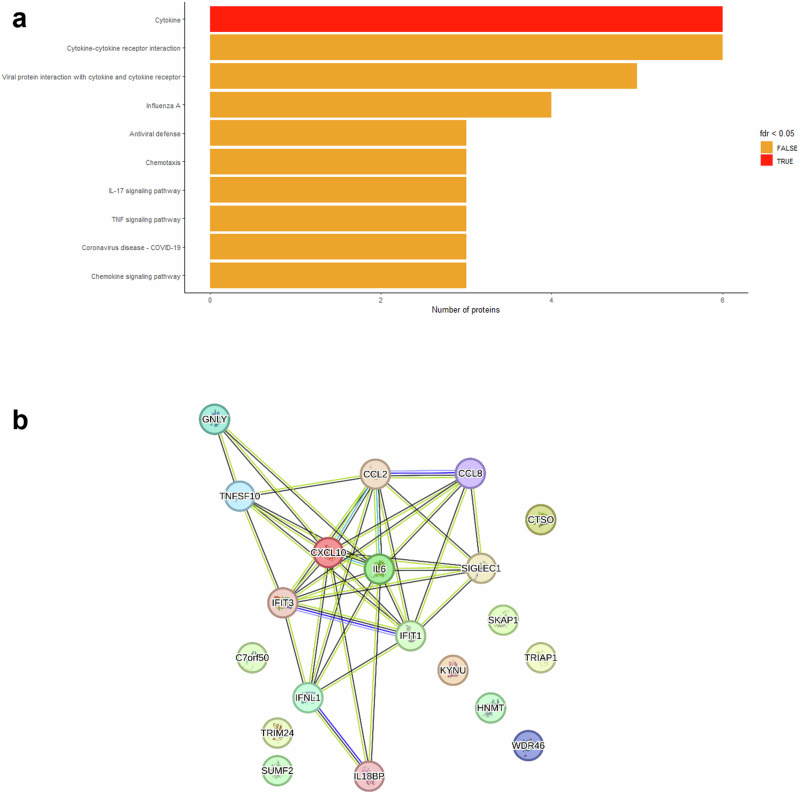
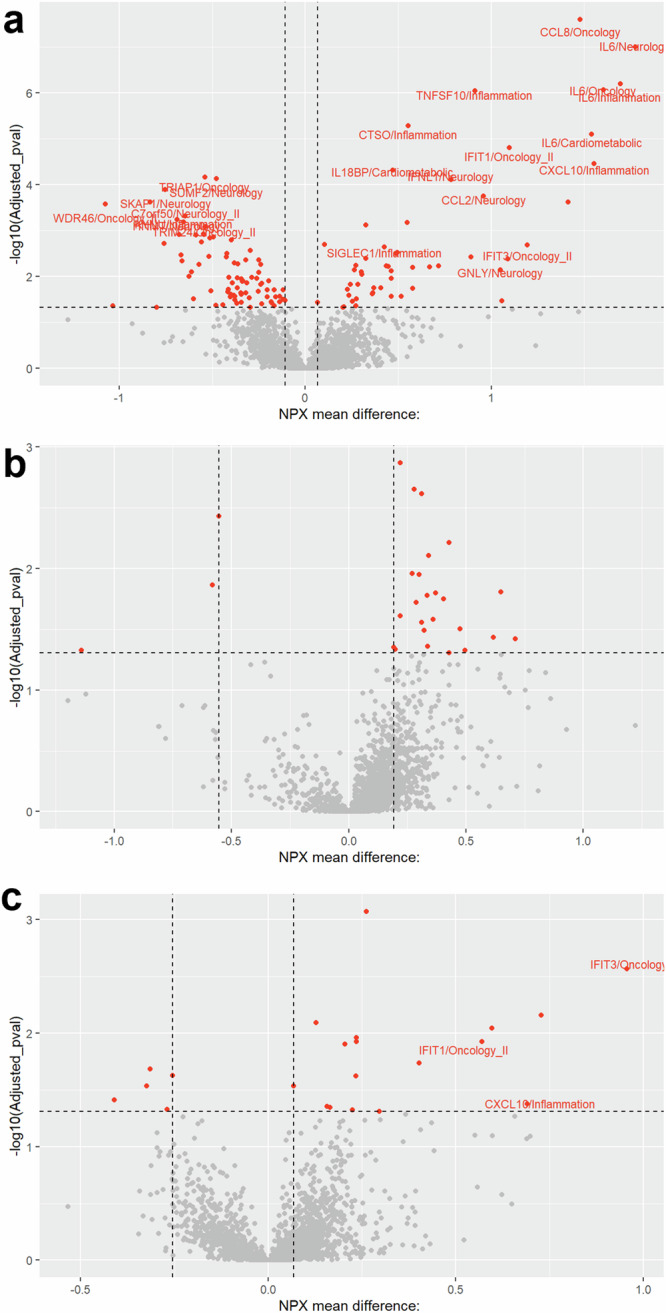
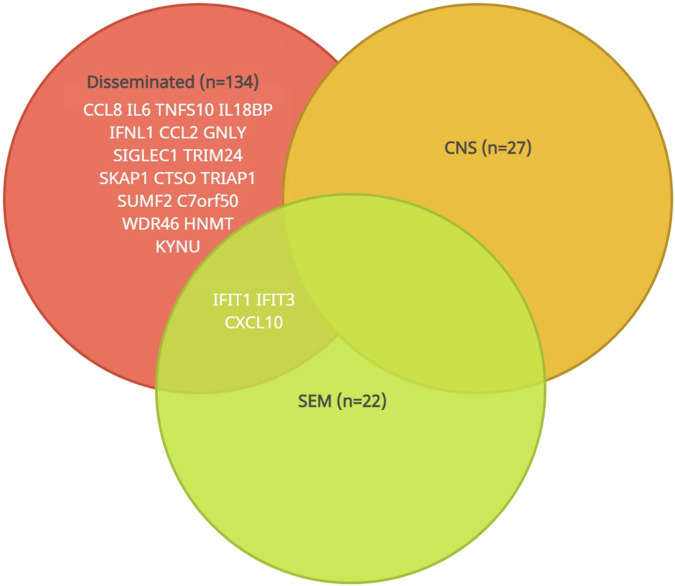
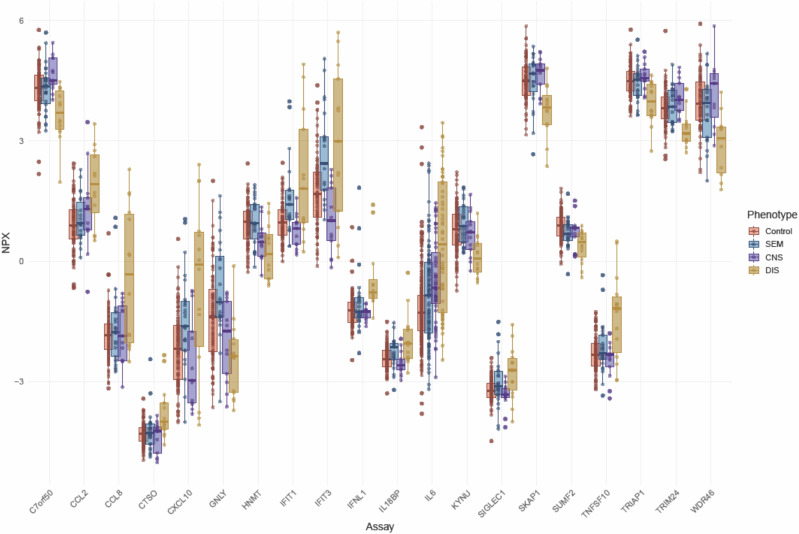
Here, we show distinct protein profiles in neonates with disseminated HSV disease, with differences in 20 proteins compared to controls. These proteins are associated with innate and adaptive immune responses and cytokine activation.
Our findings indicate the potential of neonatal screening for disseminated HSV disease to ensure early treatment and reduce the high mortality.
新生儿单纯疱疹病毒(HSV)感染危及生命,播散性感染时死亡率高达70 - 80%,这通常归因于症状不明确和治疗延迟。使用干血斑(DBS)样本进行新生儿筛查是有史以来最具影响力的预防性健康措施之一,但尚未对HSV筛查进行研究。
我们对来自全国范围的一组感染HSV的新生儿(n = 53)及其匹配对照在出生后第2 - 3天采集的DBS样本进行了高通量多重蛋白质组学研究。我们使用Olink Explore 3072面板和邻近延伸分析测量了2941种蛋白质,随后通过方差分析及事后校正和功能注释来分析差异蛋白质表达。
在此,我们展示了播散性HSV疾病新生儿独特的蛋白质谱,与对照相比有20种蛋白质存在差异。这些蛋白质与先天性和适应性免疫反应以及细胞因子激活相关。
我们的研究结果表明,对播散性HSV疾病进行新生儿筛查有潜力确保早期治疗并降低高死亡率。