Jia Guoqing, Jia Mengzhen, Li Chuntao
Department of Gastrointestinal, Beijing Shunyi Hospital, No.3 Guangming South Street, Shunyi District, Beijing, Shunyi, 101300, P.R. China.
BMC Gastroenterol. 2024 Dec 18;24(1):457. doi: 10.1186/s12876-024-03538-8.
Insufficient nocturnal sleep was associated with a higher risk of fibrosis in patients with metabolic dysfunction-associated steatotic liver disease (MASLD). Dietary fiber intake may improve the stimulate the secretion of sleep cytokines, inhibit the inflammatory pathway, contribute to regulating sleep disorders and alleviate liver fibrosis. The associations of dietary fiber intake, sleep patterns, with liver fibrosis remain unclear. The study aimed to explore the associations between dietary fiber, sleep, and liver fibrosis, as well as the moderating effect of dietary fiber intake between sleep patterns and liver fibrosis in MASLD patients.
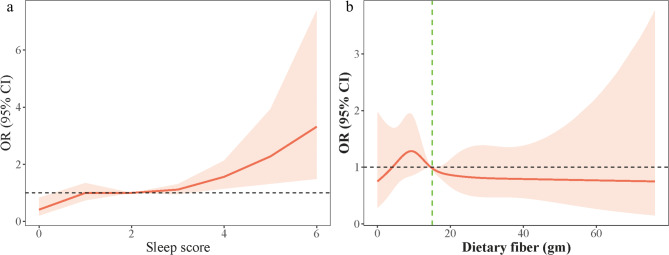
Using data from the National Health and Nutrition Examination Survey (NHANES) database spanning from 2017 to 2020, a cross-sectional study included participants with MASLD was performed to assess the relationship between sleep patterns, dietary fiber intake, and liver fibrosis. Weighted univariate and multivariate logistic regression models were used to examine the linear connection between sleep pattern, dietary fiber intake, and liver fibrosis. Restricted cubic spline (RCS) method was also performed to describe the nonlinear relationship. A two-part linear regression model was also used to estimate threshold effects. The moderating effect of dietary fiber intake was further investigated in different subgroups. All results were presented as odds ratios (ORs) and 95% confidence intervals (CIs).
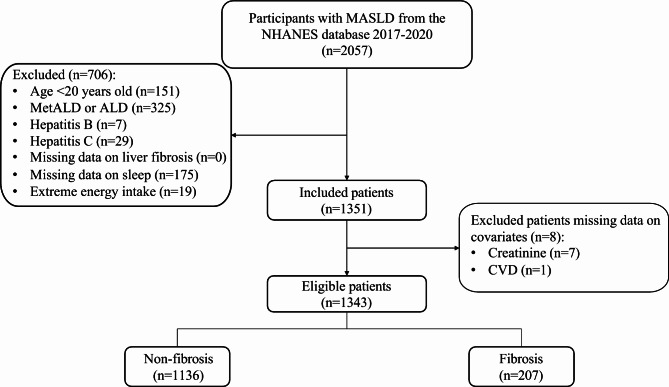
Totally, 1343 MASLD patients were included for final analysis. Among them, 207 (15.41%) have liver fibrosis. Dietary fiber intake did not correlate significantly with sleep pattern in patients with MASLD (Spearman's r = -0.028, P = 0.1678). Poor sleep pattern was related to higher odds of liver fibrosis (OR = 3.23, 95%CI: 1.05-9.90), while dietary fiber intake ≥ 15 gm/day was associated with lower liver fibrosis risk (OR = 0.51, 95%CI: 0.32-0.83). On the association between sleep pattern and liver fibrosis stratified by dietary fiber intake revealed that poor sleep patterns (OR = 15.13, 95%CI: 4.40-52.01) remained associated with increased liver fibrosis risk among individuals with dietary fiber intake < 15 gm/day. No connection was observed between poor sleep patterns and liver fibrosis in MASLD patients with higher dietary fiber intake, with moderate dietary fiber supplementation beneficial in mitigating poor sleep patterns associated with liver fibrosis. The similar findings were also found in patients aged < 50 years old, ≥ 50 years old, females, those with and without CVD groups, hypertension, and dyslipidemia. Particularly, dietary fiber intake also moderates the relationship between sleep patterns and liver fibrosis in the F4 stage (OR = 13.26, 95%CI: 4.08-43.11).
Dietary fiber intake affects the relationship between sleep patterns and liver fibrosis in MASLD patients.
夜间睡眠不足与代谢功能障碍相关脂肪性肝病(MASLD)患者发生肝纤维化的风险较高有关。膳食纤维摄入可能改善刺激睡眠细胞因子的分泌,抑制炎症途径,有助于调节睡眠障碍并减轻肝纤维化。膳食纤维摄入量、睡眠模式与肝纤维化之间的关联尚不清楚。本研究旨在探讨膳食纤维、睡眠与肝纤维化之间的关联,以及膳食纤维摄入量在MASLD患者睡眠模式与肝纤维化之间的调节作用。
利用2017年至2020年美国国家健康与营养检查调查(NHANES)数据库中的数据,对纳入的MASLD参与者进行横断面研究,以评估睡眠模式、膳食纤维摄入量与肝纤维化之间的关系。采用加权单变量和多变量逻辑回归模型来检验睡眠模式、膳食纤维摄入量与肝纤维化之间的线性联系。还采用受限立方样条(RCS)方法来描述非线性关系。采用两部分线性回归模型来估计阈值效应。在不同亚组中进一步研究膳食纤维摄入量的调节作用。所有结果均以比值比(OR)和95%置信区间(CI)表示。
总共纳入1343例MASLD患者进行最终分析。其中,207例(15.41%)有肝纤维化。MASLD患者的膳食纤维摄入量与睡眠模式无显著相关性(Spearman氏r=-0.028,P=0.1678)。睡眠模式差与肝纤维化几率较高相关(OR=3.23,95%CI:1.05-9.90),而膳食纤维摄入量≥15克/天与较低的肝纤维化风险相关(OR=0.51,95%CI:0.32-0.83)。按膳食纤维摄入量分层的睡眠模式与肝纤维化之间的关联显示,膳食纤维摄入量<15克/天的个体中,睡眠模式差(OR=15.13,95%CI:4.40-52.01)仍与肝纤维化风险增加相关。在膳食纤维摄入量较高的MASLD患者中,未观察到睡眠模式差与肝纤维化之间的关联,适度补充膳食纤维有助于减轻与肝纤维化相关的睡眠模式差。在年龄<50岁、≥50岁、女性、有和无心血管疾病组、高血压和血脂异常的患者中也发现了类似的结果。特别是,膳食纤维摄入量在F4期也调节睡眠模式与肝纤维化之间的关系(OR=13.26,95%CI:4.08-43.11)。
膳食纤维摄入量影响MASLD患者睡眠模式与肝纤维化之间的关系。