Xie Shitong, Wu Jing, Chen Pinan, He Xiaoning, Zhao Kun, Xie Feng
School of Pharmaceutical Science and Technology, Faculty of Medicine, Tianjin University, Tianjin, China.
Center for Social Science Survey and Data, Tianjin University, Tianjin, China.
BMC Public Health. 2024 Dec 18;24(1):3485. doi: 10.1186/s12889-024-20999-4.
The CHROME-G is the first generic preference-based measure developed in China. This study aimed to validate and compare the psychometric properties of the CHROME-G with the EQ-5D-5L and SF-6Dv2 among the Chinese general population.
A representative sample of the Chinese general population in terms of age, gender, education, and urban/rural residence was recruited for an online survey. During the survey, respondents completed three instruments (first the CHROME-G, then the EQ-5D-5L and SF-6Dv2 in random order), demographic and health-related questions. The retest survey was carried out after two weeks. Ceiling/floor effects were first assessed. Convergent and divergent validity was examined using Spearman's rank correlation. Known-group validity was examined using the non-parametric Kruskal-Wallis H test and effect size. Test-retest reliability was assessed using the intraclass correlation coefficient and weighted Kappa statistics.
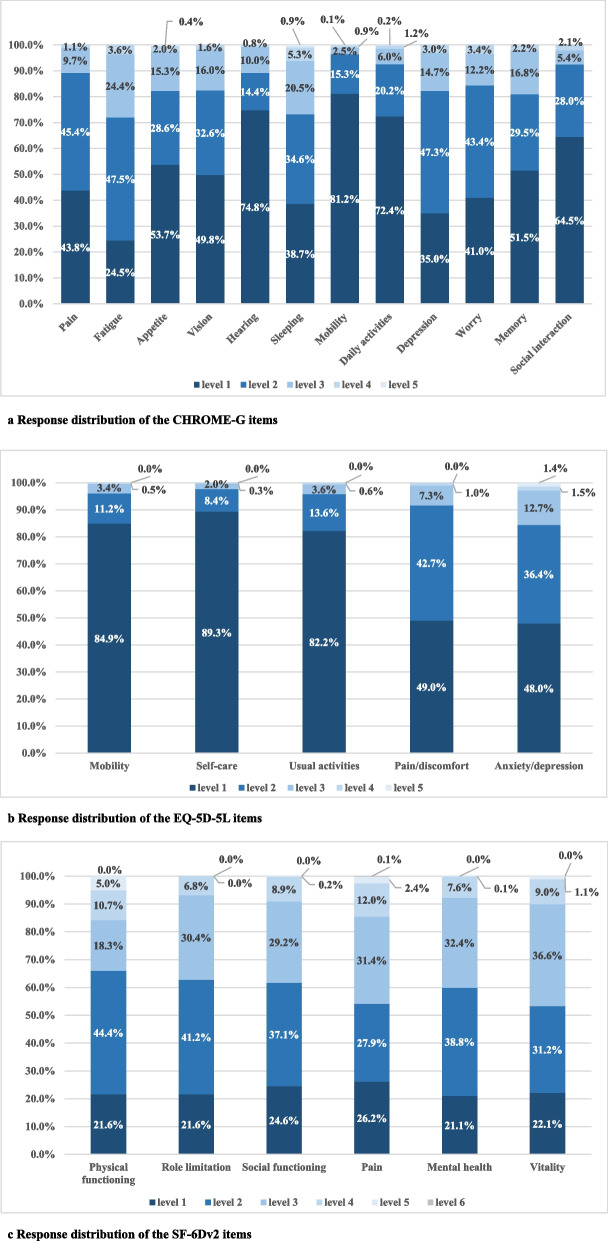
One thousand respondents (51.1% male, mean age 44.7 years) completed the first survey, with 378 also completing the retest survey. The mean ± SD completion time was 2.03 ± 0.58 min for the CHROME-G, and 1.37 ± 0.54 and 1.13 ± 0.38 min for the EQ-5D-5L and SF-6Dv2. Only the EQ-5D-5L had a ceiling effect of 35.1%. The range of Spearman rank's correlations was 0.45-0.62 for convergent validity and 0.14-0.46 for divergent validity. Among different health subgroups, the effect size for the CHROME-G, EQ-5D-5L and SF-6Dv2 was 1.348-3.416, 1.362-3.325 and 1.097-2.228, respectively. The ICC for test-retest was 0.791 for the CHROME-G, compared with 0.994 and 0.971 for the EQ-5D-5L and SF-6Dv2.
The CHROME-G showed good and comparable psychometric properties with the EQ-5D-5L and SF-6Dv2.
CHROME-G是在中国开发的首个基于偏好的通用测量工具。本研究旨在验证CHROME-G在中国普通人群中的心理测量特性,并与EQ-5D-5L和SF-6Dv2进行比较。
招募了一个在年龄、性别、教育程度和城乡居住方面具有代表性的中国普通人群样本进行在线调查。在调查过程中,受访者完成了三项测评工具(首先是CHROME-G,然后是EQ-5D-5L和SF-6Dv2,顺序随机)、人口统计学和健康相关问题。两周后进行了重测调查。首先评估天花板/地板效应。使用Spearman等级相关性检验收敛效度和区分效度。使用非参数Kruskal-Wallis H检验和效应量检验已知组效度。使用组内相关系数和加权Kappa统计量评估重测信度。
1000名受访者(男性占51.1%,平均年龄44.7岁)完成了首次调查,其中378人也完成了重测调查。CHROME-G的平均完成时间为2.03±0.58分钟,EQ-5D-5L和SF-6Dv2的平均完成时间分别为1.37±0.54分钟和1.13±0.38分钟。只有EQ-5D-5L有35.1%的天花板效应。Spearman等级相关性范围在收敛效度方面为0.45至0.62,在区分效度方面为0.14至0.46。在不同健康亚组中,CHROME-G、EQ-5D-5L和SF-6Dv2的效应量分别为1.348至3.416、1.362至3.325和1.097至2.228。CHROME-G重测的组内相关系数为0.791,而EQ-5D-5L和SF-6Dv2分别为0.994和0.971。
CHROME-G显示出与EQ-5D-5L和SF-6Dv2良好且相当 的心理测量特性。