Ezenwa-Ahanene Adanna, Salawu Adetokunbo T, Adebowale Ayo S
Department of Epidemiology and Medical Statistics, Faculty of Public Health, College of Medicine, University of Ibadan, Ibadan, Nigeria.
Fellow, European and Developing Countries Clinical Trials Partnership (EDCTP), University of Ibadan, Ibadan, Nigeria.
BMC Public Health. 2024 Dec 18;24(1):3470. doi: 10.1186/s12889-024-20840-y.
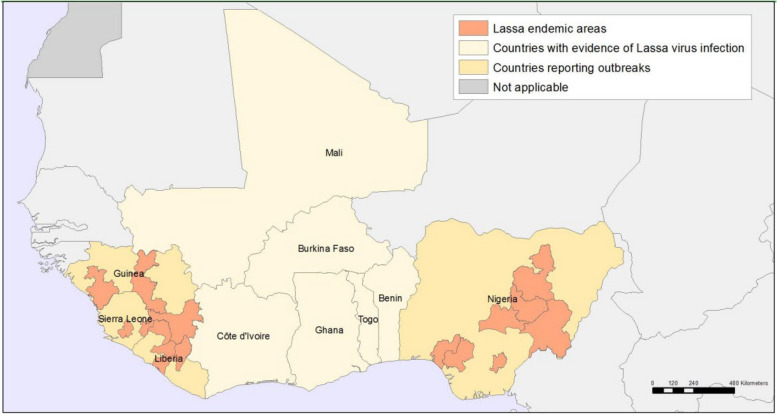
Nigeria is an epicenter for Lassa fever. Ebonyi state is located in the South-Eastern region of Nigeria where a high burden of Lassa fever has been reported. Therefore, this study was designed to assess the epidemiology of Lassa fever, its seasonality, trend, and mortality predictors in Ebonyi state, South-East, Nigeria.
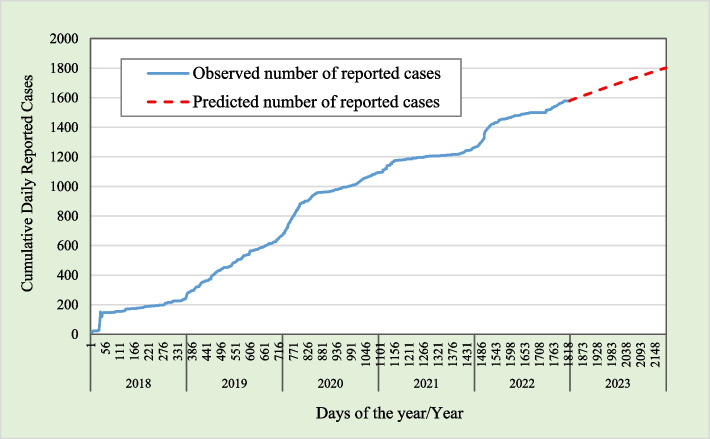
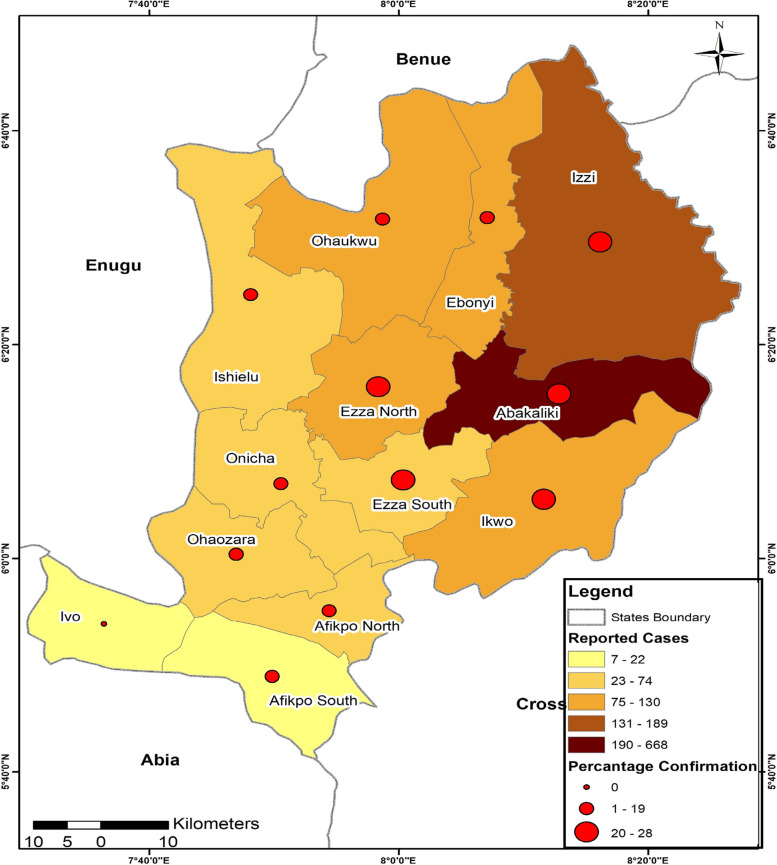
We analyzed data extracted from Ebonyi State Integrated Disease Surveillance and Response (IDSR) system over five years (2018-2022). A total of 1578 reported Lassa fever cases were captured in the IDSR out of which 300 were laboratory-confirmed. Data were analyzed using descriptive statistics, additive time series model, quadratic equation, and logistic regression model (α). Spatial distribution of reported Lassa fever cases was conducted using Arc G.I.S.
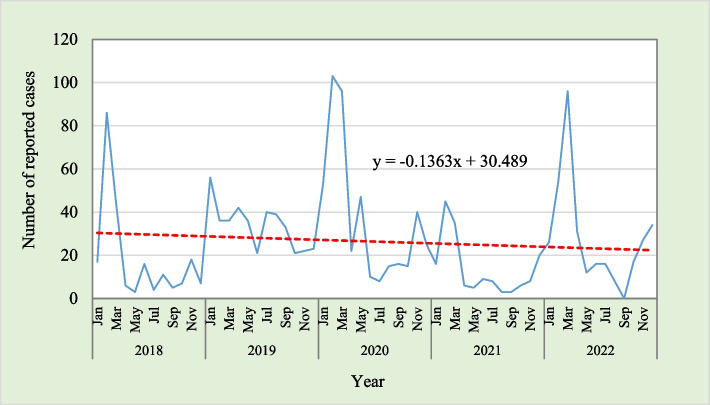
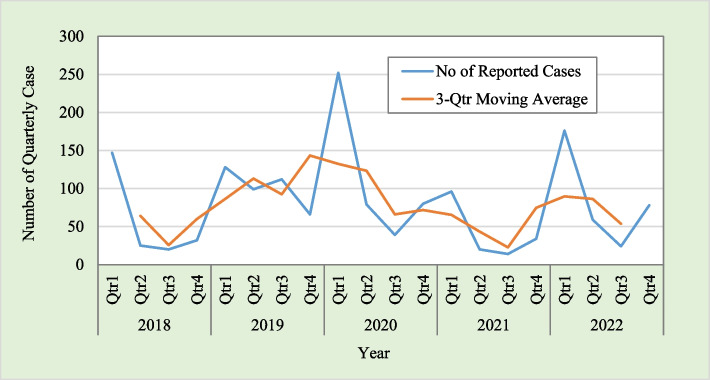
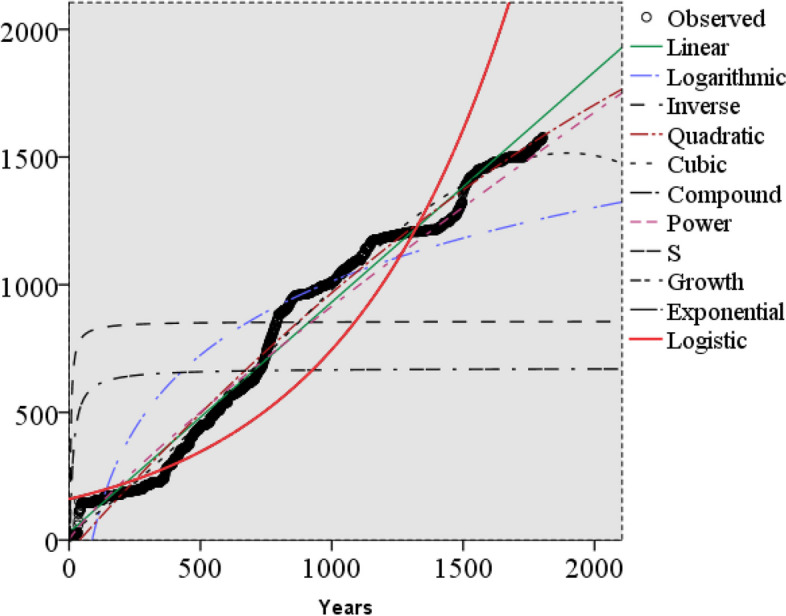
The mean age of the individuals with the reported cases of Lassa fever was 29.4 ± 17.8 years. Lassa fever showed a seasonal trend across the years. The quadratic model provided the best fit for predicting Lassa fever cumulative cases (R = 98.4%, P-value < 0.05). Projected cases of Lassa fever for the year 2023 were 123 in the 1st quarter, 23 in the 2nd quarter, 42 in the 3rd quarter, and 17 in the 4th quarter. The seasonality index was + 70.76, -28.42, -9.09, and -33.2 in the 1st, 2nd, 3rd, and 4th quarters respectively. The reported cases of Lassa fever followed a declining trend (slope = -0.1363). Farmers were 70% less likely to die from Lassa fever compared to those not working (aOR:0.3, CI: 0.17-0.83). The hot spots for Lassa fever were Abakaliki and Ezza Local Government Areas.
Although the reported Lassa fever cases followed a declining trend in Ebonyi state, there was a seasonality in the disease pattern. Being a farmer was protective against the risk of dying from Lassa fever. While efforts to eliminate and mitigate the spread of the disease in Ebonyi state should be strengthened, more attention should target the peak period of the disease.
尼日利亚是拉沙热的中心。埃邦伊州位于尼日利亚东南部地区,据报道该地区拉沙热负担沉重。因此,本研究旨在评估尼日利亚东南部埃邦伊州拉沙热的流行病学、季节性、趋势及死亡预测因素。
我们分析了从埃邦伊州综合疾病监测与应对(IDSR)系统中提取的五年(2018 - 2022年)数据。IDSR系统共记录了1578例报告的拉沙热病例,其中300例经实验室确诊。使用描述性统计、加法时间序列模型、二次方程和逻辑回归模型(α)对数据进行分析。使用Arc G.I.S.对报告的拉沙热病例进行空间分布分析。
报告的拉沙热病例患者的平均年龄为29.4±17.8岁。多年来拉沙热呈季节性趋势。二次模型最适合预测拉沙热累计病例(R = 98.4%,P值<0.05)。2023年拉沙热预测病例数为:第一季度123例,第二季度23例,第三季度42例,第四季度17例。季节性指数在第一、第二、第三和第四季度分别为+70.76、-28.42、-9.09和-33.2。报告的拉沙热病例呈下降趋势(斜率=-0.1363)。与非劳动者相比,农民死于拉沙热的可能性低70%(调整后比值比:0.3,可信区间:0.17 - 0.83)。拉沙热的热点地区是阿巴卡利基和埃扎地方政府辖区。
尽管埃邦伊州报告的拉沙热病例呈下降趋势,但疾病模式存在季节性。从事农业工作对死于拉沙热有保护作用。在加强消除和减轻埃邦伊州疾病传播的努力时,应更多关注疾病的高峰期。