Redding David W, Gibb Rory, Dan-Nwafor Chioma C, Ilori Elsie A, Yashe Rimamdeyati Usman, Oladele Saliu H, Amedu Michael O, Iniobong Akanimo, Attfield Lauren A, Donnelly Christl A, Abubakar Ibrahim, Jones Kate E, Ihekweazu Chikwe
Institute of Zoology, Zoological Society of London, Regent's Park, London, NW1 4RY, United Kingdom.
Centre for Biodiversity and Environment Research, Department of Genetics, Evolution and Environment, University College London, Gower Street, London, WC1E 6BT, United Kingdom.
Nat Commun. 2021 Oct 1;12(1):5759. doi: 10.1038/s41467-021-25910-y.
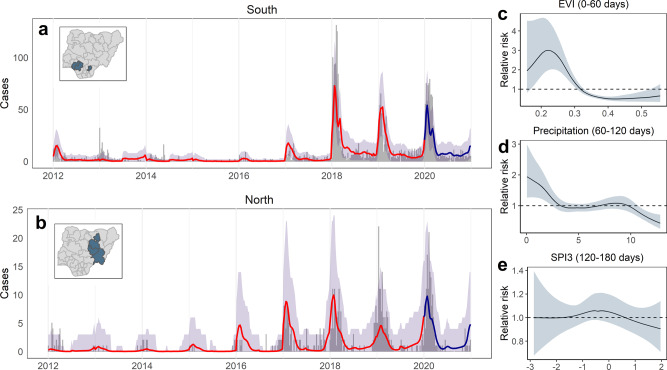
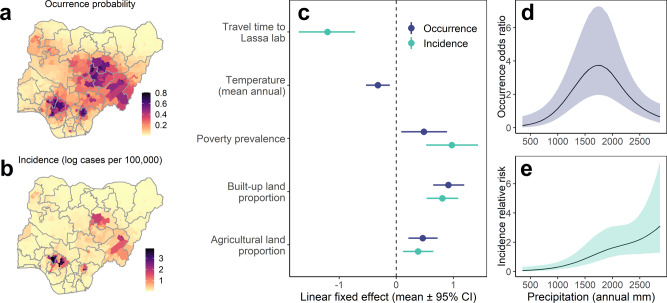
Lassa fever is a longstanding public health concern in West Africa. Recent molecular studies have confirmed the fundamental role of the rodent host (Mastomys natalensis) in driving human infections, but control and prevention efforts remain hampered by a limited baseline understanding of the disease's true incidence, geographical distribution and underlying drivers. Here, we show that Lassa fever occurrence and incidence is influenced by climate, poverty, agriculture and urbanisation factors. However, heterogeneous reporting processes and diagnostic laboratory access also appear to be important drivers of the patchy distribution of observed disease incidence. Using spatiotemporal predictive models we show that including climatic variability added retrospective predictive value over a baseline model (11% decrease in out-of-sample predictive error). However, predictions for 2020 show that a climate-driven model performs similarly overall to the baseline model. Overall, with ongoing improvements in surveillance there may be potential for forecasting Lassa fever incidence to inform health planning.
拉沙热是西非长期以来的公共卫生问题。最近的分子研究证实了啮齿动物宿主(南非多乳鼠)在引发人类感染方面的根本作用,但由于对该疾病的真实发病率、地理分布和潜在驱动因素的基线了解有限,控制和预防工作仍然受到阻碍。在这里,我们表明拉沙热的发生和发病率受气候、贫困、农业和城市化因素的影响。然而,不同的报告流程和诊断实验室的可及性似乎也是观察到的疾病发病率分布不均的重要驱动因素。使用时空预测模型,我们表明,纳入气候变异性比基线模型增加了回顾性预测价值(样本外预测误差降低了11%)。然而,2020年的预测表明,气候驱动模型的总体表现与基线模型相似。总体而言,随着监测工作的不断改进,预测拉沙热发病率为卫生规划提供信息可能具有潜力。