Bauhoff Sebastian, Sengar Manju, Pramesh C S, Dhiman Anamika, Mehndiratta Abha
Department of Global Health and Population, Harvard TH Chan School of Public Health, Boston, USA.
Tata Memorial Hospital, Mumbai, India.
BMC Health Serv Res. 2024 Dec 18;24(1):1591. doi: 10.1186/s12913-024-12018-4.
The effective operation of health insurance requires functioning administrative processes, including appropriate filing for reimbursements. The unlisted palliative care package is one of the most utilized oncology packages within Indian state health insurance schemes. We conducted a clinical audit to evaluate the appropriateness of claims for this package for patients with breast cancer.
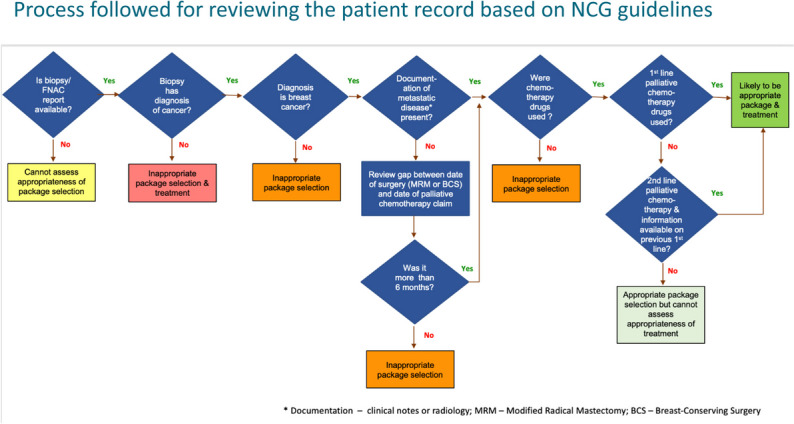
We obtained documentation submitted to support a random sample of insurance claims for the unlisted palliative care package for 50 patients (total) from one public and one private hospital, cataloged the available records, and assessed the appropriateness of package selection using clinical guidelines from India's National Cancer Grid. Where sufficient documentation was available, we also assessed the clinical appropriateness of care. We also examined whether these patients received relevant care at other hospitals that participate in the scheme and, for five purposefully selected patients, whether additional documentation had been submitted alongside other claims.
Claims for 45 of the 50 patients had sufficient documentation to assess whether the selected package was appropriate. Among these 45 claims only 33% were selected in accordance with guidelines; the public hospital had a relatively higher share of appropriate selections. In many cases (21 claims), the palliative care package was selected for adjuvant therapy and targeted therapy. While more than half of the sampled patients had multiple related encounters and sometimes received care from multiple hospitals, reviewing additional claims did not affect our conclusions.
Claims for the palliative chemotherapy unlisted package often had deficient documentation and were inappropriately selected.
医疗保险的有效运作需要有效的行政流程,包括适当的报销申请。未列入清单的姑息治疗套餐是印度国家医疗保险计划中使用最频繁的肿瘤治疗套餐之一。我们进行了一项临床审计,以评估乳腺癌患者该套餐报销申请的合理性。
我们获取了为支持从一家公立医院和一家私立医院随机抽取的50名患者(总计)的未列入清单的姑息治疗套餐保险索赔而提交的文件,对现有记录进行编目,并使用印度国家癌症网格的临床指南评估套餐选择的合理性。在有足够文件的情况下,我们还评估了护理的临床合理性。我们还调查了这些患者是否在参与该计划的其他医院接受了相关护理,对于五名有目的地挑选的患者,调查了是否在其他索赔之外还提交了额外的文件。
50名患者中有45名的索赔有足够的文件来评估所选套餐是否合适。在这45项索赔中,只有33%是根据指南选择的;公立医院的合适选择比例相对较高。在许多情况下(21项索赔),姑息治疗套餐被用于辅助治疗和靶向治疗。虽然超过一半的抽样患者有多次相关就诊经历,有时还在多家医院接受治疗,但审查额外的索赔并未影响我们的结论。
姑息化疗未列入清单套餐的索赔往往文件不足且选择不当。