Muganzi David Jolly, Kintu Timothy Mwanje, Nakandi Racheal Mukisa, Atulinda Linda, Atim Immaculate Kaducu, Mwaka Francis, Kizza Blair, Ngonzi Joseph
Mbarara University of science and technology, Mbarara, Uganda.
Makerere University, Kampala, Uganda.
BMC Med Educ. 2024 Dec 18;24(1):1481. doi: 10.1186/s12909-024-06456-1.
The healthcare workforce is one of the six core components of a well-functioning and sufficient health system. The WHO highlights that improving education and training of the health workforce is critical to improving health systems. Medical education is a pillar of the healthcare workforce. The educational environment - the physical circumstances or conditions under which learning takes place - is an important factor determining medical education's effectiveness. Its academic and clinical effects significantly determine medical students' attitudes, knowledge, skills, progression, and behaviors. To ensure strong health systems, there is a need for improvement in medical education. Improvement must be contextual and informed by locally relevant data. This study, which assessed Ugandan medical students' perception of their learning environment, provides crucial context-specific data highly relevant to the current state of medical education in Uganda.
This quantitative cross-sectional study was conducted among medical students across five medical schools in Uganda between December 2021 and February 2022. Participants completed an online questionnaire with a demographics section and the Dundee Ready Education Environment Measure (DREEM) tool. The data was analyzed using R in R Studio version 2021.09.0 + 351. The average score for each DREEM sub-scale and the total DREEM score were calculated, and their relationship with demographic characteristics was examined.
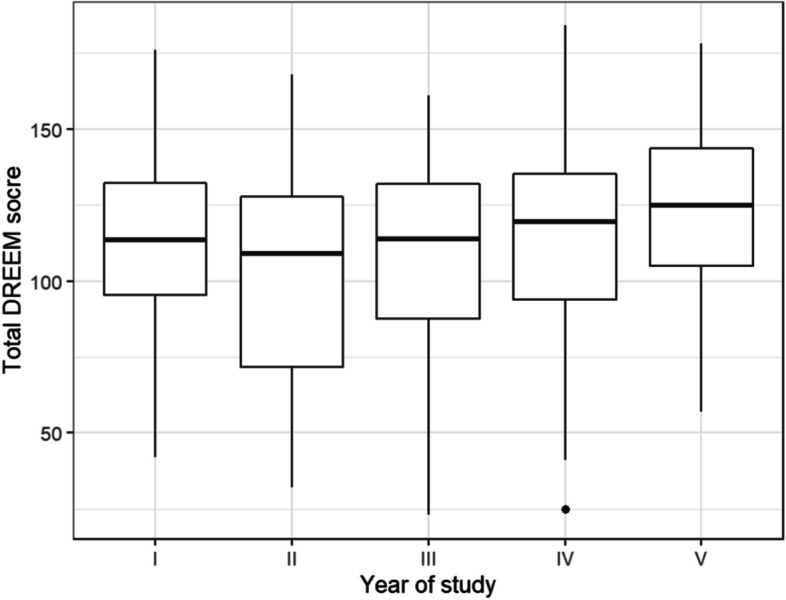
The average total DREEM score of the 335 participants was 112.27/200 (56.12%). We found that 69% (231/335) of the students had a positive perception. The sub-scale mean scores were as follows: Perception of Atmosphere - 25.14/48, Social Self-perception - 14.94/28, Perception of Teachers - 24.86/44, Perception of Learning - 28.8/48, and Academic Self-perceptions - 19.04/32. "There is a good support system for students who get stressed" was the item with the lowest mean score (1.41/5).
The study's findings indicate that medical students' perceptions of their learning environment are just above average. This suggests a need for improvement, particularly in the atmosphere and social support, to ensure the training of a robust health workforce. The results of this study should motivate stakeholders to initiate changes that will enhance the quality of medical education in Uganda.
医疗工作队伍是运转良好且充足的卫生系统的六个核心组成部分之一。世界卫生组织强调,改善卫生工作队伍的教育和培训对于改善卫生系统至关重要。医学教育是医疗工作队伍的支柱。教育环境——学习发生的物质环境或条件——是决定医学教育效果的一个重要因素。其学术和临床效果显著决定医学生的态度、知识、技能、进步和行为。为确保强大的卫生系统,有必要改善医学教育。改善必须因地制宜,并以当地相关数据为依据。本研究评估了乌干达医学生对其学习环境的看法,提供了与乌干达医学教育现状高度相关的关键特定背景数据。
本定量横断面研究于2021年12月至2022年2月在乌干达五所医学院的医学生中进行。参与者完成了一份在线问卷,问卷包括人口统计学部分和邓迪就绪教育环境量表(DREEM)工具。使用R Studio版本2021.09.0 + 351中的R对数据进行分析。计算每个DREEM子量表的平均得分和DREEM总得分,并检查它们与人口统计学特征的关系。
335名参与者的DREEM总平均得分为112.27/200(56.12%)。我们发现69%(231/335)的学生有积极的看法。子量表平均得分如下:氛围感知——25.14/48,社会自我感知——14.94/28,教师感知——24.86/44,学习感知——28.8/48,学术自我感知——19.04/32。“对感到压力的学生有良好的支持系统”这一项的平均得分最低(1.41/5)。
研究结果表明,医学生对其学习环境的看法略高于平均水平。这表明需要改进,特别是在氛围和社会支持方面,以确保培养出强大的卫生工作队伍。本研究结果应促使利益相关者发起变革,以提高乌干达医学教育的质量。