Olum Ronald, Atulinda Linda, Kigozi Edwin, Nassozi Dianah Rhoda, Mulekwa Alzan, Bongomin Felix, Kiguli Sarah
School of Medicine, College of Health Sciences, Makerere University, Kampala, Uganda.
School of Health Sciences, College of Health Sciences, Makerere University, Kampala, Uganda.
J Med Educ Curric Dev. 2020 Nov 19;7:2382120520973212. doi: 10.1177/2382120520973212. eCollection 2020 Jan-Dec.
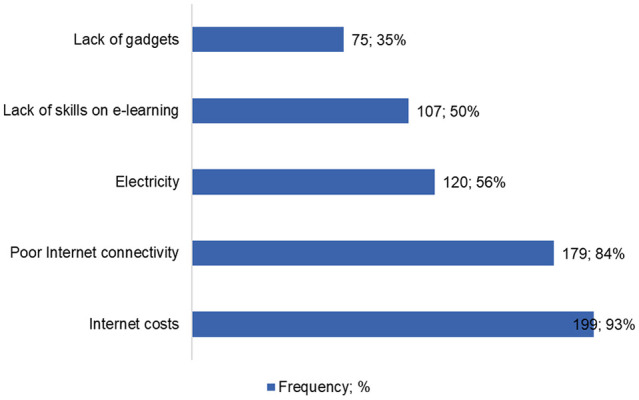
Given the dearth need for healthcare workers in the control of the ongoing COVID-19 pandemic, e-learning has been adopted in many settings to hasten the continuation of medical training. However, there is a paucity of data in low resource settings on the plausibility of online learning platforms to support medical education. We aimed to assess the awareness, attitudes, preferences, and challenges to e-learning among Bachelor of Medicine and Bachelor of Surgery (MBChB) and Bachelor of Nursing (B.NUR) students at Makerere University, Uganda. An online cross-sectional study was conducted between July and August 2020. Current MBChB and B.NUR students aged 18 years or older constituted the study population. Using Google forms, a web-based questionnaire was administered through the Makerere University mailing list and WhatsApp messenger. The questionnaire was developed using validated questions from previously published studies. Overall, 221 participants responded (response rate = 61%). Of the 214 valid responses, 195 (92.1%) were Ugandans, 123 (57.5% were male, and 165 (77.1%) were pursuing the MB ChB program. The median age was 23 (18 to 40) years. Ownership of computers, smartphones, and email addresses were at 131 (61.2%), 203 (94.9%), and 208 (97.2%), respectively. However, only 57 (26.6%) respondents had access to high or very high quality internet access. Awareness and self-reported usage of e-learning (MUELE) platforms were high among 206 (96.3%) and 177 (82.7%) respondents, respectively. However, over 50% lacked skills in using the Makerere University e-learning (MUELE) platform. About half (n = 104, 49%) of the students believed that e-learning reduces the quality of knowledge attained and is not an efficient method of teaching. Monthly income ( = .006), internet connectivity quality ( < .001), computer ownership ( = .015) and frequency of usage of academic websites or applications ( = .006) significantly affected attitudes towards e-learning. Moreover, internet costs and poor internet connectivity were the most important barriers to e-learning reported by 199 (93%) and 179 (84%) students, respectively. Sensitization and training of students and faculty on e-learning and use of existing learning platforms are important to improve the attitude and use of e-learning. Blended online and use of offline downloadable learning materials would overcome the challenges related to the variable quality of internet access in the country.
鉴于在控制当前新冠疫情过程中对医护人员的迫切需求,许多地方都采用了电子学习来加速医学培训的持续进行。然而,在资源匮乏地区,关于在线学习平台支持医学教育的可行性的数据却很少。我们旨在评估乌干达马凯雷雷大学医学学士和外科学士(MBChB)以及护理学学士(B.NUR)学生对电子学习的认知、态度、偏好和挑战。2020年7月至8月进行了一项在线横断面研究。年龄在18岁及以上的当前MBChB和B.NUR学生构成了研究人群。通过谷歌表单,通过马凯雷雷大学邮件列表和WhatsApp信使发放了一份基于网络的问卷。该问卷是使用先前发表研究中经过验证的问题编制的。总体而言,221名参与者做出了回应(回应率 = 61%)。在214份有效回复中,195人(92.1%)是乌干达人,123人(57.5%)是男性,165人(77.1%)正在攻读MBChB课程。年龄中位数为23(18至40)岁。拥有电脑、智能手机和电子邮件地址的比例分别为131人(61.2%)、203人(94.9%)和208人(97.2%)。然而,只有57人(26.6%)的受访者能够使用高质量或非常高质量的互联网。206名(96.3%)和177名(82.7%)受访者对电子学习(MUELE)平台的认知和自我报告的使用情况分别很高。然而,超过50%的人缺乏使用马凯雷雷大学电子学习(MUELE)平台的技能。约一半(n = 104,49%)的学生认为电子学习会降低所学知识的质量,且不是一种有效的教学方法。月收入(p = 0.006)、互联网连接质量(p < 0.001)、电脑拥有情况(p = 0.015)以及学术网站或应用程序的使用频率(p = 0.006)显著影响对电子学习的态度。此外,199名(93%)和179名(84%)学生分别表示,互联网费用和网络连接不佳是电子学习最重要的障碍。对学生和教师进行电子学习及现有学习平台使用方面的宣传和培训,对于改善对电子学习的态度和使用情况很重要。线上线下混合以及使用可离线下载的学习材料将克服该国互联网接入质量参差不齐带来的挑战。