Virolle Sara, Duceau Baptiste, Morawiec Elise, Fossé Quentin, Nierat Marie-Cécile, Parfait Mélodie, Decavèle Maxens, Demoule Alexandre, Delemazure Julie, Dres Martin
Service de Médecine Intensive - Réanimation-SRPR, APHP, Hôpital Pitié-Salpêtrière, Sorbonne Université, 75013, Paris, France.
Département d'Anesthésie et Réanimation Chirurgicale, APHP, Hôpital Pitié-Salpêtrière, Sorbonne Université, 75013, Paris, France.
Crit Care. 2024 Dec 18;28(1):421. doi: 10.1186/s13054-024-05172-y.
The present study was designed to investigate the evolution and the impact of respiratory muscles function and limb muscles strength on weaning success in prolonged weaning of tracheotomized patients. The primary objective was to determine whether the change in respiratory muscles function and limb muscles strength over the time is or is not associated with weaning success.
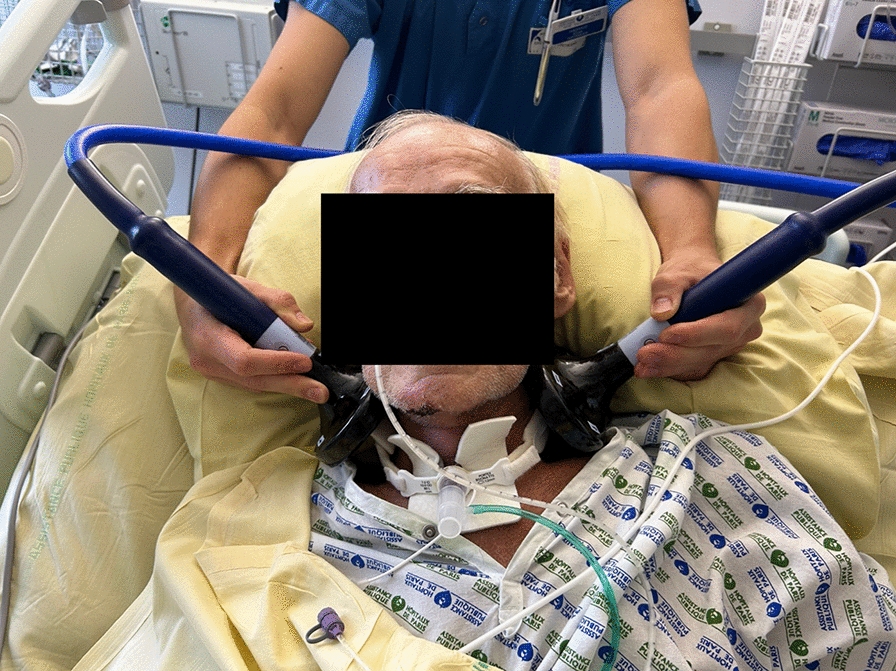
Tracheotomized patients who were ventilator dependent upon admission at a weaning center were eligible. Diaphragm function was assessed with the phrenic nerve stimulation technique and with ultrasound to measure the diaphragm thickening fraction (TFdi) and diaphragm excursion (EXdi). Global respiratory muscle function was assessed with the maximal inspiratory pressure (MIP) and the forced vital capacity (FVC). Limb muscle strength was measured with the Medical Research Council Score (MRC). Measurements were made on a weekly basis. Patients were compared according to their outcome at discharge: complete weaning, partial weaning or death.
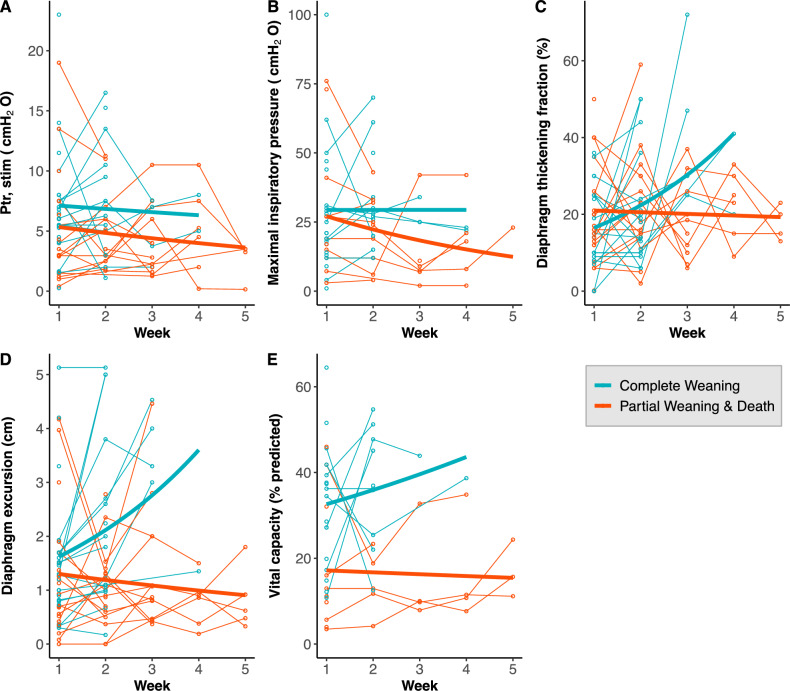
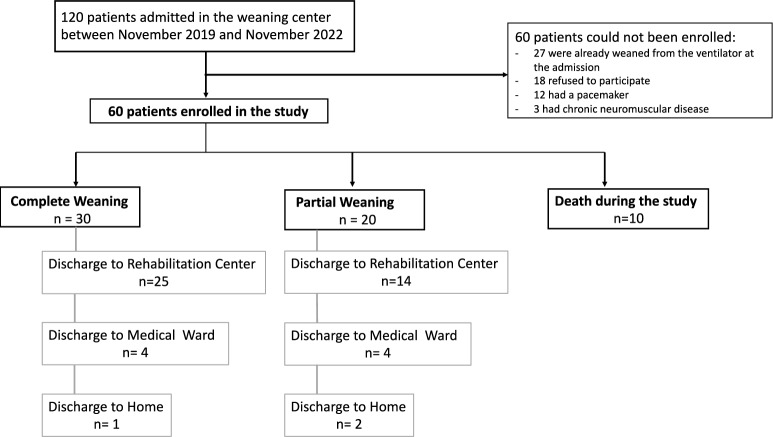
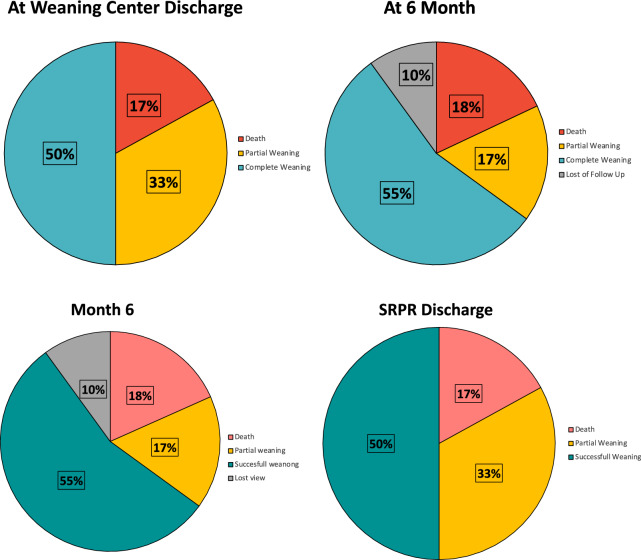
Among the 60 patients who were enrolled, 30 patients finally achieved complete weaning, 20 had partial weaning and 10 died. At 6 months, 6 patients were lost of follow-up, 33 achieved complete weaning, 10 had partial weaning and 11 died. In median, 2 (1-9) assessments were performed per patient. Diaphragm dysfunction was present in all patients with a median Ptr,stim of 5.5 cmHO (3.0-7.5). Ptr,stim, MIP, TFdi and EXdi at admission were not different between patients who achieved complete weaning and their counterparts. At discharge of the weaning center, MIP, Ptr,stim and EXdi significantly increased in patients who achieved complete weaning. The MRC score significantly increased only in patients with complete weaning. At discharge, diaphragm dysfunction was highly prevalent even in patients with complete weaning (Ptr,stim < 11 cmHO in n = 11 (37%)).
Respiratory muscle function and limb muscles strength are severely impaired in patients with prolonged weaning from mechanical ventilation. Significant improvement of diaphragm ultrasound indices was associated with successful weaning from mechanical ventilation and ICU-acquired weakness upon admission was significantly associated with good outcome suggesting that it was an amendable determinant of weaning failure in this population.
本研究旨在调查气管切开患者长期撤机过程中呼吸肌功能和肢体肌肉力量的演变及其对撤机成功的影响。主要目的是确定呼吸肌功能和肢体肌肉力量随时间的变化是否与撤机成功相关。
入选标准为入住撤机中心时依赖呼吸机的气管切开患者。采用膈神经刺激技术和超声评估膈肌功能,测量膈肌增厚分数(TFdi)和膈肌移动度(EXdi)。用最大吸气压力(MIP)和用力肺活量(FVC)评估整体呼吸肌功能。用医学研究委员会评分(MRC)测量肢体肌肉力量。每周进行一次测量。根据出院结局将患者分为:完全撤机、部分撤机或死亡。
在纳入的60例患者中,30例最终实现完全撤机,20例部分撤机,10例死亡。6个月时,6例失访,33例完全撤机,10例部分撤机,11例死亡。每位患者平均进行2(1 - 9)次评估。所有患者均存在膈肌功能障碍,Ptr,stim中位数为5.5 cmH₂O(3.0 - 7.5)。完全撤机患者与未完全撤机患者入院时的Ptr,stim、MIP、TFdi和EXdi无差异。撤机中心出院时,完全撤机患者的MIP、Ptr,stim和EXdi显著增加。仅完全撤机患者的MRC评分显著增加。出院时,即使是完全撤机患者,膈肌功能障碍也很普遍(n = 11(37%)患者的Ptr,stim < 11 cmH₂O)。
机械通气长期撤机患者的呼吸肌功能和肢体肌肉力量严重受损。膈肌超声指标的显著改善与机械通气撤机成功相关,入院时ICU获得性肌无力与良好结局显著相关,提示这是该人群撤机失败的一个可修正决定因素。