Dumbuya John Sieh, Ahmad Bashir, Zeng Cizheng, Chen Xiuling, Lu Jun
Department of Paediatrics, Affiliated Hospital of Guangdong Medical University, Zhanjiang, 524002, China.
Haikou Affiliated Hospital of Xiangya Medical College, Central South University, Haikou, 570208, China.
Health Qual Life Outcomes. 2024 Dec 19;22(1):108. doi: 10.1186/s12955-024-02324-0.
Rare diseases often entail significant challenges in clinical management and health-related quality of life (HRQoL) assessment. HRQoL assessment tools for rare diseases show substantial variability in outcomes, influenced by disease heterogeneity, intervention types, and scale characteristics. The variability in reported quality of life (QoL) improvements following interventions reflects a need to evaluate the effectiveness of HRQoL assessment tools and understand their suitability across diverse contexts.
This systematic review aims to analyse the effectiveness of various assessment scales in evaluating QoL and explores the general trends observed in the studies using the same and different assessment scales on rare diseases.
A comprehensive literature search was conducted across various databases to identify studies that reported QoL outcomes related to interventions for rare diseases. Search terms included various synonyms, and both the generic and specific terms related to rare diseases and QoL. Key variables, including intervention types, patient demographics, study design, and geographical factors, were analysed to determine their role in influencing the reported HRQoL outcomes. The findings were then compared with existing literature to identify consistent patterns and discrepancies.
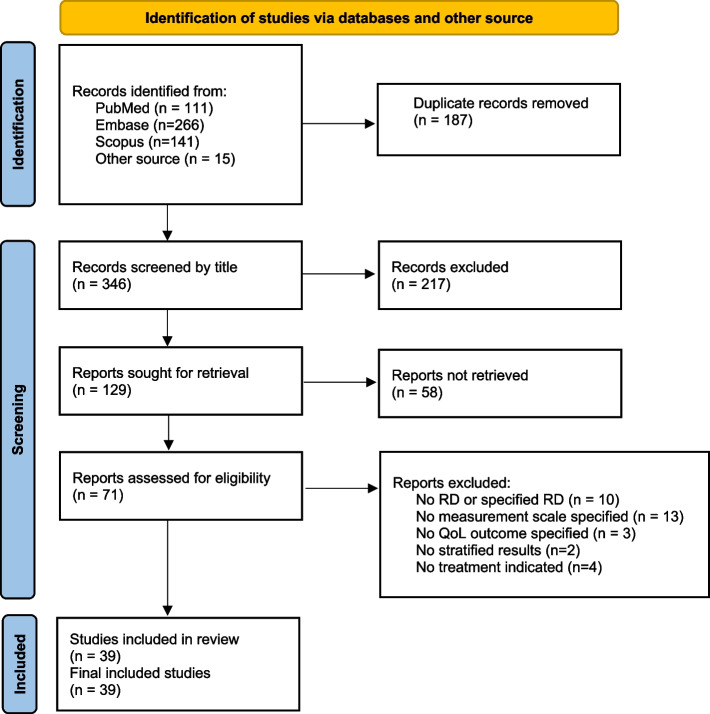
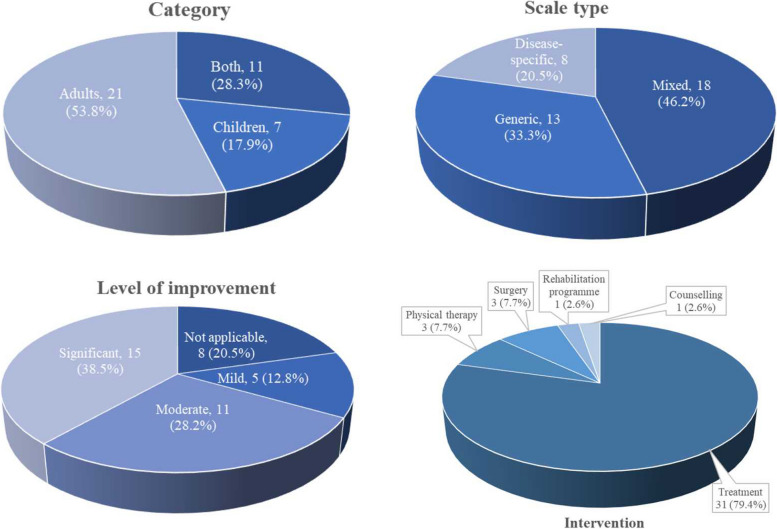
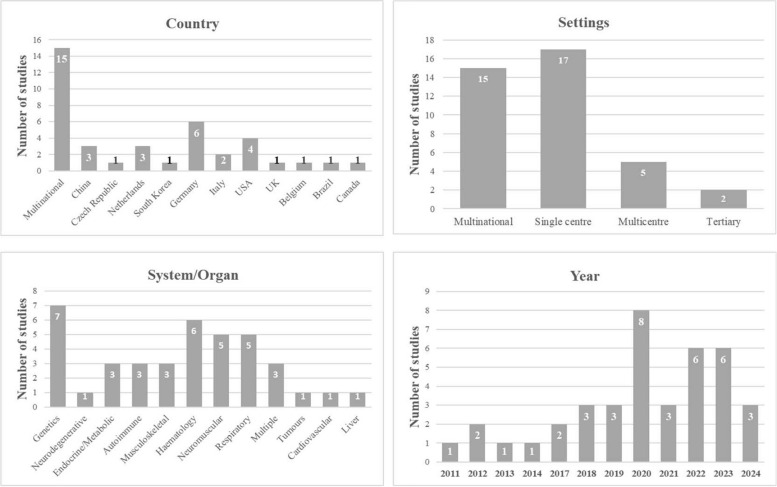
A total of 39 studies were included, comprising randomised controlled trials, observational studies, and cohort studies, with 4737 participants. Significant variations were observed in QoL improvements across studies, even when using the same assessment scales. These differences were primarily attributed to the heterogeneity in disease severity, intervention types, and patient characteristics. Studies employing disease-specific scales reported more nuanced outcomes than generic ones. Additionally, methodological differences, including study design and intervention type, contributed to variations in results and geographical factors influencing patients' perceptions of health and well-being.
The reported differences in QoL outcomes across studies can be explained by a combination of factors, including disease heterogeneity, treatment modalities, patient demographics, and assessment scale characteristics. These findings underscore the importance of selecting appropriate HRQoL assessment tools based on the research context and patient population. For more accurate comparisons across studies, it is crucial to consider these factors alongside consistent methodology and cultural adaptability of scales. Future research should focus on developing standardised guidelines for QoL assessments that accommodate the diverse needs of patients with rare diseases.
罕见病在临床管理和健康相关生活质量(HRQoL)评估方面往往带来重大挑战。用于罕见病的HRQoL评估工具在结果上显示出很大的变异性,这受到疾病异质性、干预类型和量表特征的影响。干预后报告的生活质量(QoL)改善情况的变异性反映出需要评估HRQoL评估工具的有效性,并了解它们在不同背景下的适用性。
本系统评价旨在分析各种评估量表在评估QoL方面的有效性,并探讨在使用相同和不同评估量表研究罕见病时观察到的总体趋势。
在各种数据库中进行了全面的文献检索,以识别报告与罕见病干预相关的QoL结果的研究。检索词包括各种同义词,以及与罕见病和QoL相关的通用术语和特定术语。分析关键变量,包括干预类型、患者人口统计学特征、研究设计和地理因素,以确定它们在影响报告的HRQoL结果中的作用。然后将研究结果与现有文献进行比较,以识别一致的模式和差异。
共纳入39项研究,包括随机对照试验、观察性研究和队列研究,涉及4737名参与者。即使使用相同的评估量表,各研究在QoL改善方面也观察到显著差异。这些差异主要归因于疾病严重程度、干预类型和患者特征的异质性。采用疾病特异性量表的研究报告的结果比通用量表更细微。此外,方法学差异,包括研究设计和干预类型,以及影响患者健康和幸福感认知的地理因素,都导致了结果的差异。
各研究报告的QoL结果差异可由多种因素综合解释,包括疾病异质性、治疗方式、患者人口统计学特征和评估量表特征。这些发现强调了根据研究背景和患者群体选择合适的HRQoL评估工具的重要性。为了在各研究之间进行更准确的比较,除了量表的一致方法学和文化适应性外,考虑这些因素至关重要。未来的研究应专注于制定适应罕见病患者多样化需求的QoL评估标准化指南。