Morneau-Vaillancourt Geneviève, Palaiologou Elisavet, Polderman Tinca J C, Eley Thalia C
Social, Genetic & Developmental Psychiatry Centre, Institute of Psychiatry, Psychology & Neuroscience, King's College London, London, UK.
Department of Clinical Developmental Psychology, Vrije Universiteit, Amsterdam, The Netherlands.
J Child Psychol Psychiatry. 2025 Jun;66(6):910-927. doi: 10.1111/jcpp.14099. Epub 2024 Dec 19.
Mental health problems and traits capturing psychopathology are common and often begin during adolescence. Decades of twin studies indicate that genetic factors explain around 50% of individual differences in adolescent psychopathology. In recent years, significant advances, particularly in genomics, have moved this work towards more translational findings.
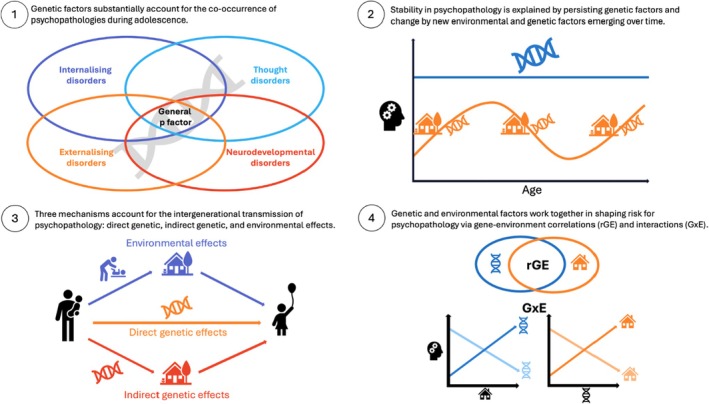
This review provides an overview of the past decade of genetically sensitive studies on adolescent development, covering both family and genomic studies in adolescents aged 10-24 years. We focus on five research themes: (1) co-occurrence or comorbidity between psychopathologies, (2) stability and change over time, (3) intergenerational transmission, (4) gene-environment interplay, and (5) psychological treatment outcomes.
First, research shows that much of the co-occurrence of psychopathologies in adolescence is explained by genetic factors, with widespread pleiotropic influences on many traits. Second, stability in psychopathology across adolescence is largely explained by persistent genetic influences, whereas change is explained by emerging genetic and environmental influences. Third, contemporary twin-family studies suggest that different co-occurring genetic and environmental mechanisms may account for the intergenerational transmission of psychopathology, with some differences across psychopathologies. Fourth, genetic influences on adolescent psychopathology are correlated with a wide range of environmental exposures. However, the extent to which genetic factors interact with the environment remains unclear, as findings from both twin and genomic studies are inconsistent. Finally, a few studies suggest that genetic factors may play a role in psychological treatment response, but these findings have not yet been replicated.
Genetically sensitive research on adolescent psychopathology has progressed significantly in the past decade, with family and twin findings starting to be replicated at the genomic level. However, important gaps remain in the literature, and we conclude by providing suggestions of research questions that still need to be addressed.
心理健康问题以及反映精神病理学的特质很常见,且往往始于青春期。数十年的双胞胎研究表明,遗传因素约占青少年精神病理学个体差异的50%。近年来,尤其是在基因组学方面取得了重大进展,推动这项工作朝着更具转化性的研究成果发展。
本综述概述了过去十年对青少年发育的遗传敏感性研究,涵盖了10至24岁青少年的家庭研究和基因组研究。我们关注五个研究主题:(1)精神病理学之间的共现或共病,(2)随时间的稳定性和变化,(3)代际传递,(4)基因-环境相互作用,以及(5)心理治疗结果。
首先,研究表明,青少年精神病理学的许多共现现象是由遗传因素造成的,对许多特质具有广泛的多效性影响。其次,整个青春期精神病理学的稳定性在很大程度上是由持续的遗传影响所解释的,而变化则是由新出现的遗传和环境影响所解释的。第三,当代双胞胎家庭研究表明,不同的共现遗传和环境机制可能解释了精神病理学的代际传递,不同精神病理学之间存在一些差异。第四,遗传因素对青少年精神病理学的影响与广泛的环境暴露相关。然而,基因因素与环境相互作用的程度仍不清楚,因为双胞胎研究和基因组研究的结果并不一致。最后,一些研究表明,遗传因素可能在心理治疗反应中起作用,但这些发现尚未得到重复验证。
在过去十年中,对青少年精神病理学的遗传敏感性研究取得了显著进展,家庭研究和双胞胎研究的结果开始在基因组水平上得到重复验证。然而,文献中仍存在重要空白,我们通过提出仍需解决的研究问题的建议来结束本文。