Waszczuk Monika A, Zavos Helena M S, Eley Thalia C
Department of Psychiatry, Stony Brook University, Stony Brook, NY, USA.
Department of Psychology, Institute of Psychiatry, Psychology and Neuroscience, King's College London, London, UK.
Eur Child Adolesc Psychiatry. 2021 Jul;30(7):1013-1025. doi: 10.1007/s00787-020-01515-6. Epub 2020 Apr 6.
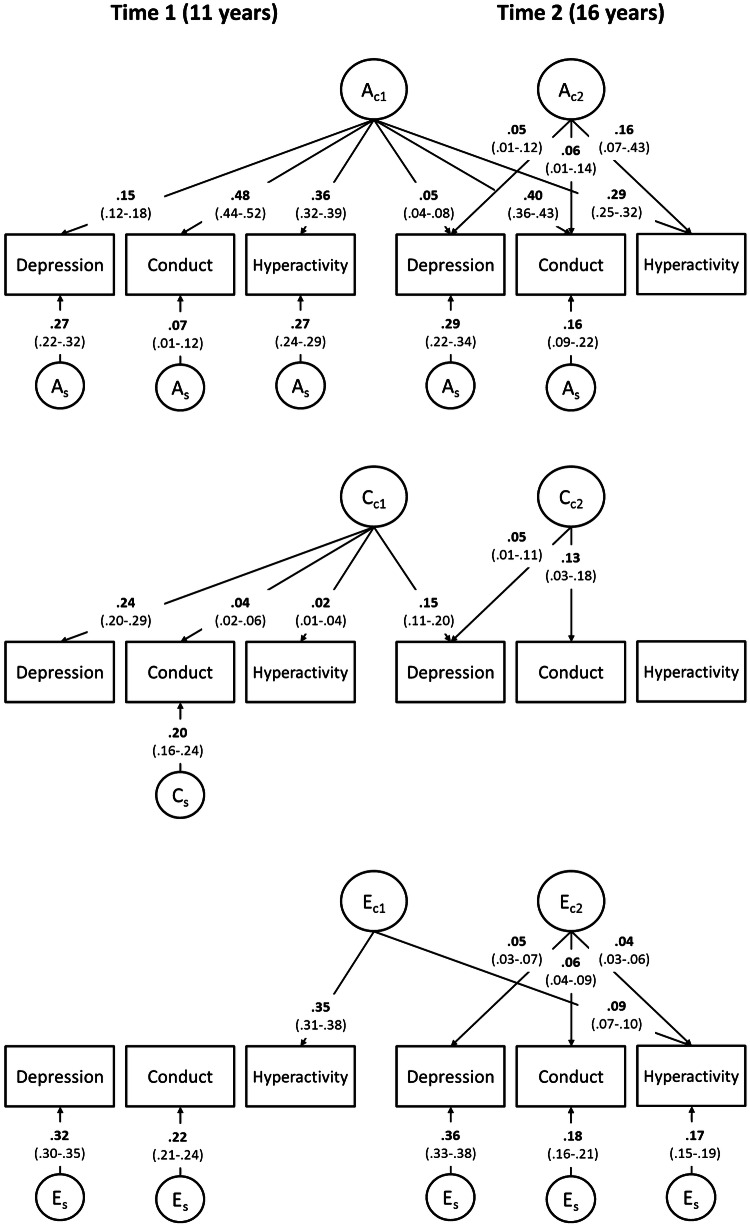
Depression, conduct, and hyperactivity symptoms are chronic and frequently co-occur in adolescence. Common genetic and environmental vulnerability to these conditions have previously been demonstrated, however, the manner in which common versus disorder-specific etiological influences operate across development and maintain symptom co-occurrence is unclear. Thus, the current study investigated the role of common genetic and environmental influences in the comorbidity of depression, conduct, and hyperactivity across adolescence. Over 10,000 twins and their parents reported adolescents' symptoms at mean ages 11 and 16 years. Biometric independent pathway models were fitted to estimate genetic and environmental contributions to the continuity of symptom co-occurrence over time, as well as time- and symptom-specific influences. Results found that a common stable genetic factor accounted for the concurrent and longitudinal co-occurrence of depression, conduct, and hyperactivity symptoms. New genetic influences common to these three symptom scales emerged at 16 years, and further contributed to symptom co-occurrence. Conversely, environmental influences largely contributed to the time-specific associations. The findings were generally consistent for self- and parent-reported symptoms. Overall, the results suggest that stable, overlapping genetic influences contribute to the co-occurrence of depression, conduct, and hyperactivity symptoms across adolescence. The results are in line with hierarchical causal models of psychopathology, which posit that much of the developmental co-occurrence between different symptoms is due to common liability. Specifically, current findings indicate that only genetic influences constitute common liability over time. Future studies should identify genetically influenced transdiagnostic risk and maintenance factors to inform prevention and treatment of comorbid internalizing and externalizing symptoms in adolescence.
抑郁、品行和多动症状具有慢性特点,且在青少年时期经常同时出现。先前已证明这些情况存在共同的遗传和环境易感性,然而,常见病因与特定障碍病因影响在整个发育过程中的作用方式以及维持症状共现的机制尚不清楚。因此,本研究调查了共同的遗传和环境影响在青少年抑郁、品行和多动共病中的作用。超过10000对双胞胎及其父母报告了青少年在平均11岁和16岁时的症状。采用生物统计学独立路径模型来估计遗传和环境对症状共现随时间连续性的影响,以及特定时间和症状的影响。结果发现,一个共同的稳定遗传因素解释了抑郁、品行和多动症状的同时出现及纵向共现。这三个症状量表共有的新遗传影响在16岁时出现,并进一步促成了症状共现。相反,环境影响在很大程度上促成了特定时间的关联。自我报告和父母报告的症状结果总体一致。总体而言,结果表明稳定、重叠的遗传影响促成了青少年期抑郁、品行和多动症状的共现。这些结果与精神病理学的层次因果模型一致,该模型假定不同症状之间的许多发育共现是由于共同易感性。具体而言,目前的研究结果表明,随着时间推移,只有遗传影响构成共同易感性。未来的研究应确定受遗传影响的跨诊断风险和维持因素,为青少年共病内化和外化症状的预防和治疗提供依据。