Zhang Lifang, Liu Ying, Han Di, Wang Yan, Geng Fanqi, Ding Wei, Zhang Xuejuan
Department of General Medicine, The Affiliated Hospital of Qingdao University, Qingdao, China.
Department of Infectious Disease, The Affiliated Hospital of Qingdao University, Qingdao, China.
Front Oncol. 2024 Dec 4;14:1463805. doi: 10.3389/fonc.2024.1463805. eCollection 2024.
Heart rate variability (HRV) is an important marker of autonomic nervous system function and cardiovascular health. Holter monitoring is a crucial method for evaluating HRV, but the procedure and result analysis are relatively complex. This study aims to develop a simplified diagnostic index for predicting HRV decline in newly diagnosed non-small cell lung cancer (NSCLC) patients and evaluate its prognostic value.
This retrospective cross-sectional study included 131 newly diagnosed NSCLC patients. Baseline characteristics were compared between normal HRV group and declined HRV group. Univariate and multivariate logistic regression analyses identified significant predictors of HRV decline. A diagnostic index was developed based on resting heart rate (RHR), serum sodium, and interleukin-6 (IL-6) and externally validated. Kaplan-Meier survival analysis assessed the prognostic value of the index.
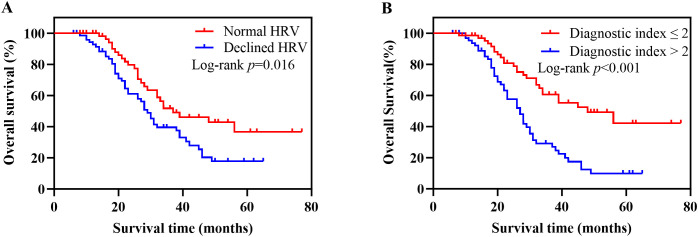
Patients with declined HRV had higher median RHR (84 b.p.m. vs. 70 b.p.m., < 0.001), lower serum sodium (136.3 mmol/L vs. 138.7 mmol/L, < 0.001), lower serum albumin (39 g/L vs. 41 g/L, = 0.031), higher lactate dehydrogenase (LDH) (202 U/L vs. 182 U/L, = 0.010), and higher IL-6 (11.42 pg/ml vs. 5.67 pg/ml, < 0.001). Multivariate analysis identified RHR (OR = 3.143, = 0.034), serum sodium (OR = 6.806, < 0.001), and IL-6 (OR = 3.203, = 0.033) as independent predictors of HRV decline. The diagnostic index, with an area under the curve (AUC) of 0.849, effectively predicted HRV decline. ROC analysis of the external validation data demonstrated an AUC of 0.788. Survival analysis showed that patients with a diagnostic index > 2 had significantly worse overall survival (log-rank < 0.001).
The study identified key clinical parameters that predict HRV decline in newly diagnosed NSCLC patients. The developed diagnostic index, based on RHR, serum sodium, and IL-6, effectively stratifies patients by HRV status and has significant prognostic value, aiding in early identification and management of high-risk patients.
心率变异性(HRV)是自主神经系统功能和心血管健康的重要标志物。动态心电图监测是评估HRV的关键方法,但操作过程和结果分析相对复杂。本研究旨在建立一个简化的诊断指标,用于预测新诊断的非小细胞肺癌(NSCLC)患者的HRV下降情况,并评估其预后价值。
这项回顾性横断面研究纳入了131例新诊断的NSCLC患者。比较了HRV正常组和HRV下降组的基线特征。单因素和多因素逻辑回归分析确定了HRV下降的显著预测因素。基于静息心率(RHR)、血清钠和白细胞介素-6(IL-6)建立了一个诊断指标并进行外部验证。Kaplan-Meier生存分析评估了该指标的预后价值。
HRV下降的患者中位RHR较高(84次/分钟对70次/分钟,<0.001),血清钠较低(136.3 mmol/L对138.7 mmol/L,<0.001),血清白蛋白较低(39 g/L对41 g/L,=0.031),乳酸脱氢酶(LDH)较高(202 U/L对182 U/L,=0.010),IL-6较高(11.42 pg/ml对5.67 pg/ml,<0.001)。多因素分析确定RHR(OR = 3.143,=0.034)、血清钠(OR = 6.806,<0.001)和IL-6(OR = 3.203,=0.033)是HRV下降的独立预测因素。该诊断指标的曲线下面积(AUC)为0.849,能有效预测HRV下降情况。外部验证数据的ROC分析显示AUC为0.788。生存分析表明,诊断指标>2的患者总生存期明显较差(对数秩检验<0.001)。
本研究确定了预测新诊断NSCLC患者HRV下降的关键临床参数。基于RHR、血清钠和IL-6建立的诊断指标能有效根据HRV状态对患者进行分层,具有显著的预后价值,有助于早期识别和管理高危患者。