Clinical Medical College, Weifang Medical University, Weifang, China.
Linyi People's Hospital, Linyi, China.
Mediators Inflamm. 2021 Oct 29;2021:2910892. doi: 10.1155/2021/2910892. eCollection 2021.
As a parameter integrating platelet (P), neutrophil (N), and lymphocyte (L) levels, the systemic immune-inflammation index (SII) has been used as a prognostic marker for patient survival in various types of solid malignant tumors. However, there is no in-depth study in non-small-cell lung cancer (NSCLC) patients with brain metastases after stereotactic radiotherapy. Therefore, we performed a retrospective analysis to determine the clinical and prognostic value of the SII in NSCLC patients with brain metastases who underwent stereotactic radiotherapy.
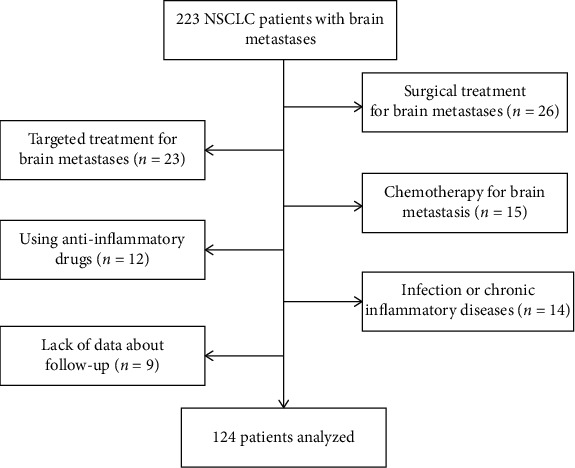
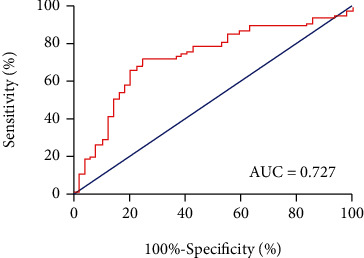
We enrolled 124 NSCLC patients with brain metastases treated with stereotactic radiotherapy in our hospital between May 2015 and June 2018. We obtained all baseline blood samples within one week prior to stereotactic radiotherapy. The SII was calculated by the following formula: neutrophil counts × platelet counts/lymphocyte counts. The optimal cutoff value of the SII for predicting prognosis was assessed by receiver operating characteristic (ROC) curves with the maximum log-rank values. The discriminative ability of predicting prognosis was calculated and compared using the Kaplan-Meier method and log-rank test. The hazard ratio (HR) and 95% confidence interval (CI) were combined to evaluate the prognostic impact of the blood index on overall survival (OS) and progression-free survival (PFS). Only those parameters that proved to be associated with statistically significant differences in clinical outcomes were compared in multivariate analysis using a multiple Cox proportional hazard regression model to identify independent prognostic factors.
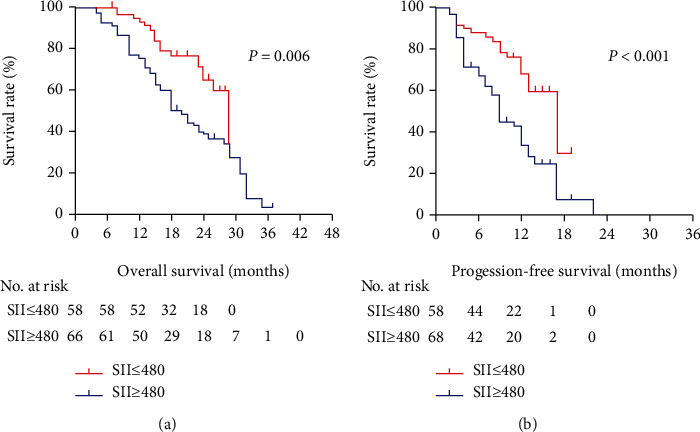
Of the total enrolled patients, 53.2% and 46.8% have high SII and low SII, respectively. In this study, Kaplan-Meier curve analysis revealed that the median PFS was 9 months (range: 2-22 months) and the median OS was 18 months (range: 4-37 months). Applying an optimal cutoff of 480 (SII), the median PFS was better in the low SII group patients (11.5 vs. 9 months), and the median OS was significantly longer in the low SII group patients (20 vs. 18 months). A SII > 480 was significantly associated with worse OS (HR: 2.196; 95% CI 1.259-3.832; = 0.006) and PFS (HR: 2.471; 95% CI 1.488-4.104; < 0.001) according to univariate analysis. In multivariate analysis, only age (HR: 2.159; 95% CI 1.205-3.869; = 0.010), KPS (HR: 1.887; 95% CI 1.114-3.198; = 0.018), and SII (HR: 1.938; 95% CI 1.046-3.589; = 0.035) were independently correlated with OS, and SII (HR: 2.224; 95% CI 1.298-3.810; = 0.004) was an independent prognostic predictor of PFS, whereas we found that other inflammation-based indices lost their independent value.
The SII, which is an integrated blood parameter based on platelet, neutrophil, and lymphocyte counts, may be an independent prognostic indicator and may be useful for the identification of NSCLC patients with brain metastases after stereotactic radiotherapy at high risk for recurrence.
作为血小板(P)、中性粒细胞(N)和淋巴细胞(L)水平的综合参数,全身免疫炎症指数(SII)已被用作各种实体恶性肿瘤患者生存的预后标志物。然而,在接受立体定向放疗的非小细胞肺癌(NSCLC)伴脑转移患者中,尚无深入研究。因此,我们进行了一项回顾性分析,以确定 SII 在接受立体定向放疗的 NSCLC 伴脑转移患者中的临床和预后价值。
我们纳入了我院 2015 年 5 月至 2018 年 6 月期间接受立体定向放疗的 124 例 NSCLC 伴脑转移患者。我们在立体定向放疗前一周内获得了所有基线血液样本。SII 通过以下公式计算:中性粒细胞计数×血小板计数/淋巴细胞计数。通过最大对数秩检验评估 ROC 曲线评估 SII 预测预后的最佳截断值。使用 Kaplan-Meier 方法和对数秩检验比较预测预后的判别能力。风险比(HR)和 95%置信区间(CI)用于评估血液指数对总生存(OS)和无进展生存(PFS)的预后影响。仅在多变量分析中,使用多因素 Cox 比例风险回归模型比较与临床结局显著相关的参数,以确定独立的预后因素。
在总入组患者中,53.2%和 46.8%的患者 SII 较高和较低,分别。在本研究中,Kaplan-Meier 曲线分析显示中位 PFS 为 9 个月(范围:2-22 个月),中位 OS 为 18 个月(范围:4-37 个月)。应用最佳截断值 480(SII),低 SII 组患者的中位 PFS 更好(11.5 个月比 9 个月),低 SII 组患者的中位 OS 显著更长(20 个月比 18 个月)。SII > 480 与 OS 较差显著相关(HR:2.196;95%CI 1.259-3.832; = 0.006)和 PFS(HR:2.471;95%CI 1.488-4.104; < 0.001)根据单因素分析。在多因素分析中,仅年龄(HR:2.159;95%CI 1.205-3.869; = 0.010)、KPS(HR:1.887;95%CI 1.114-3.198; = 0.018)和 SII(HR:1.938;95%CI 1.046-3.589; = 0.035)与 OS 相关,SII(HR:2.224;95%CI 1.298-3.810; = 0.004)是 PFS 的独立预后预测因子,而我们发现其他炎症相关指数失去了其独立价值。
SII 是一种基于血小板、中性粒细胞和淋巴细胞计数的综合血液参数,可能是一种独立的预后指标,对于识别接受立体定向放疗的 NSCLC 伴脑转移患者的复发高风险可能有用。