Zhou Yan-Bang, Zhang Kun, Zhai Hong-Kun, Bao Qing, Xiao Shanshan, Dang Junhua
Institute of Teacher Education, Ningxia University, Yinchuan, China.
Faculty of Education, Tianjin Normal University, Tianjin, China.
Front Psychol. 2024 Dec 4;15:1423615. doi: 10.3389/fpsyg.2024.1423615. eCollection 2024.
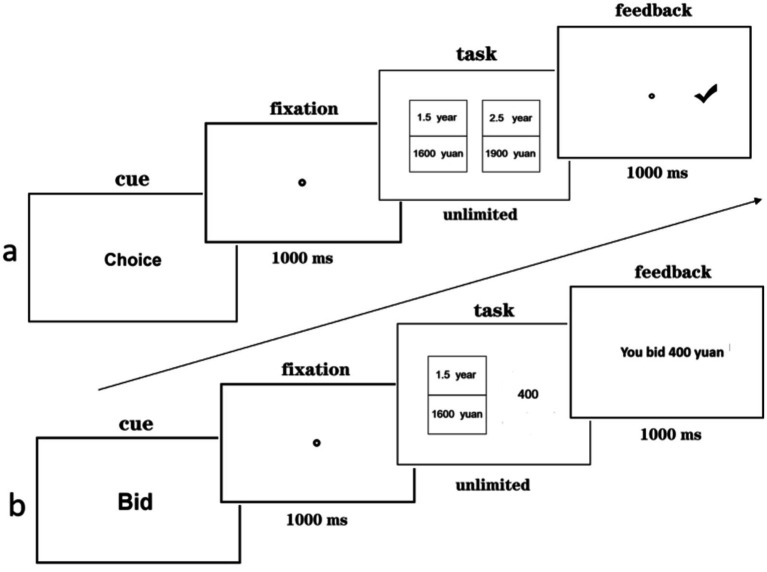
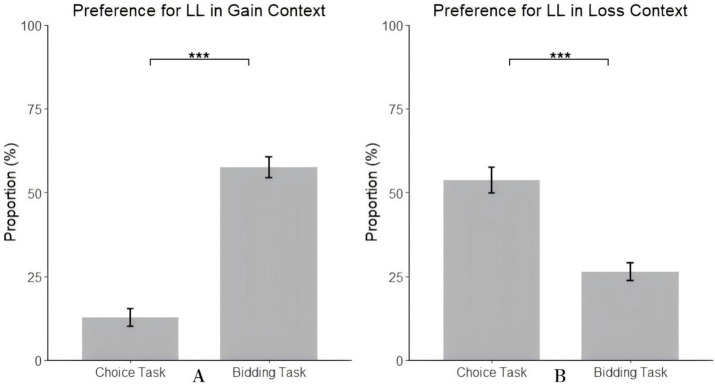
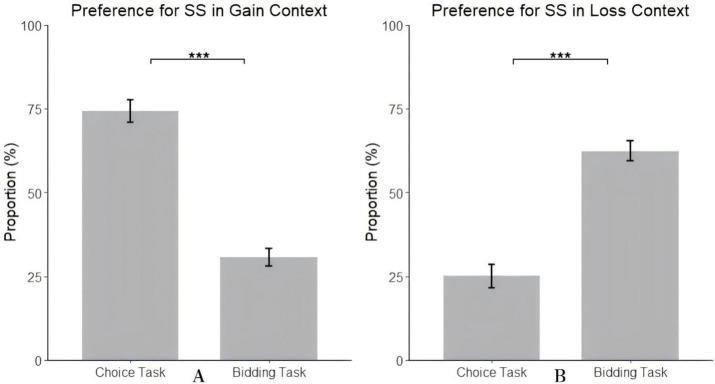
This study examines asymmetric preference reversals in intertemporal decision-making by comparing gain and loss contexts across choice and bidding tasks. In the gain context, participants preferred smaller, sooner (SS) rewards in choice tasks but assigned higher valuations to larger, later (LL) rewards in bidding tasks. Conversely, in the loss context, they showed a preference for LL options in choice tasks but provided lower bids for SS options. Bidding tasks consistently required longer decision times than choice tasks, indicating greater cognitive demands during valuation processes. A real-world questionnaire involving 370 participants validated these findings across economic and health-related scenarios. These results underscore the role of task formats in shaping preferences, offering practical insights for refining strategies in behavioral decision-making and applied contexts.
本研究通过比较选择任务和出价任务中的收益与损失情境,考察了跨期决策中的非对称偏好反转。在收益情境中,参与者在选择任务中偏好较小、较早(SS)的奖励,但在出价任务中对较大、较晚(LL)的奖励赋予更高的估值。相反,在损失情境中,他们在选择任务中表现出对LL选项的偏好,但对SS选项的出价较低。出价任务始终比选择任务需要更长的决策时间,这表明在估值过程中认知需求更大。一项涉及370名参与者的现实世界问卷调查在经济和健康相关情境中验证了这些发现。这些结果强调了任务形式在塑造偏好方面的作用,为优化行为决策和应用情境中的策略提供了实际见解。