Di Giulio Simona, Carata Elisabetta, Muci Marco, Mariano Stefania, Panzarini Elisa
Department of Biological Sciences and Technologies (Di.S.Te.B.A.), University of Salento, Lecce 73100, Italy.
Extracell Vesicles Circ Nucl Acids. 2024 Jan 11;5(1):1-15. doi: 10.20517/evcna.2023.52. eCollection 2024.
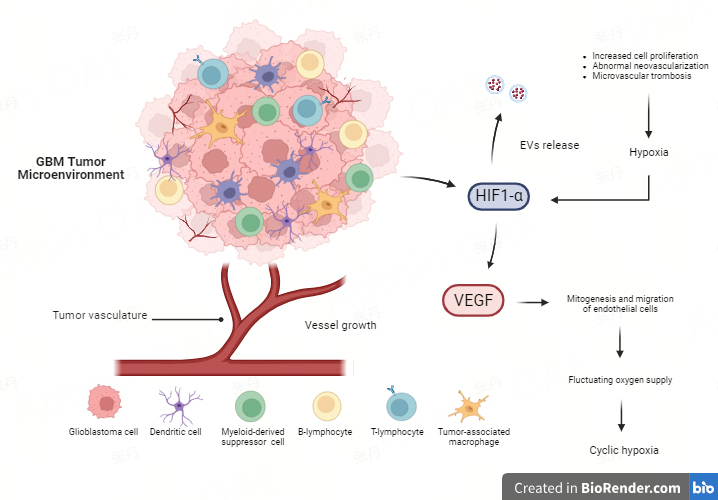
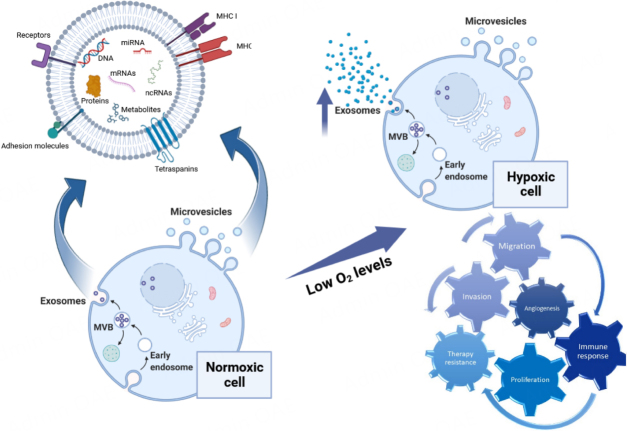
Hypoxia is a pathologic condition characterized by a tissue oxygen deficiency due to either decreased oxygen intake from outside and/or disruption of oxygen utilization in cells. This condition may arise when the oxygen demand exceeds its supply or the partial pressure of oxygen is below 10 mmHg. This situation poses a significant problem for glioblastoma (GBM) patients as it can activate angiogenesis, increase invasiveness and metastatic risk, prolong tumor survival, and suppress anti-tumor immunity, making hypoxic cells resistant to radiotherapy and chemotherapy. Low oxygen levels in tumors can cause severe cellular changes that can affect the release of extracellular vesicles (EVs), especially exosomes (EXOs), altering their proteomic profile both qualitatively and quantitatively. EXOs represent an adaptive response to hypoxic stress; therefore, they can be used to determine oxygen levels in cancer and assess its aggressiveness. They not only release signaling molecules to attract cells that promote the formation of small vessel walls but also send signals to other tumor cells that trigger their migration, which in turn plays a crucial role in the formation of metastases under hypoxia. This review investigates how the molecular profile of GBM-derived exosomes changes under hypoxic conditions, offering future possibilities for noninvasive diagnosis and monitoring of brain tumor patients.
缺氧是一种病理状态,其特征是由于外部氧气摄入减少和/或细胞内氧气利用中断导致组织缺氧。当氧气需求超过供应或氧分压低于10 mmHg时,就可能出现这种情况。这种情况给胶质母细胞瘤(GBM)患者带来了重大问题,因为它会激活血管生成、增加侵袭性和转移风险、延长肿瘤生存期并抑制抗肿瘤免疫力,使缺氧细胞对放疗和化疗产生抗性。肿瘤中的低氧水平会导致严重的细胞变化,从而影响细胞外囊泡(EVs),尤其是外泌体(EXOs)的释放,在质量和数量上改变其蛋白质组学特征。外泌体代表了对缺氧应激的一种适应性反应;因此,它们可用于确定癌症中的氧水平并评估其侵袭性。它们不仅释放信号分子来吸引促进小血管壁形成的细胞,还向其他肿瘤细胞发送信号以触发其迁移,这反过来在缺氧条件下转移的形成中起着关键作用。本综述研究了缺氧条件下GBM来源的外泌体的分子特征如何变化,为脑肿瘤患者的无创诊断和监测提供了未来的可能性。