Lin Yingyu, Lin Qingyu, Huang Li, Wang Jifei, Ma Ruixia, Liu Jiawei, Feng Shi-Ting, Cai Huasong, Li Yin, Dong Zhi
Department of Radiology, The First Affiliated Hospital, Sun Yat-sen University, Guangzhou, China.
Department of Gastrointestinal Surgery, The First Affiliated Hospital, Sun Yat-sen University, Guangzhou, China.
Quant Imaging Med Surg. 2024 Dec 5;14(12):9589-9599. doi: 10.21037/qims-24-34. Epub 2024 Oct 18.
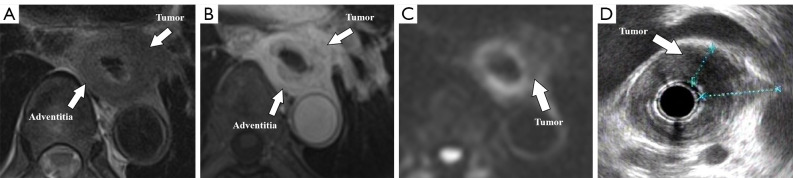
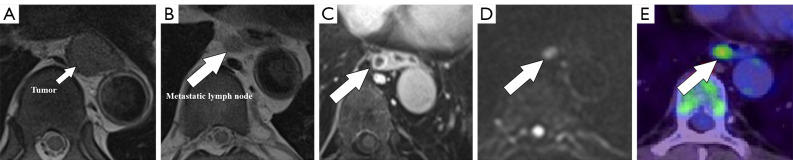
Esophageal cancer (EC) is an aggressive disease characterized by high mortality rates and a propensity for locoregional or distant recurrence. The treatment strategies and prognostic estimation for EC depend on accurate pre-treatment tumor-node-metastasis (TNM) staging. The objective of this review was to illustrate the role of various imaging modalities in achieving accurate preoperative TNM staging of EC, with a particular focus on the utilization of advanced high-resolution magnetic resonance imaging (MRI) sequences for T classification, which have shown promise in enhancing the delineation of tumor depth and extent.
A comprehensive literature search was conducted in PubMed and Web of Science databases. The studies on imaging in preoperative TNM staging of EC published in English from inception of these databases to December 31, 2022 were reviewed.
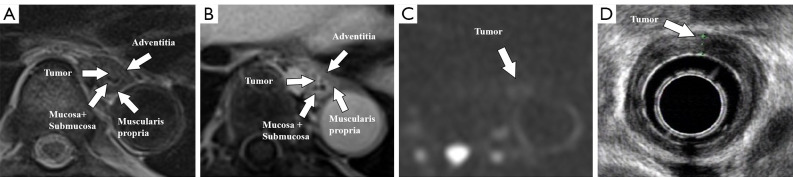
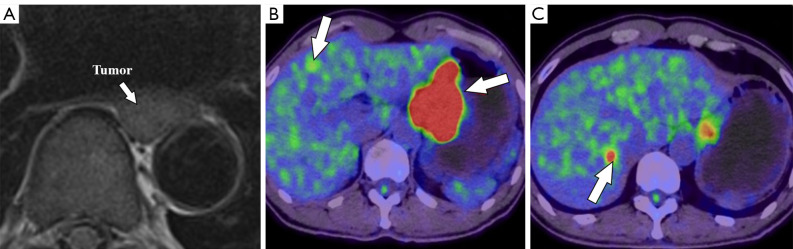
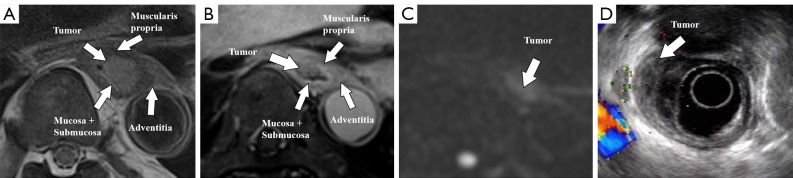
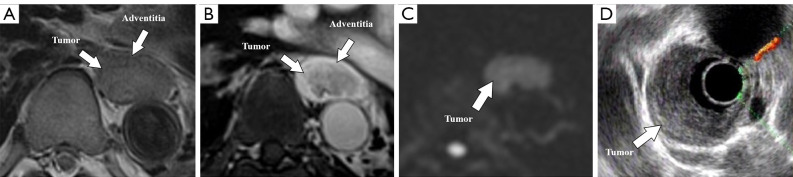
The review highlights the distinct advantages and inherent limitations of different imaging modalities for the preoperative staging of EC. Endoscopic ultrasound (EUS) provides real-time, high-resolution imaging of the esophageal wall but is operator-dependent. Computed tomography (CT) is widely available and non-invasive, but it may lack sensitivity for early T-stage identification. Positron emission tomography (PET)/CT offers accurate assessment of distant metastasis but has limited value in the evaluation of early-stage tumors. With improved techniques, MRI is particularly useful for visualization of tumor infiltration and the surrounding anatomical structures, gaining prominence in preoperative staging of EC.
Various imaging modalities including EUS, CT, PET/CT, and MRI should be applied as complementary methods for preoperative TNM staging of EC. Notably, high-resolution MRI can overcome motion-related artifacts and provide high-quality images, which may play a more important role in the management of EC in the future.
食管癌(EC)是一种侵袭性疾病,其特点是死亡率高,且易发生局部区域或远处复发。食管癌的治疗策略和预后评估取决于准确的术前肿瘤-淋巴结-转移(TNM)分期。本综述的目的是阐述各种成像方式在实现食管癌准确术前TNM分期中的作用,特别关注先进的高分辨率磁共振成像(MRI)序列在T分期中的应用,这些序列在增强肿瘤深度和范围的描绘方面已显示出前景。
在PubMed和Web of Science数据库中进行了全面的文献检索。对从这些数据库建立之初至2022年12月31日以英文发表的关于食管癌术前TNM分期成像的研究进行了综述。
本综述强调了不同成像方式在食管癌术前分期中的独特优势和固有局限性。内镜超声(EUS)可提供食管壁的实时高分辨率成像,但依赖操作者。计算机断层扫描(CT)广泛可用且无创,但对早期T分期的识别可能缺乏敏感性。正电子发射断层扫描(PET)/CT能准确评估远处转移,但在早期肿瘤评估中的价值有限。随着技术的改进,MRI对肿瘤浸润和周围解剖结构的可视化特别有用,在食管癌术前分期中日益突出。
包括EUS、CT、PET/CT和MRI在内的各种成像方式应作为食管癌术前TNM分期的补充方法应用。值得注意的是,高分辨率MRI可克服与运动相关的伪影并提供高质量图像,未来可能在食管癌的管理中发挥更重要的作用。