Huang Bei, Yang Longtao, Liu Fengrong, Gou Shizhen, Liu Jun
Department of Radiology, The Second Xiangya Hospital of Central South University, Changsha, China.
Department of Anesthesiology, The Second Xiangya Hospital, Central South University, Changsha, China.
Quant Imaging Med Surg. 2024 Dec 5;14(12):9220-9233. doi: 10.21037/qims-24-318. Epub 2024 Nov 14.
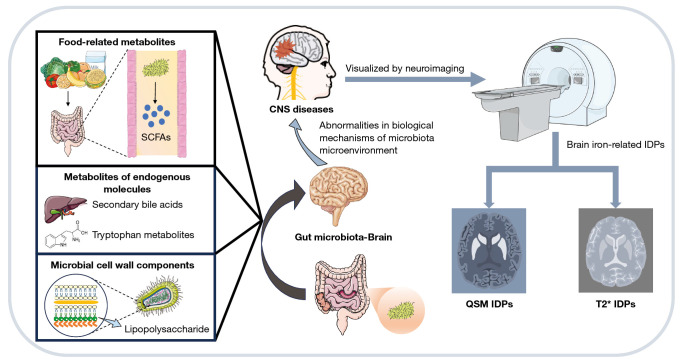
Gut microbiota are associated with brain imaging-derived phenotypes (IDPs); however, the specific causal relationship between the gut microbiota and brain iron-related IDPs remains unclear. Thus, we sought to analyze the potential causal effects of gut microbiota on brain iron-related IDPs using Mendelian randomization (MR).
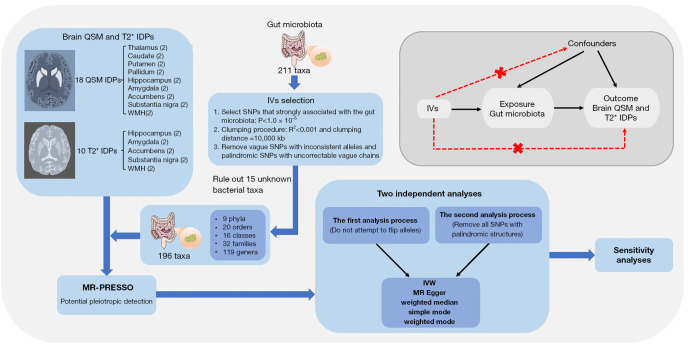
We obtained the data of 196 gut microbiota from a genome-wide association study (GWAS) from the MiBioGen database, as well as the data of 18 quantitative susceptibility mapping (QSM) IDPs and 10 T2* IDPs from the United Kingdom Biobank (UKB). We then conducted one-way two-sample MR analyses to examine their causal interactions. To guarantee the robustness of the results, we performed two independent analysis processes by selecting statistically significant instrumental variables (IVs) with a distinct level of statistical strictness, and derived the intersection of these two analyses.
Our results showed that the genus Howardella was positively correlated with the median susceptibility in the right caudate [β: 0.0935, 95% confidence interval (CI): 0.0601, 0.1269, P=4.00E-08]; the genus Dialister was positively correlated with the median susceptibility in the right accumbens (β: 0.0949, 95% CI: 0.0575, 0.1324, P=6.90E-07); the genus Butyricicoccus was positively associated with the median T2* in the left hippocampus with the additional deconfounding of the background field gradient (β: 0.1543, 95% CI: 0.0959, 0.2127, P=2.20E-07); the genus Desulfovibrio was positively related to the T2* white matter hyperintensity (WMH) IDP with WMH volume regressed out (β: 0.1168, 95% CI: 0.0697, 0.1639, P=1.20E-06). Notably, both the family Defluviitaleaceae (β: -0.1215, 95% CI: -0.1604, -0.0827, P=8.40E-10) and genus DefluviitaleaceaeUCG011 (β: -0.1142, 95% CI: -0.1614, -0.0670, P=2.10E-06) were negatively correlated with the median T2* in the right accumbens with the additional deconfounding of the background field gradient.
This study found genetic evidence that gut microbiota dysbiosis has causal effects on brain iron-related IDPs. Our findings provide novel insights into the diagnosis and therapeutic management of central nervous system (CNS) diseases.
肠道微生物群与脑成像衍生表型(IDP)相关;然而,肠道微生物群与脑铁相关IDP之间的具体因果关系仍不清楚。因此,我们试图使用孟德尔随机化(MR)分析肠道微生物群对脑铁相关IDP的潜在因果效应。
我们从MiBioGen数据库的全基因组关联研究(GWAS)中获取了196种肠道微生物群的数据,以及来自英国生物银行(UKB)的18种定量磁化率映射(QSM)IDP和10种T2* IDP的数据。然后,我们进行了单向双样本MR分析,以检验它们的因果相互作用。为确保结果的稳健性,我们通过选择具有不同统计严格程度的统计学显著工具变量(IV)进行了两个独立的分析过程,并得出这两个分析的交集。
我们的结果显示,霍氏菌属与右侧尾状核的磁化率中位数呈正相关[β:0.0935,95%置信区间(CI):0.0601,0.1269,P=4.00E-08];戴氏菌属与右侧伏隔核的磁化率中位数呈正相关(β:0.0949,95%CI:0.0575,0.1324,P=6.90E-07);丁酸球菌属与左侧海马体的T2中位数呈正相关,同时对背景场梯度进行了额外的混杂因素校正(β:0.1543,95%CI:0.0959,0.2127,P=2.20E-07);脱硫弧菌属与T2白质高信号(WMH)IDP呈正相关,且已对WMH体积进行回归分析(β:0.1168,95%CI:0.0697,0.1639,P=1.20E-06)。值得注意的是,脱卤单胞菌科(β:-0.1215,95%CI:-0.1604,-0.0827,P=8.40E-10)和脱卤单胞菌科UCG011属(β:-0.1142,95%CI:-0.1614,-0.0670,P=2.10E-06)均与右侧伏隔核的T2*中位数呈负相关,同时对背景场梯度进行了额外的混杂因素校正。
本研究发现了遗传证据,表明肠道微生物群失调对脑铁相关IDP具有因果效应。我们的研究结果为中枢神经系统(CNS)疾病的诊断和治疗管理提供了新的见解。