Zhao Ying, Zhang Minjie, Liang Weiwei, Fang Lijiang
Department of Medical Laboratory, Xian Yang Central Hospital, Xianyang, China.
Department of Medical Laboratory, The Affiliated Hospital of Shaanxi University of Chinese Medicine, Xianyang, China.
Immun Inflamm Dis. 2024 Dec;12(12):e70114. doi: 10.1002/iid3.70114.
In the past 5 years, a large number of serological assays for large-scale detection of antibodies against severe acute respiratory syndrome coronavirus 2 (SARS-CoV-2) antigen emerged. Serological assays for SARS-CoV-2 were needed to support clinical diagnosis and epidemiological investigations. However, there were limited data on the diagnostic accuracy of these serological assays. We aimed to compare the diagnostic accuracy of 11 commercial serological assays for coronavirus disease-2019 (COVID-19) by taking the reverse transcriptase polymerase chain reaction (RT-PCR) assays as the reference standard, which served as the control arm to conduct an indirect comparison of diagnostic accuracy for 11 different SARS-CoV-2 serological assays.
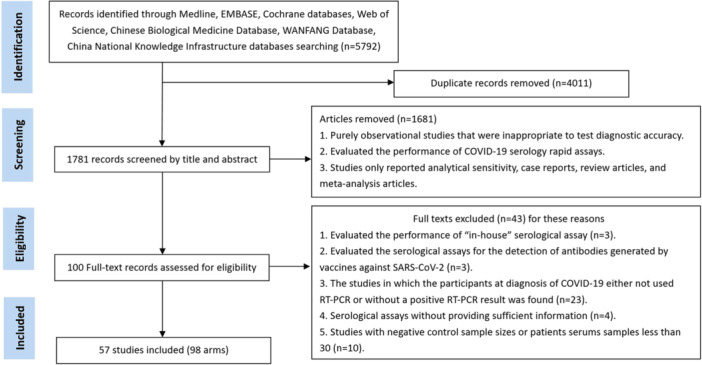
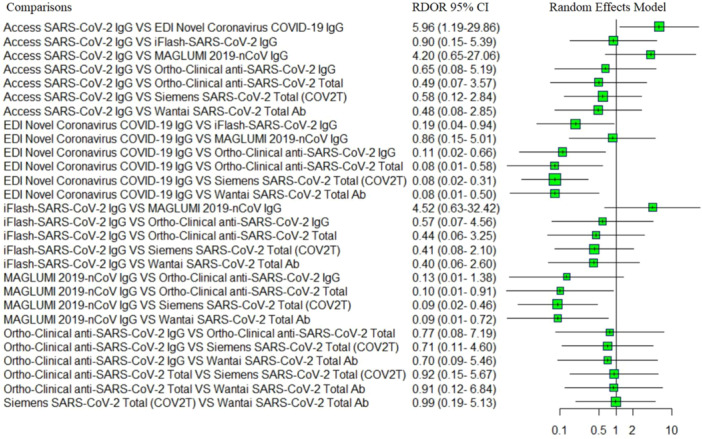
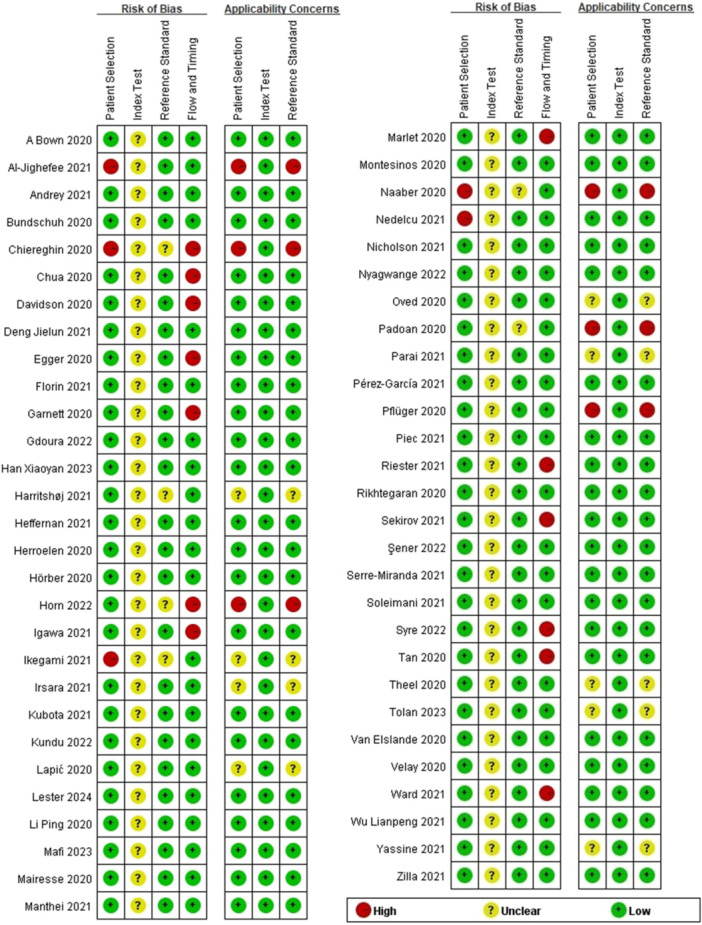
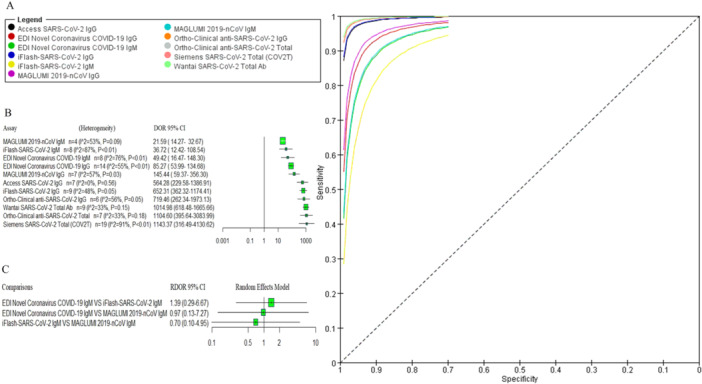
This meta-analysis was conducted following the PRISMA 2020 reporting guideline. Electronic searches were performed using the Cochrane Library, PubMed, Embase, Web of Science, Chinese Biological Medicine Database (CBM), China National Knowledge Infrastructure (CNKI), WANFANG, and Chinese Weipu (VIP) databases. Fifty-seven articles, including 11 serologic-based IgG, IgM, and total antibodies assays for SARS-CoV-2, published before June 2024, were included in this meta-analysis. The main outcome of this meta-analysis used to evaluate the performance of 11 assays included pooled diagnostic odds ratio (DOR), area under the summary receiver operating characteristic (AUC), and summary receiver operating characteristic curve (SROC). The R software was used for adjusted indirect comparison to calculate the relative diagnostic odds ratio (RDOR) with corresponding 95% confidence intervals (CIs), and indirect comparison forest plots showed the results.
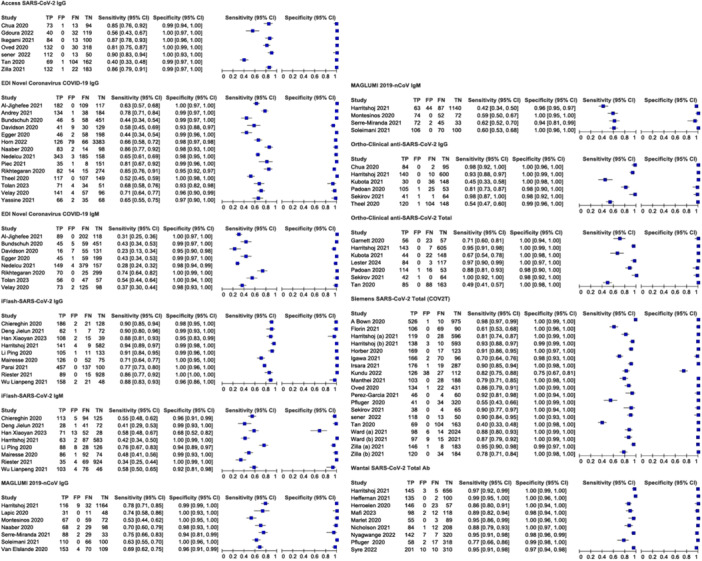
A total of 57 articles met the eligibility criteria for inclusion in our meta-analysis. The pooled DOR and the AUC for access SARS-CoV-2 IgG were 564.28 (95% CI 229.58-1386.91) and 1.00, and as for EDI novel coronavirus COVID-19 IgG those were 85.27 (95% CI 53.99-134.68) and 0.95, for EDI novel coronavirus COVID-19 IgM were 49.42 (95% CI 16.47-148.30) and 0.86, for iFlash-SARS-CoV-2 IgG were 652.31 (95% CI 362.32-1174.41) and 0.97, for iFlash-SARS-CoV-2 IgM were 36.72 (95% CI 12.42-108.54) and 0.76, for MAGLUMI 2019-nCoV IgG were 145.44 (95% CI 59.37-356.30) and 0.90, for MAGLUMI 2019-nCoV IgM were 21.59 (95% CI 14.27-32.67) and 0.59, for ortho-clinical anti-SARS-CoV-2 IgG were 719.46 (95% CI 262.34-1973.13) and 1.00, for ortho-clinical anti-SARS-CoV-2 total were 1104.60 (95% CI 395.64-3083.99) and 1.00, for Siemens SARS-CoV-2 total (COV2T) were 1143.37 (95% CI 316.49-4130.62) and 0.99, for Wantai SARS-CoV-2 total Ab were 1014.98 (95% CI 618.48-1665.66) and 1.00. The pooled DOR for assays-based IgG (n = 43), assays-based total antibody (n = 35), and assays-based IgM (n = 20) was 242.88 (95% CI 157.66-374.16), 1215.90 (95% CI 547.14-2702.07), and 40.99 (95% CI 22.63-74.25). The diagnostic accuracy of assays-based total antibody performed better than those of assays-based IgG and assays-based IgM; assays-based IgG performed better than assays-based IgM.
This study suggested that the Siemens SARS-CoV-2 total (COV2T), ortho-clinical anti-SARS-CoV-2 total, and Wantai SARS-CoV-2 total had the best overall diagnostic accuracy. The diagnostic efficacy of the assays-based total antibody had statistically significantly higher accuracy than those of assays-based IgG and assays-based IgM for COVID-19.
在过去5年中,出现了大量用于大规模检测严重急性呼吸综合征冠状病毒2(SARS-CoV-2)抗原抗体的血清学检测方法。需要SARS-CoV-2血清学检测来支持临床诊断和流行病学调查。然而,关于这些血清学检测诊断准确性的数据有限。我们旨在以逆转录聚合酶链反应(RT-PCR)检测为参考标准,比较11种新型冠状病毒肺炎(COVID-19)商业血清学检测的诊断准确性,以RT-PCR检测作为对照臂,对11种不同的SARS-CoV-2血清学检测的诊断准确性进行间接比较。
本荟萃分析按照PRISMA 2020报告指南进行。使用Cochrane图书馆、PubMed、Embase、Web of Science、中国生物医学数据库(CBM)、中国知网(CNKI)、万方和维普(VIP)数据库进行电子检索。纳入本荟萃分析的有57篇文章,包括2024年6月之前发表的11种基于血清学的针对SARS-CoV-2的IgG、IgM和总抗体检测。本荟萃分析用于评估11种检测性能的主要结果包括合并诊断比值比(DOR)、汇总接受者操作特征曲线下面积(AUC)和汇总接受者操作特征曲线(SROC)。使用R软件进行调整后的间接比较,以计算相对诊断比值比(RDOR)及其相应的95%置信区间(CI),间接比较森林图显示结果。
共有57篇文章符合纳入我们荟萃分析的资格标准。用于检测SARS-CoV-2 IgG的合并DOR和AUC分别为564.28(95%CI 229.58 - 1386.91)和1.00,用于检测EDI新型冠状病毒COVID-19 IgG的分别为85.27(95%CI 53.99 - 134.68)和0.95,用于检测EDI新型冠状病毒COVID-19 IgM的分别为49.42(95%CI 16.47 - 148.30)和0.86,用于检测iFlash-SARS-CoV-2 IgG的分别为652.31(95%CI 362.32 - 1174.41)和0.97,用于检测iFlash-SARS-CoV-2 IgM的分别为36.72(95%CI 12.42 - 108.54)和0.76,用于检测MAGLUMI 2019-nCoV IgG的分别为145.44(95%CI 59.37 - 356.30)和0.90,用于检测MAGLUMI 2019-nCoV IgM的分别为21.59(95%CI 14.27 - 32.67)和0.59,用于检测ortho-clinical抗SARS-CoV-2 IgG的分别为719.46(95%CI 262.34 - 1973.13)和1.00,用于检测ortho-clinical抗SARS-CoV-2总抗体的分别为1104.60(95%CI 395.64 - 3083.99)和1.00,用于检测西门子SARS-CoV-2总抗体(COV2T)的分别为1143.37(95%CI 316.49 - 4130.62)和0.99,用于检测万泰SARS-CoV-2总抗体的分别为1014.98(95%CI 618.48 - 1665.66)和1.00。基于IgG的检测(n = 43)、基于总抗体的检测(n = 35)和基于IgM的检测(n = 20)的合并DOR分别为242.88(95%CI 157.66 - 374.16)、1215.90(95%CI 547.14 - 2702.07)和40.99(95%CI 22.63 - 74.25)。基于总抗体的检测的诊断准确性优于基于IgG的检测和基于IgM的检测;基于IgG的检测优于基于IgM的检测。
本研究表明,西门子SARS-CoV-2总抗体(COV2T)、ortho-clinical抗SARS-CoV-2总抗体和万泰SARS-CoV-2总抗体具有最佳的总体诊断准确性。对于COVID-19,基于总抗体的检测的诊断效能在统计学上显著高于基于IgG的检测和基于IgM的检测。