Yamanaka Yuta, Okuno Yukiko, Kamisako Keisuke, Okazaki Yuta, Nakanishi Kentaro, Sanada Yume, Yoshida Kiyori, Ikoma Tatsuki, Takeyasu Yuki, Katsushima Utae, Yoshioka Hiroshige, Kurata Takayasu
Department of Thoracic Oncology, Kansai Medical University Hospital, Osaka, Japan.
Cancer Med. 2024 Dec;13(24):e70480. doi: 10.1002/cam4.70480.
Extensive small cell lung cancer (ES-SCLC) are currently managed using first-line chemotherapy options, including atezolizumab (Atezo) plus etoposide and carboplatin (CE) or durvalumab (Durva) plus etoposide with either cisplatin (PE) or carboplatin (CE). However, a definitive distinction in therapeutic effects between Atezo and Durva in these regimens remains unestablished.
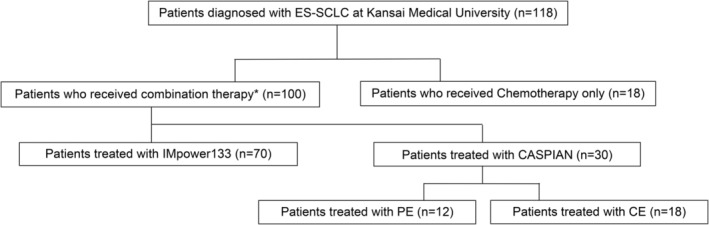
We analyzed data from 100 patients diagnosed with ES-SCLC who received immune checkpoint inhibitors (ICIs) as first-line chemotherapy. Among them, 70 were administered Atezo + CE, 12 received Durva + PE, and 18 received Durva + CE. We assessed the efficacy of the two ICIs across various factors.
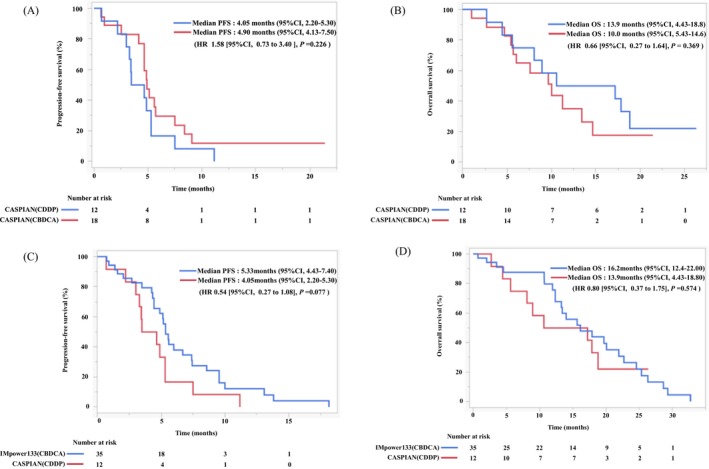
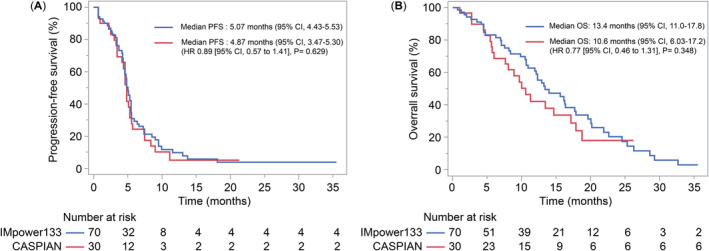
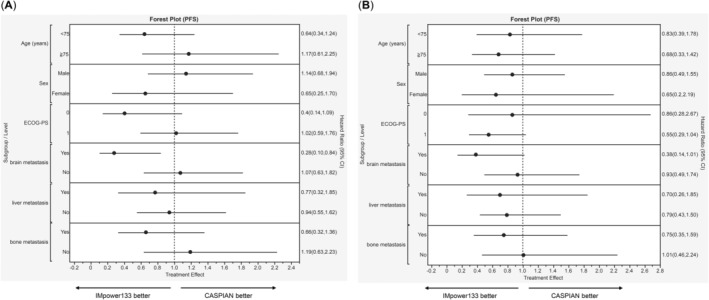
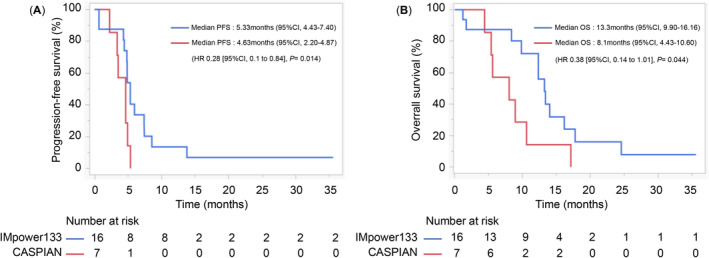
The progression-free survival (PFS) and overall survival (OS) did not significantly differ between Atezo + CE and Durva + CE/PE as first-line chemotherapy treatments for SCLC. We observed no significant differences in age, sex, performance status (PS), liver metastasis, bone metastasis, or platinum-based agent usage between the treatment cohorts. However, a marked improvement in PFS and OS was observed in the solitary patient with brain metastasis treated with Atezo + CE.
The primary distinction between these treatments was observed in the management of patients with brain metastasis. The literature lacks comparative studies on the effects of first-line ICI treatment on the central nervous system, rendering our findings significant in clinical practice. Despite the retrospective nature of this study and the potential for various biases, we recommend the preferential use of Atezo + CE in patients with brain metastasis to potentially enhance prognosis.
广泛期小细胞肺癌(ES-SCLC)目前采用一线化疗方案进行治疗,包括阿替利珠单抗(阿特珠单抗)联合依托泊苷和卡铂(CE),或度伐利尤单抗(度伐单抗)联合依托泊苷和顺铂(PE)或卡铂(CE)。然而,在这些方案中,阿特珠单抗和度伐利尤单抗之间治疗效果的明确差异尚未确立。
我们分析了100例被诊断为ES-SCLC且接受免疫检查点抑制剂(ICI)作为一线化疗的患者的数据。其中,70例接受阿特珠单抗+CE治疗,12例接受度伐利尤单抗+PE治疗,18例接受度伐利尤单抗+CE治疗。我们评估了两种ICI在各种因素下的疗效。
作为SCLC的一线化疗方案,阿特珠单抗+CE与度伐利尤单抗+CE/PE之间的无进展生存期(PFS)和总生存期(OS)无显著差异。我们观察到治疗组之间在年龄、性别、体能状态(PS)、肝转移、骨转移或铂类药物使用方面无显著差异。然而,接受阿特珠单抗+CE治疗的孤立性脑转移患者的PFS和OS有显著改善。
这些治疗方法的主要区别在于脑转移患者的管理。文献中缺乏关于一线ICI治疗对中枢神经系统影响的比较研究,这使得我们的发现在临床实践中具有重要意义。尽管本研究具有回顾性且存在各种偏倚的可能性,但我们建议脑转移患者优先使用阿特珠单抗+CE,以潜在地改善预后。