Silveira Victor Nogueira da Cruz, França Ana Karina Teixeira da Cunha, Santos Alcione Miranda Dos
Universidade Federal do Maranhão, Postgraduate Program in Colletive Health - São Luís (MA), Brazil.
Rev Bras Epidemiol. 2024 Dec 16;27:e240069. doi: 10.1590/1980-549720240069. eCollection 2024.
To evaluate the heterogeneity in the consumption of fresh or minimally processed foods (FMPF) and ultra-processed foods (UPF) in the Brazilian population ≥10 years of age.
Cross-sectional study that used data from the food consumption and resident module from the 2017-2018 edition of the Family Budget Survey. Variables relating to sex, region of residence, household status and per capita family income in minimum wages were used. The outcomes were dietary participation in percentage of FMPF and UPF. Heterogeneity was assessed using random effects produced by linear mixed-effects models.
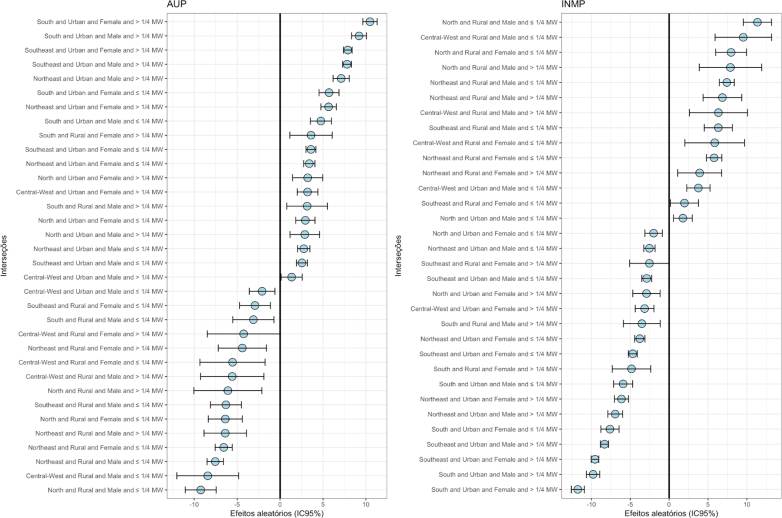
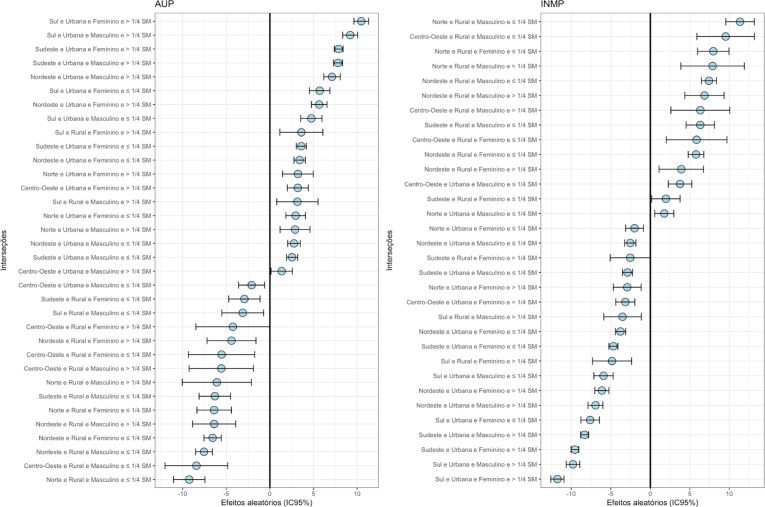
Thirty-two random effects were obtained for the consumption of FMPF and 34 for UPF. Living in the urban area of the South and Southeast regions, as well as having a higher income were driving factors in the consumption of UPF and reducing the consumption of FMPF. Living in a rural area and having low income were mainly reducing factors in the consumption of UPF and driving factors in the consumption of FMPF.
The consumption of UPF and FMPF was determined by the set of factors that represented easy access to these foods, whether geographic or economic such as income.
评估巴西10岁及以上人群在新鲜或轻度加工食品(FMPF)和超加工食品(UPF)消费方面的异质性。
横断面研究,使用了2017 - 2018年家庭预算调查中食品消费和居民模块的数据。使用了与性别、居住地区、家庭状况以及以最低工资计算的人均家庭收入相关的变量。结果是FMPF和UPF在饮食中所占的百分比。使用线性混合效应模型产生的随机效应评估异质性。
FMPF消费获得32个随机效应,UPF消费获得34个随机效应。生活在南部和东南部地区的城市地区以及拥有较高收入是UPF消费的驱动因素,也是FMPF消费减少的因素。生活在农村地区和低收入主要是UPF消费减少的因素以及FMPF消费的驱动因素。
UPF和FMPF的消费由一系列因素决定,这些因素代表了获取这些食品的便利程度,无论是地理因素还是经济因素,如收入。