Santos Letícia Martins, Shimabuko Danielle Yumi, Sipert Carla Renata
Department of Biomaterial and Oral Biology, School of Dentistry, University of São Paulo, São Paulo, Brazil.
Department of Restorative Dentistry, School of Dentistry, University of São Paulo, São Paulo, Brazil.
Braz Dent J. 2024 Dec 16;35:e246054. doi: 10.1590/0103-644020246054. eCollection 2024.
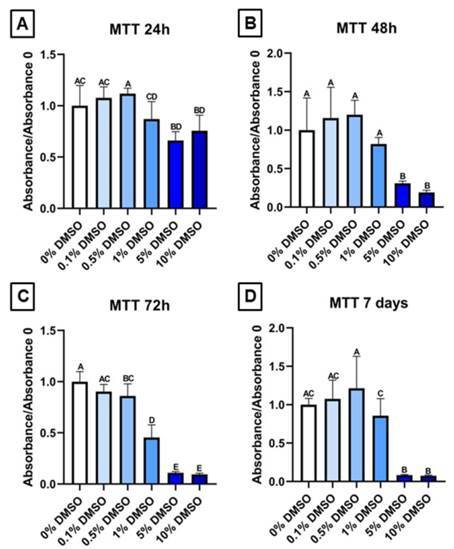
Dimethyl sulfoxide (DMSO) is widely used as an adjuvant in dissolving insoluble compounds in an aqueous medium; however, it can induce significant molecular changes in cells. The possible damages may occur obeying a tissue-specific profile, and the effect on human apical papilla cells (hAPC) remains unknown. Therefore, this study aimed to evaluate DMSO effects on the viability and mineralization activity in hAPC cultures in vitro and to establish standards of maximum concentrations for its use in laboratory routines. hAPCs were cultured, plated, and maintained in media containing increasing concentrations of Dimethyl sulfoxide (0.1%, 0.5%, 1%, 5%, and 10%) for 24 h, 48 h, 72 h, and 7 days. At each time point, the cells were subjected to the MTT assay. The Alizarin red S staining assay was performed to evaluate the osteo/odontogenic mineralization potential of hAPC DMSO-exposed (0.1%, 0.5%, and 1%) in the 21-day time-point. Statistical analysis was performed using one-way analysis of variance followed by Tukey's post hoc test (p<0.05). In general, the 5% and 10% DMSO concentrations were shown to be cytotoxic for hAPC at all analyzed time points, and the hAPC DMSO-stimulated presented higher osteo/odontogenic mineralization potential. Therefore, the 5% and 10% DMSO concentrations should be avoided, and the mineralization activity assay should be carefully designed in order to avoid biases at in vitro assays using hAPC cultures.
二甲基亚砜(DMSO)在水性介质中作为溶解不溶性化合物的佐剂被广泛使用;然而,它会在细胞中诱导显著的分子变化。可能的损伤可能会遵循组织特异性特征发生,而其对人根尖乳头细胞(hAPC)的影响仍然未知。因此,本研究旨在评估DMSO对体外培养的hAPC活力和矿化活性的影响,并确定其在实验室常规使用中的最大浓度标准。将hAPC培养、接种并维持在含有不同浓度二甲基亚砜(0.1%、0.5%、1%、5%和10%)的培养基中24小时、48小时、72小时和7天。在每个时间点,对细胞进行MTT测定。在21天时间点,对暴露于DMSO(0.1%、0.5%和1%)的hAPC进行茜素红S染色测定,以评估其成骨/牙源性矿化潜力。采用单因素方差分析,然后进行Tukey事后检验进行统计分析(p<0.05)。总体而言,在所有分析的时间点,5%和10%的DMSO浓度对hAPC具有细胞毒性,而DMSO刺激的hAPC具有更高的成骨/牙源性矿化潜力。因此,应避免使用5%和10%的DMSO浓度,并且在使用hAPC培养物进行体外测定时,应仔细设计矿化活性测定以避免偏差。