Marques Gabriela Ávila, Amaral André F S, Passos Valéria Lima, Weber Priscila, Oliveira Paula Duarte de, Menezes Ana Maria Baptista, Gonçalves Helen, Wehrmeister Fernando César
. Programa de Pós-Graduação em Epidemiologia, Universidade Federal de Pelotas, Pelotas (RS), Brasil.
. Instituto Nacional do Coração e Pulmão, Imperial College London, Reino Unido.
J Bras Pneumol. 2024 Dec 16;50(6):e20240317. doi: 10.36416/1806-3756/e20240317. eCollection 2024.
To estimate the prevalence of allergic rhinitis (AR), atopic dermatitis (AD), and wheezing, and to describe their patterns of co-occurrence according to different characteristics in adolescence and early adulthood.
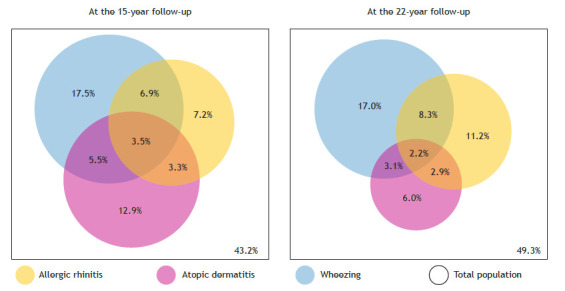
Cross-sectional analyses from the 15-year and 22-year follow-ups of the 1993 Pelotas (Brazil) Birth Cohort. The outcomes were assessed based on self-reported data, and the patterns of co-occurrence were determined using cluster analysis. The sample was described using absolute and relative frequencies according to the independent variables. Venn diagrams were generated to visualize the co-occurrence of AR, AD, and wheezing.
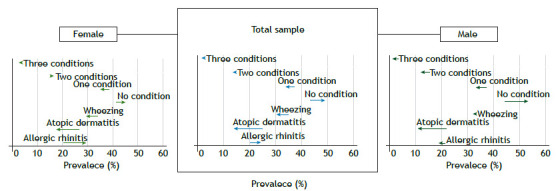
Data on AR, AD, and wheezing were available for 4,286 participants at 15 years and 3,789 at 22 years. At 15 years, AR was reported by 20.9% of participants, AD by 25.2%, and wheezing by 33.4%. Meanwhile, at 22 years, AR was reported by 24.6%, AD by 14.2%, and wheezing by 30.7%. Notably, the overlap between AR and wheezing was greater than that of the other conditions (6.9% at 15 years and 8.3% at 22 years). Participants with lower maternal education and lower income were more likely to report having "no health condition". At 15 years, White individuals most frequently reported "three conditions" (4.1%; p<0.001), whereas at 22 years, they primarily reported "two conditions" (15.6%; p<0.001). The co-occurrence of all three health conditions was found to be greater than expected, with an observed rate 2.1 times higher (95% CI 1.4 - 3.0) at 22 years.
This study highlights the social gradient in the diagnosis and reporting of co-occurrence of AR, AD, and wheezing.
评估变应性鼻炎(AR)、特应性皮炎(AD)和喘息的患病率,并根据青少年和成年早期的不同特征描述它们的共现模式。
对1993年巴西佩洛塔斯出生队列进行15年和22年随访的横断面分析。根据自我报告数据评估结果,并使用聚类分析确定共现模式。根据自变量,用绝对频率和相对频率描述样本。绘制维恩图以直观显示AR、AD和喘息的共现情况。
15岁时,4286名参与者提供了AR、AD和喘息的数据,22岁时为3789名。15岁时,20.9%的参与者报告患有AR,25.2%报告患有AD,33.4%报告有喘息。同时,22岁时,24.6%报告患有AR,14.2%报告患有AD,30.7%报告有喘息。值得注意的是,AR和喘息之间的重叠比其他情况更大(15岁时为6.9%,22岁时为8.3%)。母亲教育程度较低和收入较低的参与者更有可能报告“无健康问题”。15岁时,白人个体最常报告“三种情况”(4.1%;p<0.001),而22岁时,他们主要报告“两种情况”(15.6%;p<0.001)。发现所有三种健康状况的共现情况高于预期,22岁时观察到的发生率高出2.1倍(95%CI 1.4 - 3.0)。
本研究突出了AR、AD和喘息共现诊断与报告中的社会梯度。