Alraddadi Eman A, Alatawi Yasser, Kumar Raju S, Bukhari Jawad I, Alghamdi Abdulrahman E, Lughbi Shahad, Alghamdi Reema, Al Sulaiman Khalid, Alamri Faisal F
Department of Basic Sciences, College of Science and Health Professions, King Saud bin Abdulaziz University for Health Sciences, Jeddah, Saudi Arabia.
King Abdullah International Medical Research Center, Jeddah, Saudi Arabia.
Metab Brain Dis. 2024 Dec 19;40(1):72. doi: 10.1007/s11011-024-01508-3.
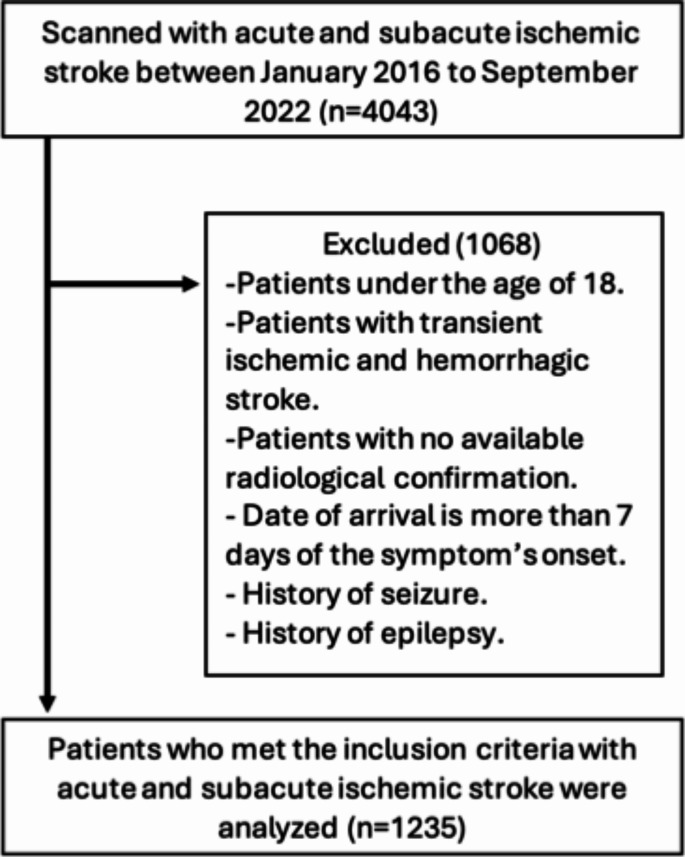
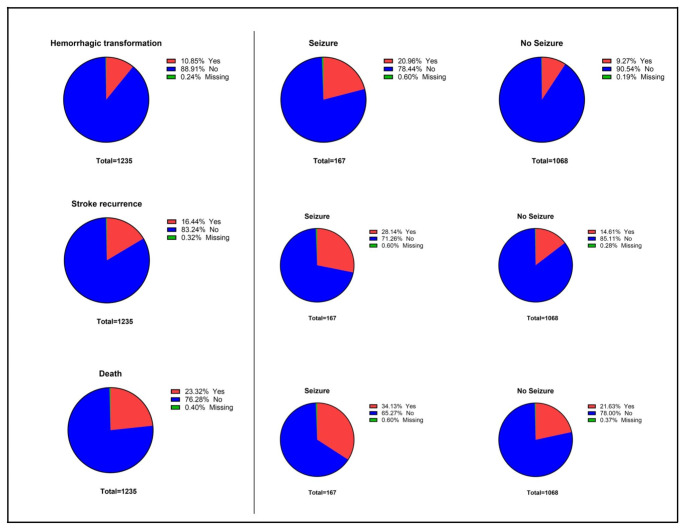
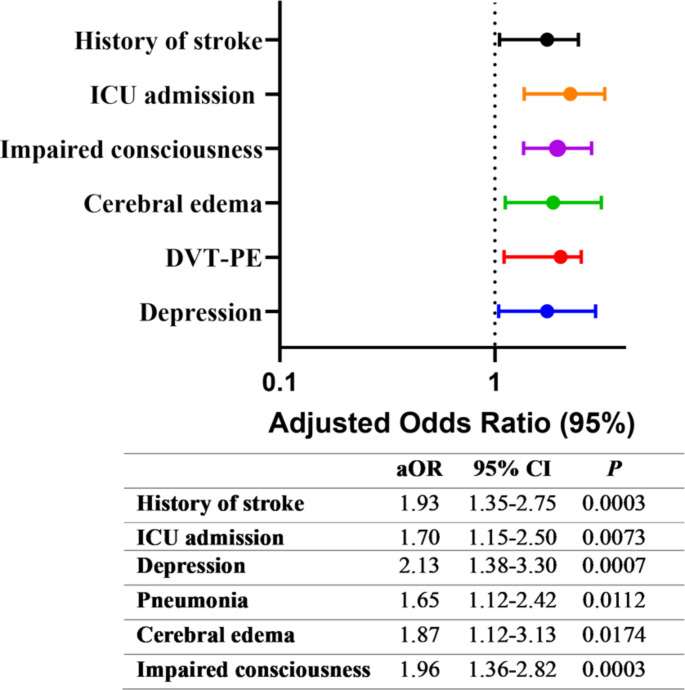
Post-stroke seizures present a global challenge, yet its frequency and factors associated with its incidence are poorly documented, particularly in the Middle East. Thus, this study aims to investigate post-stroke seizure frequency and stroke-associated factors among ischemic stroke patients in Saudi Arabia, addressing demographic, clinical, and comorbid aspects to improve prognosis, diagnosis, prevention, and management. A multicenter, cohort observational study included eligible ischemic stroke patients who were categorized into those who developed seizures after injury and those who did not. Additionally, the study assessed the association between post-stroke seizure and 12-month mortality, 12-month stroke recurrence, and the occurrence of hemorrhagic transformation (HT) within 30 days. The study involved 1235 ischemic stroke patients, in which 13.5% developed post-stroke seizures. Patients with post-stroke seizures had more extended hospital stays, higher intensive care unit (ICU) admission rates, and a higher prevalence of comorbidities. Factors independently associated with post-stroke seizures included previous stroke history (OR = 1.93; 1.35-2.75), ICU admission (OR = 1.7; 1.15-2.5), and depression (OR = 2.1; 1.38-3.30). Logistic regression revealed associations between post-stroke seizures and HT (OR = 2.61; 1.70-4.00), stroke recurrence (OR = 2.30; 1.58-3.36), and mortality (OR = 1.89; 1.33-2.68). However, after adjusting for covariates, post-stroke seizures were significantly associated with stroke recurrence only (aOR = 1.7; 1.11-2.63). Our study identifies notable associations and risk factors for post-stroke seizures in ischemic stroke patients. This underscores the importance of adopting a comprehensive approach to stroke care to enhance the prediction, prevention, and management of post-stroke seizures. Further research is warranted to validate these findings, enhance the understanding of post-stroke seizure mechanisms, and guide management strategies.
中风后癫痫是一个全球性挑战,但其发生率及相关因素的记录却很不完善,尤其是在中东地区。因此,本研究旨在调查沙特阿拉伯缺血性中风患者的中风后癫痫发生率及与中风相关的因素,涵盖人口统计学、临床及合并症等方面,以改善预后、诊断、预防及管理。一项多中心队列观察性研究纳入了符合条件的缺血性中风患者,这些患者被分为受伤后发生癫痫的患者和未发生癫痫的患者。此外,该研究评估了中风后癫痫与12个月死亡率、12个月中风复发率以及30天内出血性转化(HT)发生情况之间的关联。该研究涉及1235例缺血性中风患者,其中13.5%发生了中风后癫痫。中风后癫痫患者的住院时间更长,重症监护病房(ICU)入院率更高,合并症患病率也更高。与中风后癫痫独立相关的因素包括既往中风史(OR = 1.93;1.35 - 2.75)、入住ICU(OR = 1.7;1.15 - 2.5)和抑郁症(OR = 2.1;1.38 - 3.30)。逻辑回归显示中风后癫痫与HT(OR = 2.61;1.70 - 4.00)、中风复发(OR = 2.30;1.58 - 3.36)和死亡率(OR = 1.89;1.33 - 2.68)之间存在关联。然而,在对协变量进行调整后,中风后癫痫仅与中风复发显著相关(校正OR = 1.7;1.11 - 2.63)。我们的研究确定了缺血性中风患者中风后癫痫的显著关联和危险因素。这凸显了采用全面的中风护理方法以加强中风后癫痫预测、预防和管理的重要性。有必要进行进一步研究以验证这些发现,加深对中风后癫痫机制的理解,并指导管理策略。