Alraddadi Eman A, Alotaibi Hashim F, Alatawi Yasser, Aljabri Ahmed, Alghamdi Ahmed A, Alturki Fahad, Alamri Faisal F
Department of Basic Sciences, College of Science and Health Professions, King Saud Bin Abdulaziz University for Health Sciences, Jeddah, Saudi Arabia.
King Abdullah International Medical Research Center, Jeddah, Saudi Arabia.
Front Neurol. 2025 Feb 5;16:1478175. doi: 10.3389/fneur.2025.1478175. eCollection 2025.
Stroke recurrence is a serious and prevalent complication of ischemic stroke that warrants additional investigation.
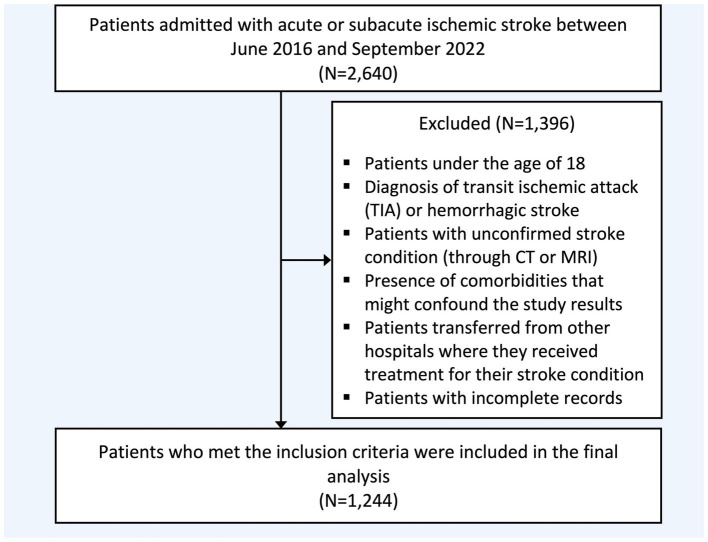
A hospital-based retrospective observational study included acute-subacute ischemic stroke adult patients. The primary aim was to determine the risk factors associated with recurrent stroke within 365 days. Additionally, a combined outcome consisting of any stroke recurrence or all-cause mortality within 365 days was considered secondary outcome. Univariate and multivariable Cox proportional-hazards models were used to examine the association of risk factors with stroke recurrence and composite death/stroke recurrence.
Of 1,244 patients, 112 (9%) experienced stroke recurrence. The multivariable analysis identified risk factors for stroke recurrence including history of previous stroke (HR = 3.65, 95% CI:2.28-5.99, = 0.0001), tissue plasminogen activator (tPA) treatment (HR = 2.84, 95% CI:1.57-4.86, = 0.0003), seizure (HR = 1.96, 95% CI:1.14-3.22, = 0.0105), and depression (HR = 2.26, 95% CI:1.33-3.69, = 0.0016). Only previous stroke history (HR = 2.37, 95% CI:1.74-3.26, = 0.0001) remained significantly associated with the combined outcome of stroke recurrence/death. Additional risk factors for the composite outcome included older age of patients (HR = 1.02, 95% CI:1.01-1.03, = 0.0009), admission to the intensive care unit (ICU) (HR = 3.70, 95% CI:2.63-5.22, = 0.0105), pneumonia (HR = 1.47, 95% CI:1.05-2.05, = 0.0249), and brain edema (HR = 2.36, 95% CI:1.58-3.46, = 0.0001).
Key findings include a stroke recurrence rate of 9.96% and a combined death/stroke recurrence rate of 21.83% within 365 days. Multivariable analysis confirmed that history of stroke, receiving tPA, experiencing seizures, and depression were significantly associated with stroke recurrence. Implementing additional preventive measures for individuals in these high-risk categories is essential. Further studies are needed to validate our findings.
卒中复发是缺血性卒中一种严重且常见的并发症,值得进一步研究。
一项基于医院的回顾性观察性研究纳入了急性 - 亚急性缺血性卒中成年患者。主要目的是确定与365天内复发性卒中相关的危险因素。此外,将365天内任何卒中复发或全因死亡率组成的联合结局视为次要结局。采用单变量和多变量Cox比例风险模型来检验危险因素与卒中复发及复合死亡/卒中复发之间的关联。
在1244例患者中,112例(9%)发生了卒中复发。多变量分析确定了卒中复发的危险因素,包括既往卒中史(HR = 3.65,95%CI:2.28 - 5.99,P = 0.0001)、组织型纤溶酶原激活剂(tPA)治疗(HR = 2.84,95%CI:1.57 - 4.86,P = 0.0003)、癫痫发作(HR = 1.96,95%CI:1.14 - 3.22,P = 0.0105)和抑郁(HR = 2.26,95%CI:1.33 - 3.69,P = 0.0016)。只有既往卒中史(HR = 2.37,95%CI:1.74 - 3.26,P = 0.0001)与卒中复发/死亡的联合结局仍显著相关。复合结局的其他危险因素包括患者年龄较大(HR = 1.02,95%CI:1.01 - 1.03,P = 0.0009)、入住重症监护病房(ICU)(HR = 3.70,95%CI:2.63 - 5.22,P = 0.0105)、肺炎(HR = 1.47,95%CI:1.05 - 2.05,P = 0.0249)和脑水肿(HR = 2.36,95%CI:1.58 - 3.46,P = 0.0001)。
主要发现包括365天内卒中复发率为9.96%,死亡/卒中复发合并率为21.83%。多变量分析证实,卒中史、接受tPA治疗、癫痫发作和抑郁与卒中复发显著相关。对这些高危人群采取额外的预防措施至关重要。需要进一步研究来验证我们的发现。