Zhou Yangyang, Liu Pengtao, Tang Yaqi, Liu Jie, Tang Yaru, Zhuang Yumeng, Li Xiaoting, Xu Kaiqi, Zhou Zhi, Li Jigang, He Guangming, Deng Xing Wang, Yang Li
College of Plant Protection, China Agricultural University, Beijing 100193, China.
State Key Laboratory of Wheat Improvement, School of Advanced Agricultural Sciences and School of Life Sciences, Peking-Tsinghua Center for Life Sciences, Peking University, Beijing 100871, China.
Proc Natl Acad Sci U S A. 2024 Dec 24;121(52):e2412755121. doi: 10.1073/pnas.2412755121. Epub 2024 Dec 19.
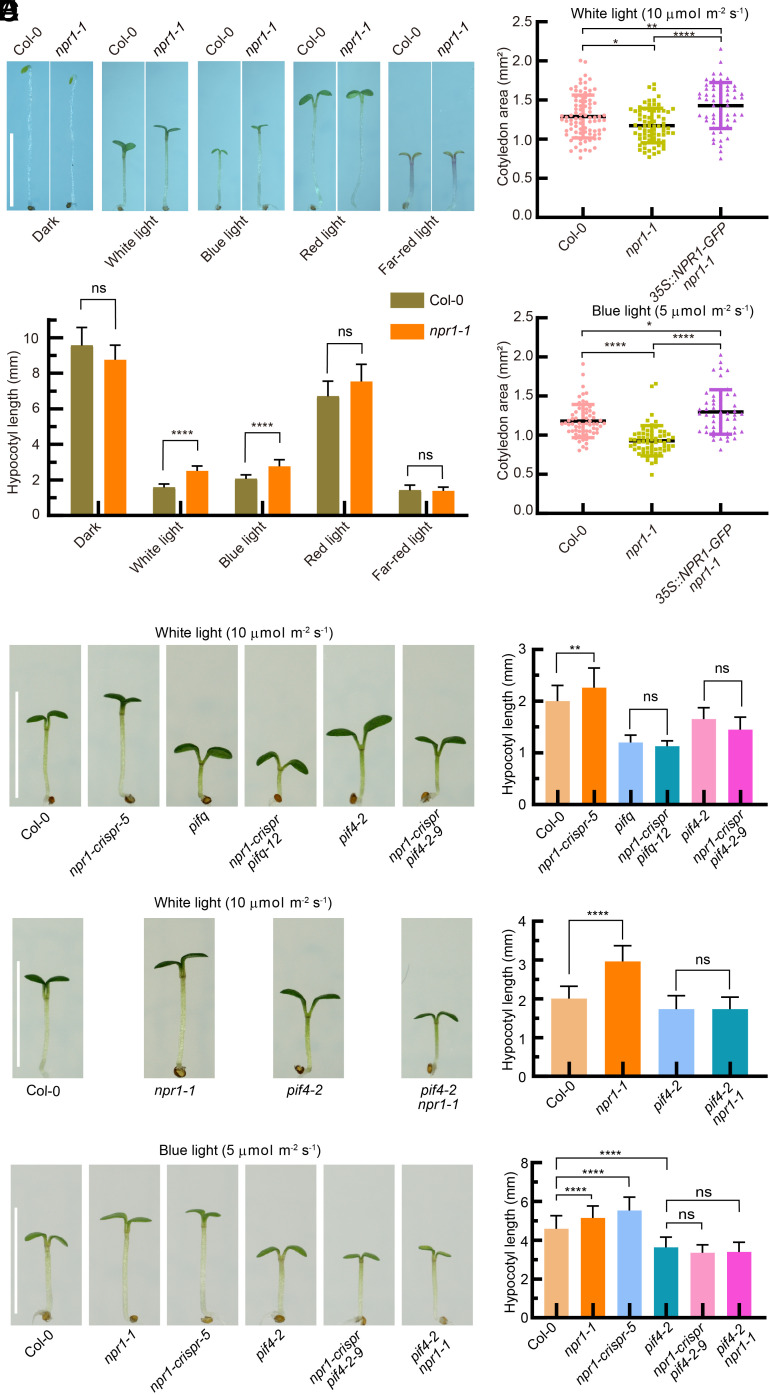
Light is a major determinant of plant growth and survival. NONEXPRESSER OF PATHOGENESIS-RELATED GENES 1 (NPR1) acts as a receptor for salicylic acid (SA) and serves as the key regulator of SA-mediated immune responses. However, the mechanisms by which plants integrate light and SA signals in response to environmental changes, as well as the role of NPR1 in regulating plant photomorphogenesis, remain poorly understood. This study shows that SA promotes plant photomorphogenesis by regulating PHYTOCHROME INTERACTING FACTOR 4 (PIF4). Specifically, NPR1 promotes photomorphogenesis under blue light by facilitating the degradation of PIF4 through light-induced polyubiquitination. NPR1 acts as a substrate adaptor for the CULLIN3-based E3 ligase, which ubiquitinates PIF4 at Lys129, Lys252, and Lys428, and leading to PIF4 degradation via the 26S proteasome pathway. Genetically, is epistatic to in the regulation of blue light-induced photomorphogenesis, suggesting it acts downstream of NPR1. Furthermore, cryptochromes mediate the polyubiquitination of PIF4 by NPR1 in response to blue light by promoting the interaction and ubiquitination between NPR1 and PIF4. Transcriptome analysis revealed that under blue light, NPR1 and PIF4 coordinately regulate numerous downstream genes related to light and auxin signaling pathways. Overall, these findings unveil a role for NPR1 in photomorphogenesis, highlighting a mechanism for posttranslational regulation of PIF4 in response to blue light. This mechanism plays a pivotal role in the fine-tuning of plant development, enabling plants to adapt to complex environmental changes.
光是植物生长和存活的主要决定因素。病程相关基因非表达子1(NPR1)作为水杨酸(SA)的受体,是SA介导的免疫反应的关键调节因子。然而,植物如何整合光和SA信号以响应环境变化,以及NPR1在调节植物光形态建成中的作用,仍知之甚少。本研究表明,SA通过调节光敏色素互作因子4(PIF4)促进植物光形态建成。具体而言,NPR1通过光诱导的多聚泛素化促进PIF4的降解,从而在蓝光下促进光形态建成。NPR1作为基于CULLIN3的E3连接酶的底物衔接蛋白,该连接酶在赖氨酸129、赖氨酸252和赖氨酸428处使PIF4泛素化,并通过26S蛋白酶体途径导致PIF4降解。在基因层面上,在蓝光诱导的光形态建成调控中对呈上位性,表明它在NPR1下游起作用。此外,隐花色素通过促进NPR1与PIF4之间的相互作用和泛素化,介导NPR1对PIF4的多聚泛素化以响应蓝光。转录组分析显示,在蓝光下,NPR1和PIF4协同调节许多与光和生长素信号通路相关的下游基因。总体而言,这些发现揭示了NPR1在光形态建成中的作用,突出了PIF4响应蓝光的翻译后调控机制。该机制在植物发育的精细调节中起关键作用,使植物能够适应复杂的环境变化。