Tominaga Kentaro, Kechele Daniel O, Sanchez J Guillermo, Vales Simon, Jurickova Ingrid, Roman Lizza, Asai Akihiro, Enriquez Jacob R, McCauley Heather A, Kishimoto Keishi, Iwasawa Kentaro, Singh Akaljot, Horio Yuko, Múnera Jorge O, Takebe Takanori, Zorn Aaron M, Helmrath Michael A, Denson Lee A, Wells James M
Division of Developmental Biology, Cincinnati Children's Hospital Medical Center, Cincinnati, Ohio; Center for Stem Cell and Organoid Medicine, Cincinnati Children's Hospital Medical Center, Cincinnati, Ohio; Division of Gastroenterology and Hepatology, Graduate School of Medical and Dental Sciences, Niigata University, Niigata, Japan.
Division of Developmental Biology, Cincinnati Children's Hospital Medical Center, Cincinnati, Ohio; Center for Stem Cell and Organoid Medicine, Cincinnati Children's Hospital Medical Center, Cincinnati, Ohio.
Cell Mol Gastroenterol Hepatol. 2025;19(4):101444. doi: 10.1016/j.jcmgh.2024.101444. Epub 2024 Dec 17.
BACKGROUND & AIMS: Organs of the gastrointestinal tract contain tissue-resident immune cells that function during tissue development, homeostasis, and disease. However, most published human organoid model systems lack resident immune cells, thus limiting their potential as disease avatars. For example, human intestinal organoids (HIOs) derived from pluripotent stem cells contain epithelial and various mesenchymal cell types but lack immune cells. In this study, we aimed to develop an HIO model with functional tissue-resident macrophages.
HIOs and macrophages were generated separately through the directed differentiation of human pluripotent stem cells and combined in vitro. Following 2 weeks of coculture, the organoids were used for transcriptional profiling, functional analysis of macrophages, or transplanted into immunocompromised mice and matured in vivo for an additional 10-12 weeks.
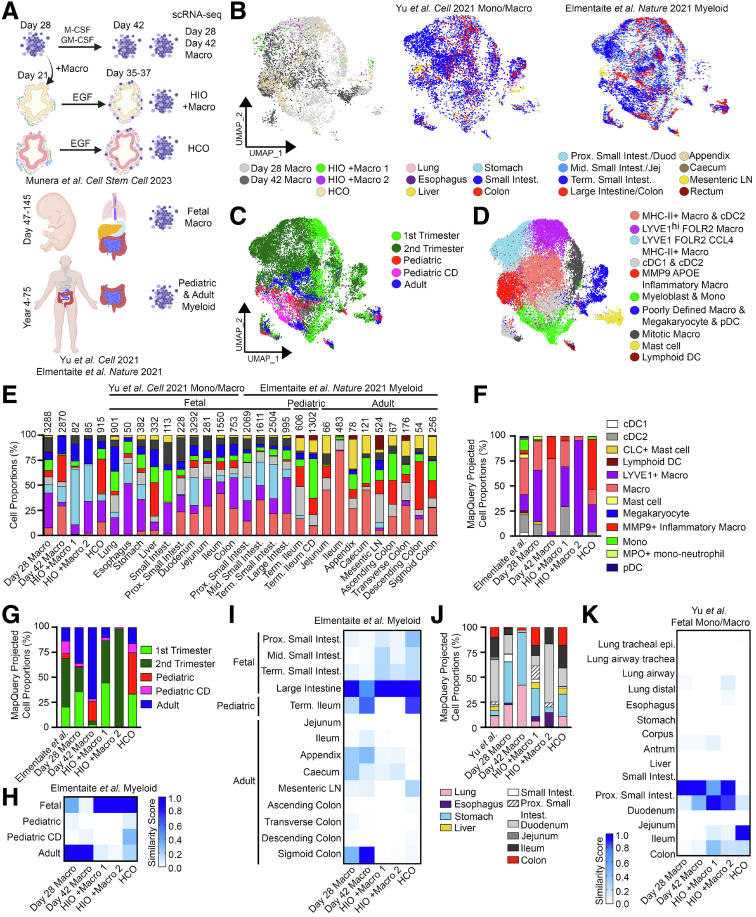
Macrophages were incorporated into developing HIOs and persisted for 2 weeks in vitro HIOs and for at least 12 weeks in HIOs in vivo. These cocultured macrophages had a transcriptional signature that resembled those in the human fetal intestine, indicating that they were acquiring the features of tissue-resident macrophages. HIO macrophages could phagocytose bacteria and produced inflammatory cytokines in response to proinflammatory signals, such as lipopolysaccharide, which could be reversed with interleukin-10.
We generated an HIO system containing functional tissue-resident macrophages for an extended period. This new organoid system can be used to investigate the molecular mechanisms involved in inflammatory bowel disease.
胃肠道器官含有组织驻留免疫细胞,这些细胞在组织发育、稳态维持和疾病过程中发挥作用。然而,大多数已发表的人类类器官模型系统缺乏驻留免疫细胞,因此限制了它们作为疾病替身的潜力。例如,源自多能干细胞的人类肠道类器官(HIOs)包含上皮细胞和各种间充质细胞类型,但缺乏免疫细胞。在本研究中,我们旨在开发一种具有功能性组织驻留巨噬细胞的HIO模型。
通过人类多能干细胞的定向分化分别生成HIOs和巨噬细胞,并在体外将它们组合。共培养2周后,将类器官用于转录谱分析、巨噬细胞功能分析,或移植到免疫缺陷小鼠体内,并在体内再成熟10 - 12周。
巨噬细胞被整合到发育中的HIOs中,在体外HIOs中持续存在2周,在体内HIOs中持续至少12周。这些共培养的巨噬细胞具有与人类胎儿肠道相似的转录特征,表明它们正在获得组织驻留巨噬细胞的特征。HIO巨噬细胞可以吞噬细菌,并在受到促炎信号(如脂多糖)刺激时产生炎性细胞因子,而白细胞介素-10可以逆转这种情况。
我们生成了一个长期包含功能性组织驻留巨噬细胞的HIO系统。这个新的类器官系统可用于研究炎症性肠病的分子机制。