Wei Qipeng, Zhan Jinxiang, Chen Xiaofeng, Li Hao, Guo Weijun, Liu Zihao, Huang Qingyan, Cai Dongling
Department of Orthopedics, Panyu Hospital of Chinese Medicine, Guangzhou, Guangdong, China.
Guangzhou University of Chinese Medicine, Guangzhou, China.
BMC Musculoskelet Disord. 2024 Dec 20;25(1):1052. doi: 10.1186/s12891-024-08111-8.
This study aims to identify the risk factors associated with bone cement loosening after percutaneous vertebroplasty/kyphoplasty (PVP/PKP) for osteoporotic vertebral compression fractures (OVCF) and to develop a clinical prediction model for bone cement loosening.
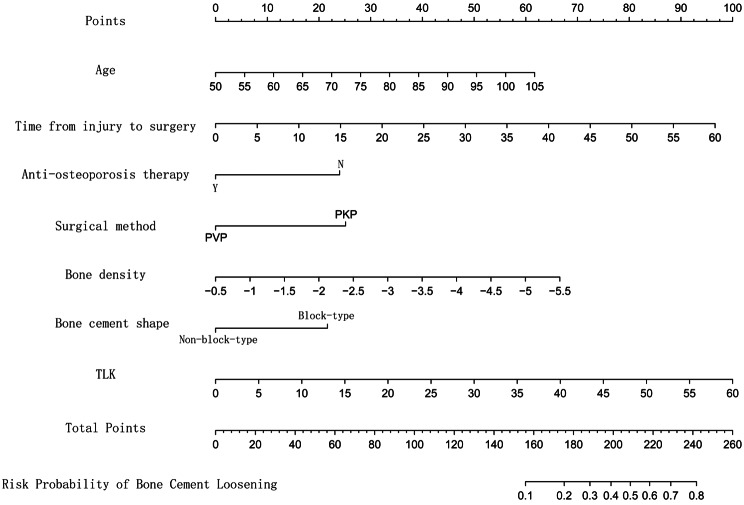
Clinical data of patients who underwent PVP/PKP for OVCF at Guangzhou Panyu Hospital from June 2017 to June 2021 were collected, with a division into loosening group and normal group based on postoperative follow-up imaging. Univariate analysis was conducted to explore the correlation between clinical data and bone cement loosening. Multivariate logistic regression analysis was performed to identify independent risk factors for bone cement loosening after PVP/PKP for OVCF. The nomogram prediction model was constructed using R and evaluated through DCA, calibration curve, and ROC curve assessments.
① Multivariate analysis indicated age, time from injury to surgery, bone density, thoracolumbar kyphosis(TLK), anti-osteoporosis therapy, surgical approach, and bone cement shape were independent risk factors for bone cement loosening after PVP/PKP for OVCF. ② The nomogram clinical prediction model based on multivariate regression showed an area under the ROC curve of 0.86. The DCA curve and calibration curve demonstrated good consistency between predicted and actual results.
The clinical prediction model for bone cement loosening after PVP/PKP in OVCF indicates that advanced age, longer time from injury to surgery, low bone density, inadequate correction of thoracolumbar kyphosis, PKP, non-anti-osteoporosis therapy, and block-type bone cement are associated with a higher risk of bone cement loosening, showing excellent discriminative capacity and promising clinical utility.
本研究旨在确定经皮椎体成形术/后凸成形术(PVP/PKP)治疗骨质疏松性椎体压缩骨折(OVCF)后骨水泥松动的相关危险因素,并建立骨水泥松动的临床预测模型。
收集2017年6月至2021年6月在广州番禺医院接受PVP/PKP治疗OVCF患者的临床资料,根据术后随访影像学分为松动组和正常组。进行单因素分析以探讨临床资料与骨水泥松动之间的相关性。进行多因素logistic回归分析以确定OVCF患者PVP/PKP后骨水泥松动的独立危险因素。使用R构建列线图预测模型,并通过决策曲线分析(DCA)、校准曲线和ROC曲线评估进行评价。
①多因素分析表明,年龄、受伤至手术时间、骨密度、胸腰椎后凸(TLK)、抗骨质疏松治疗、手术方式和骨水泥形状是OVCF患者PVP/PKP后骨水泥松动的独立危险因素。②基于多因素回归的列线图临床预测模型的ROC曲线下面积为0.86。DCA曲线和校准曲线显示预测结果与实际结果具有良好的一致性。
OVCF患者PVP/PKP后骨水泥松动的临床预测模型表明,高龄、受伤至手术时间长、骨密度低、胸腰椎后凸矫正不足、PKP、未进行抗骨质疏松治疗和块状骨水泥与骨水泥松动风险较高相关,具有出色的鉴别能力和良好的临床应用前景。