Hsia Chu-Hsuan, Su Hsiu-Yueh, Chen Yue-Hwa, Chuang Han-Chuan, Chien Yi-Wen
School of Nutrition and Health Sciences, Taipei Medical University, Taipei, 11031, Taiwan, ROC.
Department of Dietetics, Taipei Medical University Hospital, Taipei, 11031, Taiwan, ROC.
BMC Gastroenterol. 2024 Dec 19;24(1):467. doi: 10.1186/s12876-024-03561-9.
Several studies revealed the beneficial effects of probiotics against the incidence of antibiotic-associated diarrhea of hospitalized patients but it is rarely to assess the nutrition status. This study investigated the effects of probiotics in elderly hospitalized tube-fed patients with antibiotics use and is the first study that concerns the nutritional status among these patients.
Elderly hospitalized tube-fed patients who were using antibiotics were recruited. Probiotics were given within 48 h after their first antibiotic therapy, and then twice daily 2 h after consuming antibiotics and a meal; the probiotics were continued to use for an additional 7 days after completion of antibiotics therapy. Anthropometric data, laboratory data, medication records, nutritional status, nutrition intake and data on stool form were collected.
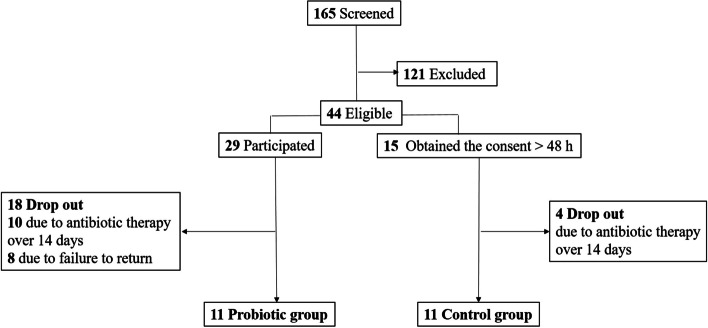
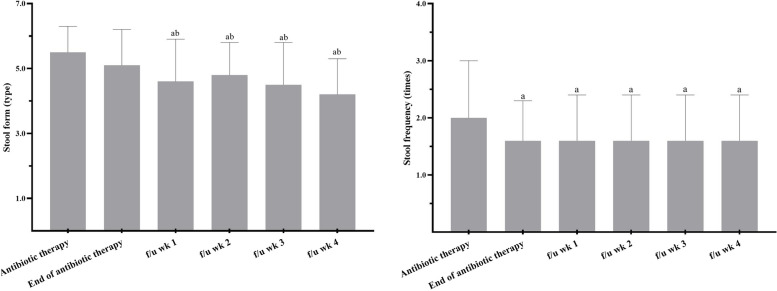
Twenty-nine patients served as probiotic group. 11 patients completed the study in both groups. In probiotic group, the stool form was found to exhibit no significant differences between the beginning and end of antibiotics therapy (5.5 ± 0.8 vs 5.1 ± 1.1, p = 0.21), but the stool frequency significantly decreased (2.0 ± 1.0 vs 1.6 ± 0.7, p = 0.05). In control group, the stool form between the beginning and end of antibiotics therapy exhibited significant improvement (5.6 ± 1.4 vs 4.5 ± 1.4, p = 0.01), but not in the frequency (2.7 ± 2.1 vs 2.4 ± 1.5, p = 0.1). The initial NRS 2002 score of the probiotic and control groups were similar. (3.6 ± 1.7 vs 3.7 ± 1.8, p = 1.00), and their nutrition status both significantly improved during the last visit before discharged (2.6 ± 0.9 vs 2.9 ± 1.3).
Probiotic supplementation in elderly hospitalized tube-fed patients significantly reduced stool frequency during antibiotic treatment. Improvements in stool form were observed only during the follow-up period. Nutritional status remained stable, with patients' nutritional needs adequately met throughout the study.
多项研究揭示了益生菌对住院患者抗生素相关性腹泻发生率的有益影响,但很少评估营养状况。本研究调查了益生菌对老年住院鼻饲患者使用抗生素的影响,并且是第一项关注这些患者营养状况的研究。
招募正在使用抗生素的老年住院鼻饲患者。在首次抗生素治疗后48小时内给予益生菌,然后在服用抗生素和进食后2小时每日两次;抗生素治疗结束后益生菌继续使用7天。收集人体测量数据、实验室数据、用药记录、营养状况、营养摄入量和大便形态数据。
29例患者作为益生菌组。两组各有11例患者完成研究。在益生菌组中,发现抗生素治疗开始和结束时大便形态无显著差异(5.5±0.8对5.1±1.1,p=0.21),但大便频率显著降低(2.0±1.0对1.6±0.7,p=0.05)。在对照组中,抗生素治疗开始和结束时大便形态有显著改善(5.6±1.4对4.5±1.4,p=0.01),但频率无改善(2.7±2.1对2.4±1.5,p=0.1)。益生菌组和对照组的初始NRS 2002评分相似(3.6±1.7对3.7±1.8,p=1.00),出院前最后一次访视时两组营养状况均显著改善(2.6±0.9对2.9±1.3)。
老年住院鼻饲患者补充益生菌可显著降低抗生素治疗期间的大便频率。仅在随访期间观察到大便形态改善。营养状况保持稳定,在整个研究过程中患者的营养需求得到充分满足。