Zhang Qin-Bao, Wu Gang, Wang Ze-Ying, Cui Zhi-Liang, Zhang Hong-Xia
Department of Cardiology, Hulunbuir People's Hospital, No. 20 of Shengli Street, Hailaer District, Hulunbuir, 021000, China.
Department of Neurology, Hulunbuir People's Hospital, Hulunbuir, 021000, China.
J Cardiothorac Surg. 2024 Dec 19;19(1):656. doi: 10.1186/s13019-024-03174-z.
This study retrospectively analyzed the relationship between serum-free triiodothyronine (FT3) levels and the prognosis of coronary atherosclerotic cardiopathy (CHD) in patients from alpine regions treated with drug-coated balloons (DCB).
Data from 201 CHD patients with DCB at Hulunbuir People's Hospital between September 2019 and August 2023 were included. Patients were divided into two groups based on the occurrence of major adverse cardiovascular events (MACE) after surgery. Univariate and multivariate logistic regression analyses were conducted to identify risk factors. The predictive efficiency of these risk factors for MACE was evaluated using the ROC curve.
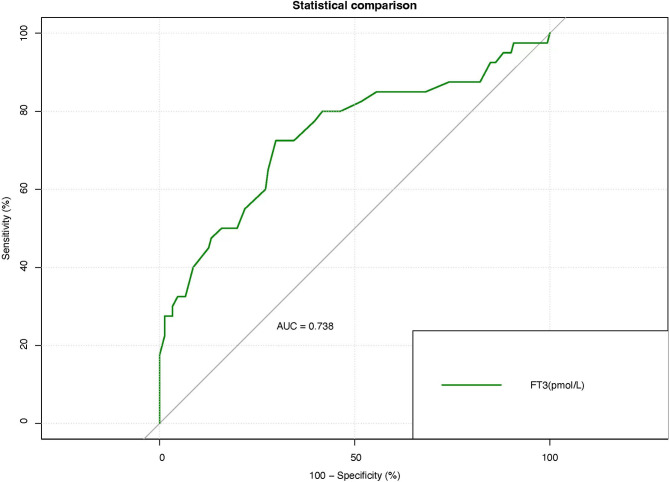
The poor prognosis group had significantly higher ages, a greater proportion of patients with a history of previous coronary interventions, and elevated levels of N-terminal pro-B-type natriuretic peptide compared to the good prognosis group. In contrast, FT3 levels were significantly lower (P < 0.05). No significant differences were observed in surgical parameters such as DCB target lesion site, lesion length, or puncture approach between the groups (P > 0.05). Multivariate binary logistic regression analysis identified FT3 level as an independent predictor factor of MACE in CHD patients treated with DCB. The optimal cut-off value for FT3 in predicting adverse prognosis following DCB surgery was 3.30 pmol/L, with a sensitivity of 72.5%, specificity of 62.8%, and an area under the curve (AUC) of 0.741 (P < 0.05).
Decreased FT3 levels serve as a biomarker for predicting the occurrence of MACE in patients from alpine regions undergoing DCB treatment for CHD. There is a significant correlation between reduced FT3 levels and the incidence of MACE in these patients.
本研究回顾性分析了高寒地区接受药物涂层球囊(DCB)治疗的冠心病(CHD)患者血清游离三碘甲状腺原氨酸(FT3)水平与预后的关系。
纳入2019年9月至2023年8月在呼伦贝尔市人民医院接受DCB治疗的201例CHD患者的数据。根据术后主要不良心血管事件(MACE)的发生情况将患者分为两组。进行单因素和多因素逻辑回归分析以确定危险因素。使用ROC曲线评估这些危险因素对MACE的预测效率。
与预后良好组相比,预后不良组患者年龄显著更高,既往有冠状动脉介入治疗史的患者比例更大,N末端B型利钠肽水平升高。相比之下,FT3水平显著更低(P<0.05)。两组之间在DCB靶病变部位、病变长度或穿刺方法等手术参数方面未观察到显著差异(P>0.05)。多因素二元逻辑回归分析确定FT3水平是接受DCB治疗的CHD患者发生MACE的独立预测因素。DCB手术后预测不良预后的FT3最佳截断值为3.30 pmol/L,灵敏度为72.5%,特异度为62.8%,曲线下面积(AUC)为0.741(P<0.05)。
FT3水平降低是预测高寒地区接受DCB治疗CHD患者发生MACE的生物标志物。这些患者中FT3水平降低与MACE发生率之间存在显著相关性。