Gui Wan-Yu, Yin Jun-Gang, Liao Jian-Cheng, Luo Hui-Zhi, You Qing, Gong Jia-Hui, Xiang Jie, Zou Jian-Dong, Li Chang-Yin
Department of Clinical Pharmacology, Jiangsu Province Hospital of Chinese Medicine, Affiliated Hospital of Nanjing University of Chinese Medicine, No. 155 Hanzhong Road, Nanjing, 210029, China.
Center of Good Clinical Practice, Jiangsu Province Hospital of Chinese Medicine, Affiliated Hospital of Nanjing University of Chinese Medicine, No. 155 Hanzhong Road, Nanjing, 210029, China.
Chin Med. 2024 Dec 19;19(1):174. doi: 10.1186/s13020-024-01045-2.
As a typical medicinal food homology species, Chinese herbal medicine Astragali radix (AR) has been widely used to regulate the human immune system worldwide. However, the human immunomodulation of AR and its corresponding mechanisms remain unclear.
First, following a fortnight successive AR administration, the changes in immune cytokines and immune cells from 20 healthy human subjects were used as immune indicators to characterize the immunomodulatory effects of AR. Subsequently, ultra-high-performance liquid chromatography coupled with quadrupole-time-of-flight mass spectrometry (UHPLC-Q-TOF/MS) based lipidomics and metabolomics analysis was performed on human serum, urine, and feces samples to investigate the changes in metabolic profiles. Then, 16S rRNA gene sequencing of feces samples was adopted for the changes of human gut microbiota. Finally, correlation analysis was conducted on the gut microbiome, metabolome/lipidome data, and immune indicators.
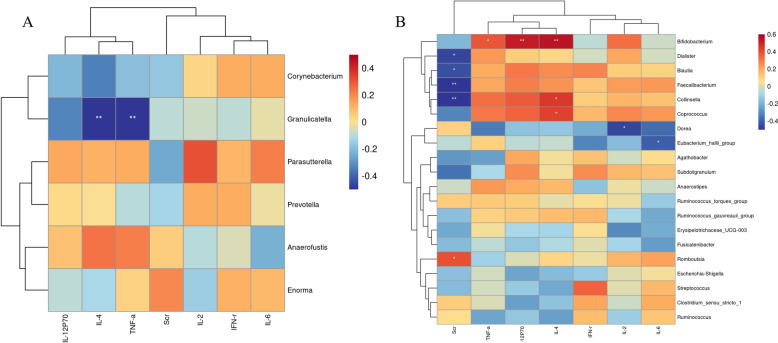
AR displayed good safety in clinical use and posed a minor impact on gut microbiota major genera, global metabolic profiles, and immune cells. Meanwhile, AR could significantly up-regulate anti-inflammatory cytokines, down-regulate serum creatinine and pro-inflammatory cytokines, promote the anabolism of arginine, glycerolipid, sphingolipid, and purine, and the catabolism of phenylalanine and glycerophospholipid. Moreover, these AR-induced changes were closely correlated with significantly decreased Granulicatella, slightly higher Bifidobacterium, Ruminococcus, and Subdoligranulum, and slightly lower Blautia.
The study clearly demonstrated that AR could modulate the human immune, by modifying the metabolism of amino acids, lipids, and purines in a microbiota-related way. Trial registration ChiCTR, ChiCTR2100054765. Registered 26 December 2021-Prospectively registered, https://www.chictr.org.cn/historyversionpub.html?regno=ChiCTR2100054765.
作为一种典型的药食同源物种,中药黄芪在全球范围内被广泛用于调节人体免疫系统。然而,黄芪对人体的免疫调节作用及其相应机制仍不清楚。
首先,在连续两周给予黄芪后,将20名健康人类受试者的免疫细胞因子和免疫细胞变化作为免疫指标,以表征黄芪的免疫调节作用。随后,对人血清、尿液和粪便样本进行基于超高效液相色谱-四极杆-飞行时间质谱(UHPLC-Q-TOF/MS)的脂质组学和代谢组学分析,以研究代谢谱的变化。然后,采用粪便样本的16S rRNA基因测序来分析人体肠道微生物群的变化。最后,对肠道微生物组、代谢组/脂质组数据和免疫指标进行相关性分析。
黄芪在临床使用中显示出良好的安全性,对肠道微生物群主要属、整体代谢谱和免疫细胞的影响较小。同时,黄芪可显著上调抗炎细胞因子,下调血清肌酐和促炎细胞因子,促进精氨酸、甘油脂、鞘脂和嘌呤的合成代谢,以及苯丙氨酸和甘油磷脂的分解代谢。此外,这些黄芪诱导的变化与显著减少的颗粒链菌属、略高的双歧杆菌属、瘤胃球菌属和副多形杆菌属以及略低的布劳特氏菌属密切相关。
该研究清楚地表明,黄芪可以通过与微生物群相关的方式调节人体免疫,调节氨基酸、脂质和嘌呤的代谢。试验注册:中国临床试验注册中心,ChiCTR2100054765。于2021年12月26日前瞻性注册,https://www.chictr.org.cn/historyversionpub.html?regno=ChiCTR2100054765。