Bossa Guilherme Volpe, May Sylvio
Institute of Mathematical and Physical Sciences, Universidad Austral de Chile, Valdivia, Chile.
Department of Physics, North Dakota State University, Fargo, ND, United States.
Front Chem. 2024 Dec 5;12:1502840. doi: 10.3389/fchem.2024.1502840. eCollection 2024.
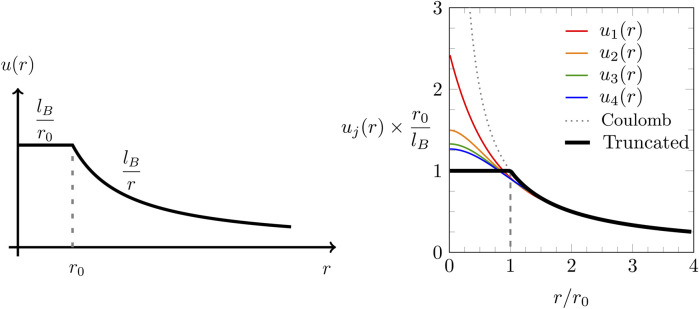
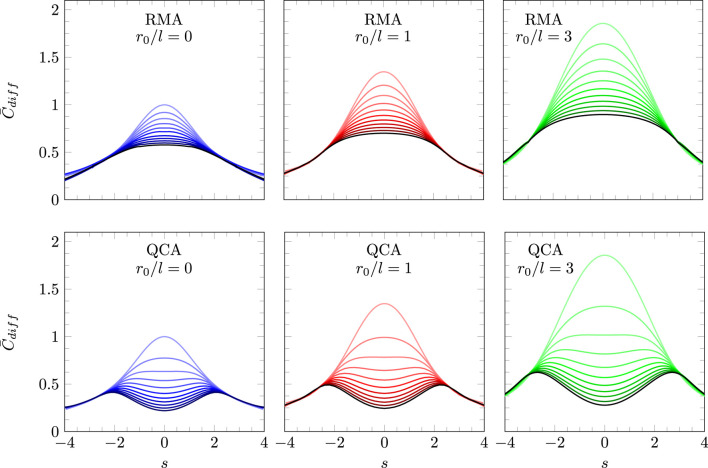
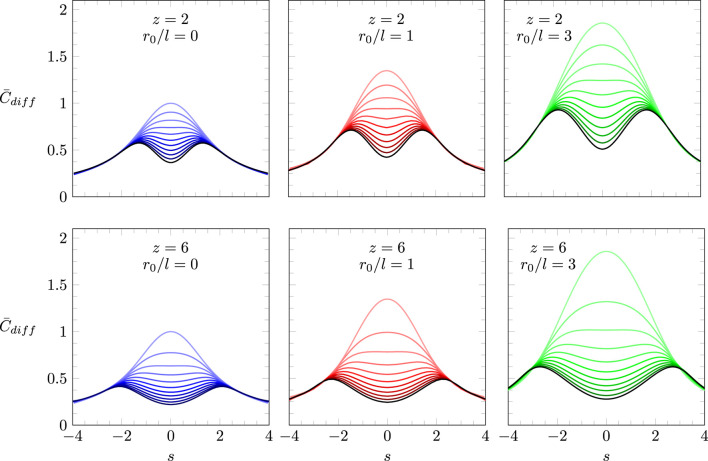
Lattice-based mean-field models of ionic liquids neglect charge discreteness and ion correlations. To address these limitations, we propose separating the short-range and long-range parts of the electrostatic interaction by truncating the Coulomb potential below a fixed distance that is equal to or slightly larger than that between neighboring ions. Interactions and correlations between adjacent ions can then be modeled explicitly, whereas longer-ranged electrostatic interactions are captured on the mean-field level. We implement this approximation into the framework of modeling a compact, solvent-free ionic liquid by, first, considering terms up to the fourth order of the operator that represents the truncated Coulomb potential and, second, by accounting for electrostatic correlations between pairs of neighboring ions on the level of the quasi-chemical approach. A set of boundary conditions for the resulting self-consistent fourth-order differential equation follows from functional minimization of the free energy. The differential capacitance of an ionic liquid in contact with a planar electrode is calculated analytically up to quadratic order in the electrode's surface charge density by solving the linearized model and applying a perturbation approach valid beyond the linear regime. We demonstrate that charge discreteness enhances the differential capacitance, whereas electrostatic correlations between ion-ion pairs drive the transition from a bell-shaped to a camel-shaped profile of differential capacitance. Our approach offers a systematic way to further improve the treatment of charge discreteness, account for short-range electrostatic and non-electrostatic interactions, and include higher-order ion-ion correlations.
基于晶格的离子液体平均场模型忽略了电荷离散性和离子相关性。为了解决这些局限性,我们建议通过将库仑势截断到一个固定距离以下来分离静电相互作用的短程和长程部分,该固定距离等于或略大于相邻离子之间的距离。然后可以明确地对相邻离子之间的相互作用和相关性进行建模,而长程静电相互作用则在平均场水平上进行捕捉。我们通过以下方式将这种近似方法应用于对紧凑的无溶剂离子液体进行建模的框架中:首先,考虑代表截断库仑势的算符的四阶项;其次,在准化学方法的层面上考虑相邻离子对之间的静电相关性。通过自由能的泛函最小化得出所得自洽四阶微分方程的一组边界条件。通过求解线性化模型并应用超出线性范围有效的微扰方法,解析计算了与平面电极接触的离子液体的微分电容,直至电极表面电荷密度的二次项。我们证明电荷离散性增强了微分电容,而离子 - 离子对之间的静电相关性驱动了微分电容从钟形到驼峰形的转变。我们的方法提供了一种系统的方式来进一步改进对电荷离散性的处理,考虑短程静电和非静电相互作用,并纳入高阶离子 - 离子相关性。