Institute of Physical Chemistry, Polish Academy of Sciences, 01-224 Warsaw, Poland.
Institute for Computational Physics, University of Stuttgart, Stuttgart 70569, Germany.
Chem Rev. 2023 May 24;123(10):6668-6715. doi: 10.1021/acs.chemrev.2c00728. Epub 2023 May 10.
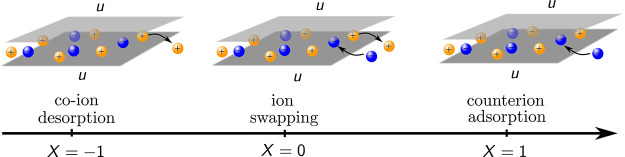
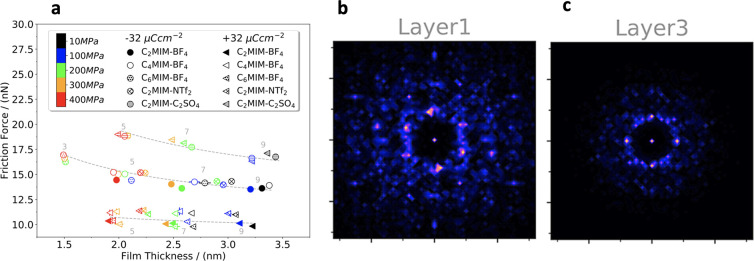
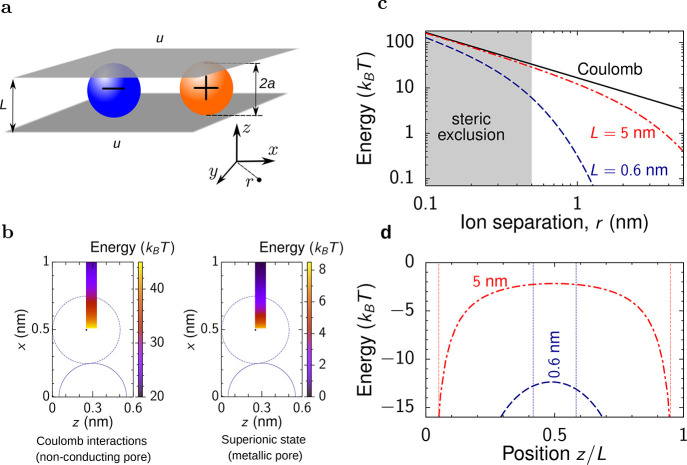
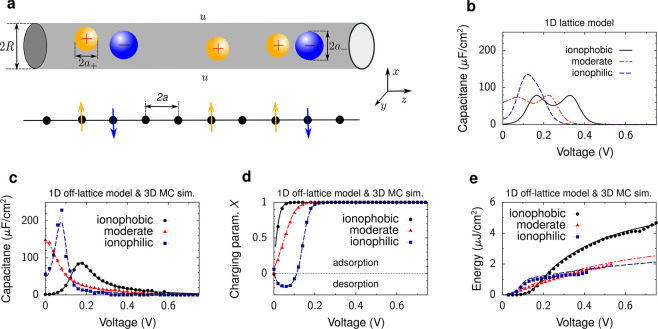
Room-temperature ionic liquids (RTILs) have exciting properties such as nonvolatility, large electrochemical windows, and remarkable variety, drawing much interest in energy storage, gating, electrocatalysis, tunable lubrication, and other applications. Confined RTILs appear in various situations, for instance, in pores of nanostructured electrodes of supercapacitors and batteries, as such electrodes increase the contact area with RTILs and enhance the total capacitance and stored energy, between crossed cylinders in surface force balance experiments, between a tip and a sample in atomic force microscopy, and between sliding surfaces in tribology experiments, where RTILs act as lubricants. The properties and functioning of RTILs in confinement, especially nanoconfinement, result in fascinating structural and dynamic phenomena, including layering, overscreening and crowding, nanoscale capillary freezing, quantized and electrotunable friction, and superionic state. This review offers a comprehensive analysis of the fundamental physical phenomena controlling the properties of such systems and the current state-of-the-art theoretical and simulation approaches developed for their description. We discuss these approaches sequentially by increasing atomistic complexity, paying particular attention to new physical phenomena emerging in nanoscale confinement. This review covers theoretical models, most of which are based on mapping the problems on pertinent statistical mechanics models with exact analytical solutions, allowing systematic analysis and new physical insights to develop more easily. We also describe a classical density functional theory, which offers a reliable and computationally inexpensive tool to account for some microscopic details and correlations that simplified models often fail to consider. Molecular simulations play a vital role in studying confined ionic liquids, enabling deep microscopic insights otherwise unavailable to researchers. We describe the basics of various simulation approaches and discuss their challenges and applicability to specific problems, focusing on RTIL structure in cylindrical and slit confinement and how it relates to friction and capacitive and dynamic properties of confined ions.
室温离子液体(RTILs)具有非挥发性、大电化学窗口和显著的多样性等令人兴奋的特性,在储能、门控、电催化、可调润滑等应用中引起了广泛关注。受限 RTILs 出现在各种情况下,例如在超级电容器和电池的纳米结构电极的孔中,因为这些电极增加了与 RTILs 的接触面积,并提高了总电容和存储能量;在表面力平衡实验中的交叉圆柱之间;在原子力显微镜中的尖端和样品之间;以及在摩擦学实验中的滑动表面之间,其中 RTILs 用作润滑剂。RTILs 在受限环境(特别是纳米受限)中的性质和功能导致了迷人的结构和动态现象,包括分层、过筛和拥挤、纳米级毛细冷冻、量子和电动可调摩擦以及超离子态。本综述全面分析了控制这些系统性质的基本物理现象,以及为描述它们而开发的当前最先进的理论和模拟方法。我们按原子复杂性递增的顺序讨论这些方法,特别关注在纳米受限中出现的新物理现象。本综述涵盖了理论模型,其中大多数基于将问题映射到具有精确解析解的相关统计力学模型上,从而允许更轻松地进行系统分析和获得新的物理见解。我们还描述了经典密度泛函理论,它提供了一种可靠且计算成本低廉的工具,可以考虑简化模型经常忽略的一些微观细节和相关性。分子模拟在研究受限离子液体方面发挥着重要作用,使研究人员能够获得无法获得的微观洞察力。我们描述了各种模拟方法的基础知识,并讨论了它们的挑战和适用性,重点是圆柱和狭缝受限中的受限离子液体结构,以及它与摩擦以及受限离子的电容和动态性质的关系。