Tauseef Hafsah A, Coppersmith Daniel D L, Reid-Russell Azure J, Nagpal Anisha, Ross Jaclyn, Nock Matthew K, Eisenlohr-Moul Tory
Department of Psychiatry, University of Illinois Chicago, Chicago, IL, United States.
Department of Psychology, Harvard University, Cambridge, MA, United States.
Front Psychiatry. 2024 Dec 5;15:1434499. doi: 10.3389/fpsyt.2024.1434499. eCollection 2024.
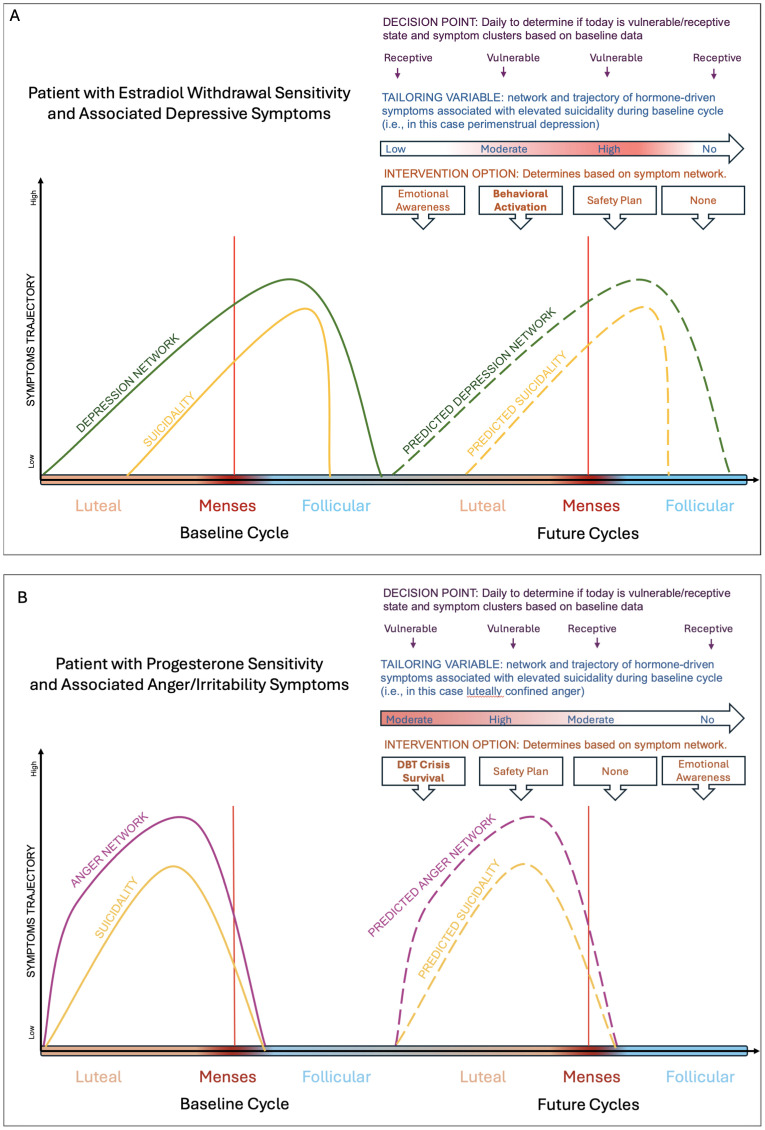
This paper discusses the scientific rationale and methodological considerations for incorporating the menstrual cycle as a time-varying intra-individual factor in personalized medicine models, such as Just-In-Time Adaptive Interventions (JITAIs). Among patients, accumulating evidence suggests that the normal hormone fluctuations of the menstrual cycle represent a time-varying factor that can trigger or exacerbate psychiatric symptoms, including but not limited to affective dysregulation, suicidality, and irritability. While only a minority of the general female population experiences significant cyclical changes, this hormone-sensitive response appears to be greater among patients with psychiatric disorders, with studies demonstrating that a majority of patients recruited for past-month suicidal ideation demonstrate worsening of their suicidality around menses. However, no interventions target suicidality during this monthly period of elevated risk despite evidence of a clear recurring biological trigger. This unique and recurrent "biotype" of suicidality is well-suited for JITAIs. In addition to providing a rationale for the inclusion of the cycle in JITAI, we provide illustrative options and examples regarding the measurement and implementation of cycle variables in JITAIs. We discuss how JITAIs might be leveraged to use menstrual cycle data to identify states of vulnerability within people and strategically select and deploy interventions based upon their receptivity at various phases in the cycle. Furthermore, we discuss how to integrate passive measures for tracking the menstrual cycle. Although much research is needed before implementation, we maintain that the menstrual cycle represents a critically understudied time-varying feature that may markedly improve the accuracy of JITAI models for predicting suicidality.
本文讨论了将月经周期作为个体内随时间变化的因素纳入个性化医疗模型(如即时自适应干预,JITAIs)的科学依据和方法学考量。在患者中,越来越多的证据表明,月经周期中正常的激素波动是一个随时间变化的因素,可引发或加剧精神症状,包括但不限于情感失调、自杀倾向和易怒。虽然只有少数普通女性人群经历显著的周期性变化,但这种激素敏感反应在精神疾病患者中似乎更为明显,研究表明,在过去一个月有自杀意念的患者中,大多数人在月经期间自杀倾向会加重。然而,尽管有明确的反复出现的生物学触发因素的证据,但在这个每月风险升高的时期,没有针对自杀倾向的干预措施。这种独特且反复出现的自杀倾向“生物类型”非常适合即时自适应干预。除了为在即时自适应干预中纳入月经周期提供依据外,我们还提供了关于即时自适应干预中周期变量测量和实施的说明性选项和示例。我们讨论了如何利用即时自适应干预来使用月经周期数据识别个体的脆弱状态,并根据他们在周期各阶段的接受程度有策略地选择和部署干预措施。此外,我们讨论了如何整合用于跟踪月经周期的被动测量方法。虽然在实施前还需要大量研究,但我们认为月经周期是一个研究严重不足的随时间变化的特征,可能会显著提高即时自适应干预模型预测自杀倾向的准确性。