University of Illinois at Chicago, Department of Psychiatry, USA; University of Illinois at Chicago, Medical Scientist Training Program, USA.
University of Illinois at Chicago, Medical Scientist Training Program, USA; University of Illinois at Chicago, Department of Neurology and Rehabilitation, USA.
Front Neuroendocrinol. 2023 Oct;71:101098. doi: 10.1016/j.yfrne.2023.101098. Epub 2023 Aug 22.
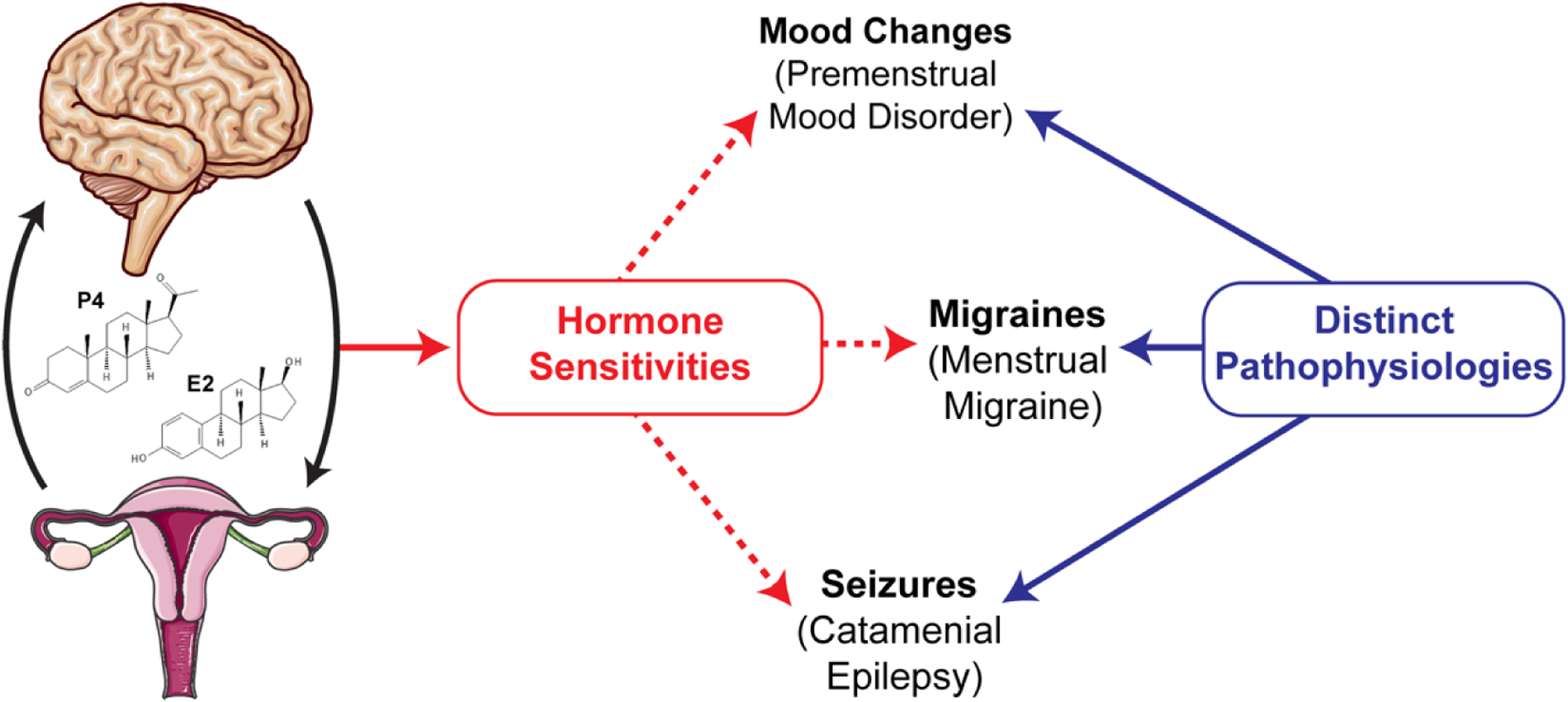
Cyclic variations in hormones during the normal menstrual cycle underlie multiple central nervous system (CNS)-linked disorders, including premenstrual mood disorder (PMD), menstrual migraine (MM), and catamenial epilepsy (CE). Despite this foundational mechanistic link, these three fields operate independently of each other. In this scoping review (N = 85 studies), we survey existing human research studies in PMD, MM, and CE to outline the exogenous experimental hormone manipulation trials conducted in these fields. We examine a broad range of literature across these disorders in order to summarize existing diagnostic practices and research methods, highlight gaps in the experimental human literature, and elucidate future research opportunities within each field. While no individual treatment or study design can fit every disease, there is immense overlap in study design and established neuroendocrine-based hormone sensitivity among the menstrual cycle-related disorders PMD, MM, and CE.
Background. The menstrual cycle can be a biological trigger of symptoms in certain brain disorders, leading to specific, menstrual cycle-linked phenomena such as premenstrual mood disorders (PMD), menstrual migraine (MM), and catamenial epilepsy (CE). Despite the overlap in chronicity and hormonal provocation, these fields have historically operated independently, without any systematic communication about methods or mechanisms.
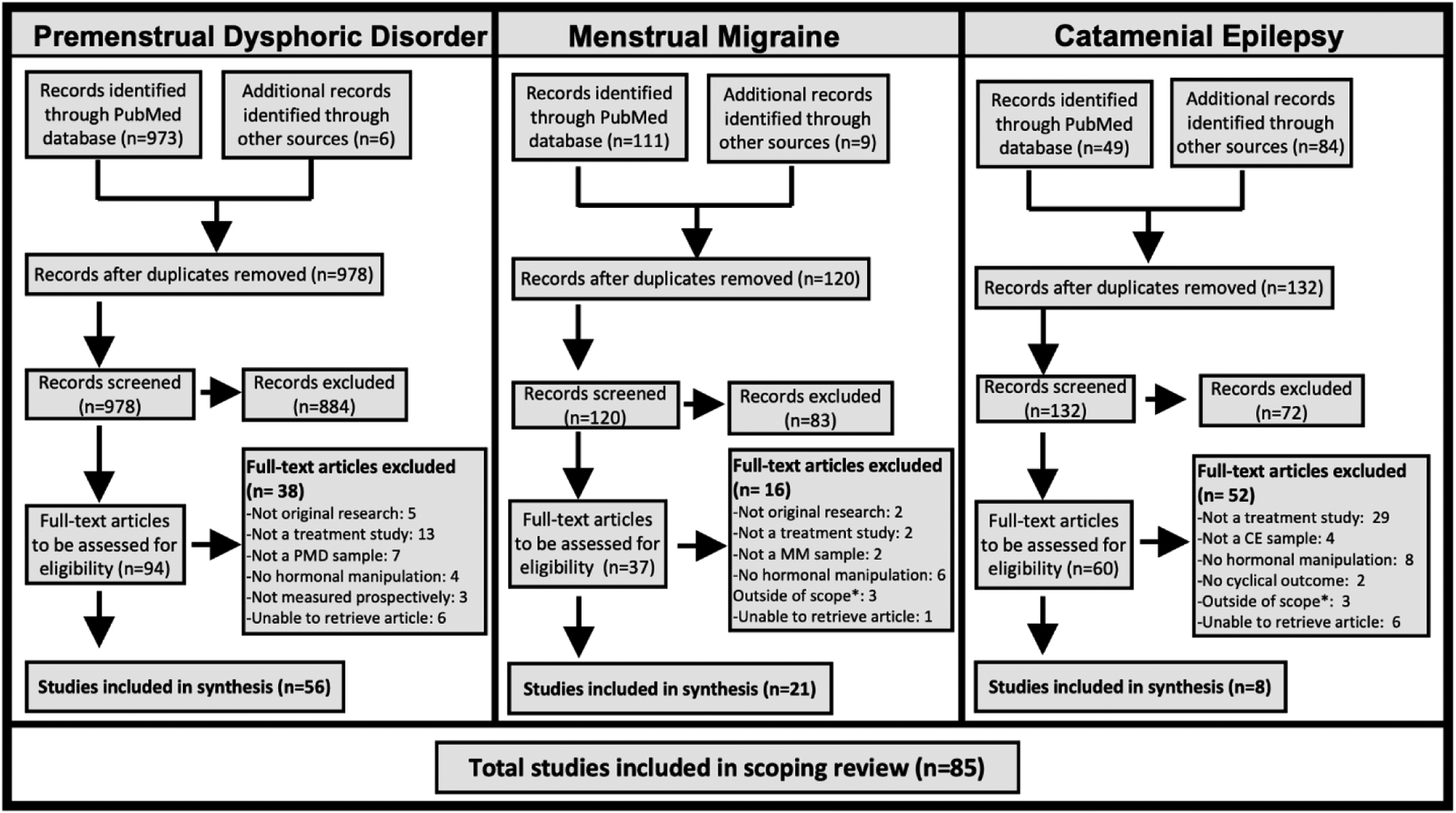
Online databases were used to identify articles published between 1950 and 2021 that studied hormonal manipulations in reproductive-aged females with either PMD, MM, or CE. We selected N = 85 studies that met the following criteria: 1) included a study population of females with natural menstrual cycles (e.g., not perimenopausal, pregnant, or using hormonal medications that were not the primary study variable); 2) involved an exogenous hormone manipulation; 3) involved a repeated measurement across at least two cycle phases as the primary outcome variable.
After exporting online database query results, authors extracted sample size, clinical diagnosis of sample population, study design, experimental hormone manipulation, cyclical outcome measure, and results from each trial. Charting was completed manually, with two authors reviewing each trial.
Exogenous hormone manipulations have been tested as treatment options for PMD (N = 56 trials) more frequently than MM (N = 21) or CE (N = 8). Combined oral contraceptive (COC) trials, specifically those containing drospirenone as the progestin, are a well-studied area with promising results for treating both PMDD and MM. We found no trials of COCs in CE. Many trials test ovulation suppression using gonadotropin-releasing hormone agonists (GnRHa), and a meta-analysis supports their efficacy in PMD; GnRHa have been tested in two MM-related trials, and one CE open-label case series. Finally, we found that non-contraceptive hormone manipulations, including but not limited to short-term transdermal estradiol, progesterone supplementation, and progesterone antagonism, have been used across all three disorders.
Research in PMD, MM, and CE commonly have overlapping study design and research methods, and similar effects of some interventions suggest the possibility of overlapping mechanisms contributing to their cyclical symptom presentation. Our scoping review is the first to summarize existing clinical trials in these three brain disorders, specifically focusing on hormonal treatment trials. We find that PMD has a stronger body of literature for ovulation-suppressing COC and GnRHa trials; the field of MM consists of extensive estrogen-based studies; and current consensus in CE focuses on progesterone supplementation during the luteal phase, with limited estrogen manipulations due to concerns about seizure provocation. We argue that researchers in any of these respective disciplines would benefit from greater communication regarding methods for assessment, diagnosis, subtyping, and experimental manipulation. With this scoping review, we hope to increase collaboration and communication among researchers to ultimately improve diagnosis and treatment for menstrual-cycle-linked brain disorders.
在线数据库用于识别 1950 年至 2021 年间发表的研究,这些研究涉及对患有经前期心境障碍(PMD)、经期偏头痛(MM)或月经性癫痫(CE)的育龄女性进行激素操纵。我们选择了符合以下标准的 N=85 项研究:1)包括自然月经周期的女性研究人群(例如,非绝经前、怀孕或使用不是主要研究变量的激素药物);2)涉及外源性激素操纵;3)作为主要结果变量,至少进行两次周期阶段的重复测量。
从在线数据库查询结果导出后,作者提取了每个试验的样本量、样本人群的临床诊断、研究设计、实验激素操纵、周期性结果测量和结果。图表由两名作者手动完成,对每个试验进行审查。
作为 PMD(N=56 项试验)的治疗选择,已经测试了外源性激素操纵,比 MM(N=21)或 CE(N=8)更频繁。结合口服避孕药(COC)试验,特别是含有屈螺酮作为孕激素的 COC 试验,是一个研究较多的领域,对治疗 PMDD 和 MM 都有很好的效果。我们没有发现 CE 中 COC 的试验。许多试验使用促性腺激素释放激素激动剂(GnRHa)抑制排卵,一项荟萃分析支持 GnRHa 在 PMD 中的疗效;GnRHa 已在两项与 MM 相关的试验中进行了测试,一项 CE 开放标签病例系列研究也进行了测试。最后,我们发现非避孕激素操纵,包括但不限于短期经皮雌二醇、孕激素补充和孕激素拮抗,已用于所有三种疾病。
PMD、MM 和 CE 的研究通常具有重叠的研究设计和研究方法,一些干预措施的相似效果表明,可能存在重叠的机制导致其周期性症状表现。我们的范围综述是首次总结这三种大脑疾病的现有临床试验,特别是重点关注激素治疗试验。我们发现,PMD 有更多关于排卵抑制 COC 和 GnRHa 试验的文献;MM 领域有大量基于雌激素的研究;目前 CE 的共识集中在黄体期补充孕激素,由于担心引发癫痫,雌激素操纵有限。我们认为,任何这些相关学科的研究人员都将受益于更多关于评估、诊断、亚型和实验操纵方法的交流。通过本范围综述,我们希望增加研究人员之间的合作和交流,最终改善与月经周期相关的大脑疾病的诊断和治疗。