Tang Michael, Fteiha Bashar, Meng Shumei
Baylor University Medical Center, Dallas, TX 75246, USA.
Texas A&M School of Medicine, Bryan, TX 77807, USA.
JCEM Case Rep. 2024 Dec 19;3(1):luae235. doi: 10.1210/jcemcr/luae235. eCollection 2025 Jan.
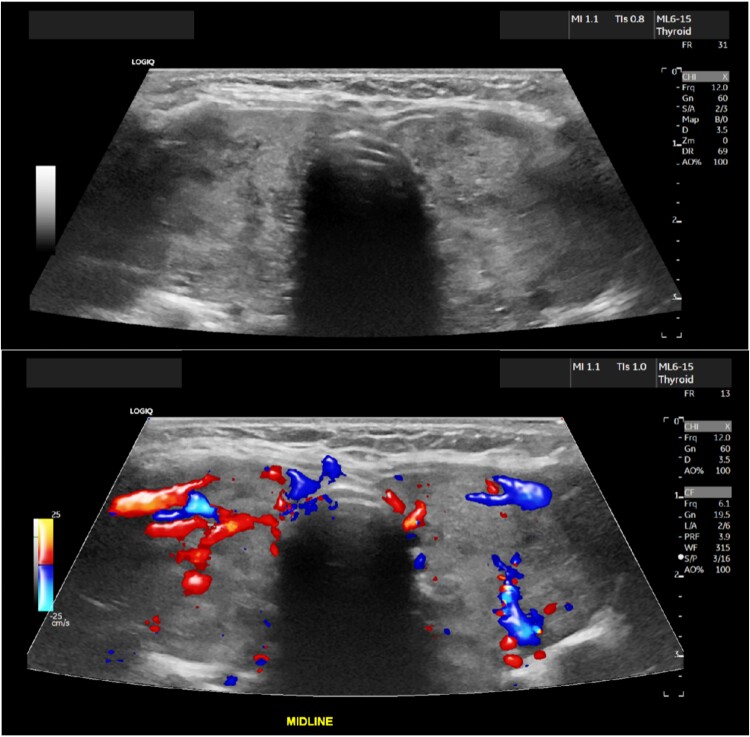
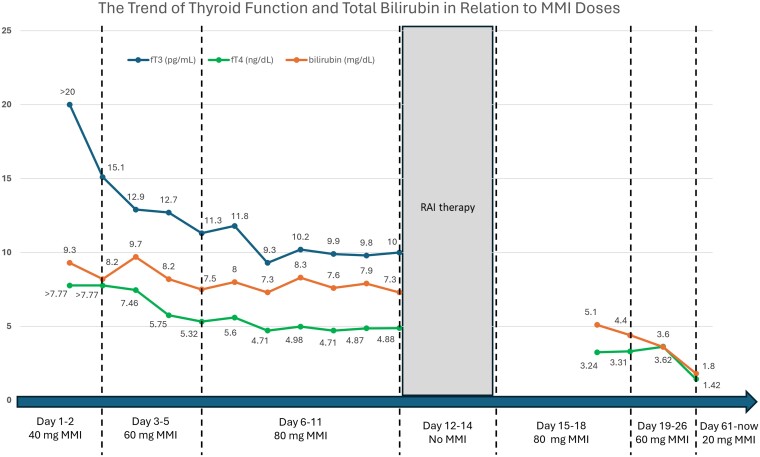
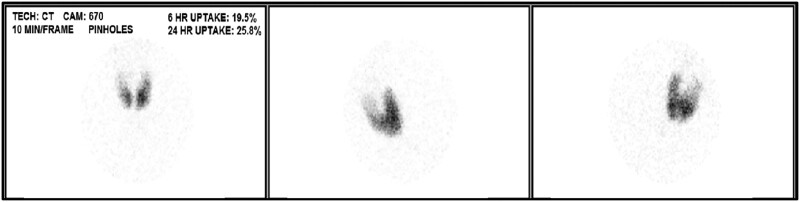
As the leading cause of hyperthyroidism, Graves disease (GD) does not often present with its classical triad of pretibial myxedema, goiter, and exophthalmos but instead is often recognized by various manifestations such as tachycardia, weight loss, jaundice, or dermatopathy and requires utmost clinical vigilance. Three treatment modalities for GD exist as antithyroid drugs (ATDs), radioactive iodine (RAI), and surgery, but each bears its own serious side effects. Furthermore, there have been several reports in the literature about ATD resistance that can complicate management. We describe a rare complex case of methimazole (MMI)-resistant GD in a 58-year-old woman with multiple comorbidities including heart failure, atrial fibrillation, liver cirrhosis, and hypertension. She presented with an initial complaint of diffuse swelling and was found to have severe thyrotoxicosis. Despite high doses of MMI, her thyroid function remained significantly elevated. Thyroid uptake and scan while on MMI showed high radioactive iodine uptake. After receiving RAI therapy, her thyroid function and bilirubin improved markedly, liver enzymes remained stable, and anasarca responded to diuretics. This case highlights the challenges in managing resistant GD and emphasizes the necessity of personalized treatment plans.
作为甲状腺功能亢进症的主要病因,格雷夫斯病(GD)并不常表现为胫前黏液性水肿、甲状腺肿和突眼这一典型三联征,而是常通过心动过速、体重减轻、黄疸或皮肤病等各种表现被识别,需要临床高度警惕。GD有三种治疗方式,即抗甲状腺药物(ATD)、放射性碘(RAI)和手术,但每种都有其严重的副作用。此外,文献中有几篇关于ATD耐药的报道,这可能会使治疗复杂化。我们描述了一例罕见的复杂病例,一名58岁女性患有格雷夫斯病,对甲巯咪唑(MMI)耐药,同时伴有多种合并症,包括心力衰竭、心房颤动、肝硬化和高血压。她最初的主诉是全身肿胀,被发现患有严重的甲状腺毒症。尽管使用了高剂量的MMI,她的甲状腺功能仍显著升高。服用MMI期间的甲状腺摄取和扫描显示放射性碘摄取率高。接受RAI治疗后,她的甲状腺功能和胆红素明显改善,肝酶保持稳定,全身性水肿对利尿剂有反应。该病例突出了治疗耐药性GD的挑战,并强调了个性化治疗方案的必要性。